

Nshongi Gorilla Family in Bwindi
Nshongi Gorilla Family in Bwindi: History, Location and Trekking Guide The Nshongi Gorilla Family holds an important place…
Read article →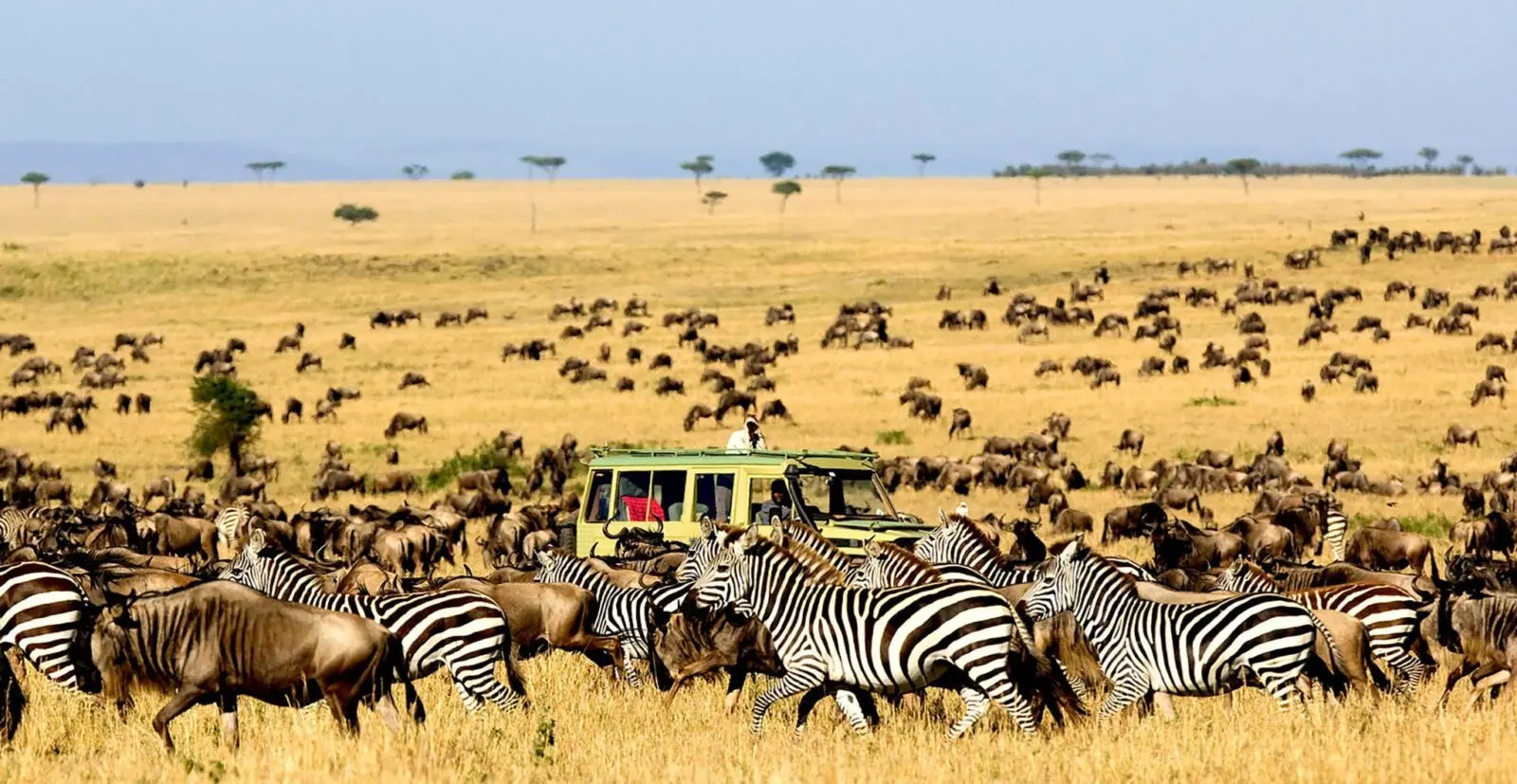
Travel Guide
Discover fascinating zebra migration facts, including why zebras migrate, their relationship with wildebeest, predators, and migration routes.
The Zebra Migration Facts highlighted in the source focus on why zebras migrate, their relationship with wildebeest, predators, and migration routes. These themes help travelers understand that migration is not simply a spectacular scene created for safari visitors. It is part of a larger ecological process shaped by wildlife movement and changing conditions.
For travelers, learning about migration before a safari can improve the experience considerably.
Instead of searching only for the largest herd or most dramatic photograph, visitors can begin to notice movement patterns, interactions between species, and the challenges animals face as they travel through their environment.
One of the central Zebra Migration Facts is that movement is connected with the animals’ need to respond to environmental conditions and resources.
Migration should not be imagined as a perfectly synchronized parade in which every animal moves along the same route at exactly the same time.
Wildlife responds to natural conditions.
This is why safari travelers should be cautious about itineraries promising an exact wildlife spectacle on a specific day.
Historical patterns can guide travel planning, but they cannot guarantee where every herd will be.
A professional guide uses current local knowledge and field information to make practical decisions during the safari.
Travelers should remain flexible.
If the animals have moved differently from what an old map suggests, the itinerary may need to adapt.
This flexibility is one of the differences between authentic wildlife tourism and a scheduled attraction.
The source specifically highlights the relationship between zebras and wildebeest.
For safari visitors, seeing different herbivore species moving through the same broader landscape can demonstrate how migration involves an ecosystem rather than one isolated animal.
Travelers should observe how different species use the environment instead of treating every herd as background scenery.
Binoculars can help visitors notice behavior across a large area.
Photography can also tell the story effectively.
A wide image showing multiple species and the surrounding landscape may communicate migration better than a close portrait of one zebra.
Predators form another important part of the source’s migration theme.
Moving herbivores exist within ecosystems that also contain predators.
Visitors may hope to see hunting behavior, but no ethical safari can guarantee a kill.
Wildlife encounters happen naturally.
Guides should not be pressured to chase animals or position vehicles irresponsibly simply because tourists want dramatic footage.
If predator-prey behavior occurs, visitors should remain calm and allow the event to unfold without interference.
Some people may find these encounters difficult to watch.
That reaction is understandable, but predation is part of natural ecosystems.
Travelers can choose to look away without expecting guides to interfere with wildlife.
Migration routes are another subject identified by the source.
Travelers often encounter simplified maps showing wildlife movement, and these can be useful for understanding general patterns.
However, a route should not be interpreted as a railway line.
Animals respond to environmental conditions rather than tourism calendars.
This is particularly important when choosing accommodation.
A camp that is well positioned for wildlife during one period may be less suitable during another.
Travelers planning specifically around migration should obtain current destination information and understand that even good planning cannot eliminate natural uncertainty.
A longer safari can provide more flexibility than a very short visit.
If wildlife movement is the main priority, spending several days in an appropriate region gives guides more opportunities to respond to current conditions.
Photographers may benefit particularly from this extra time.
One afternoon of poor weather or distant animals becomes less significant when several game drives are available.
The most useful Zebra Migration Facts ultimately help travelers become better wildlife observers.
Migration is about movement, survival, environmental conditions, relationships between species, and the landscapes through which animals travel.
The experience should not be reduced to obtaining one famous photograph.
Visitors should respect wildlife-viewing rules.
Vehicles should remain in appropriate areas and avoid blocking animal movement.
Drivers should not be pressured to move too close to herds or predators.
Noise should be controlled.
Waste should remain inside the vehicle.
During crowded sightings, patience becomes especially important.
A responsible guide may choose a less congested position even if another vehicle appears closer to the animals.
This can produce a calmer experience for both wildlife and guests.
Families can use migration as an educational experience.
Children can learn why animals move, how predators and herbivores interact, and why landscapes need to remain connected.
This turns a safari into more than wildlife identification.
The source’s focus on why zebras migrate, their relationship with wildebeest, predators, and migration routes provides a strong framework for understanding the phenomenon.
The best safari experiences come from combining this knowledge with flexibility.
Animals do not move for the convenience of visitors.
Routes can vary, predator encounters cannot be scheduled, and herd locations may change.
These uncertainties do not reduce the value of the journey. They are precisely what make migration a genuine natural event.
Travelers who understand the Zebra Migration Facts before departure can therefore approach their safari with better expectations.
Instead of demanding a predetermined spectacle, they can watch the landscape carefully, listen to experienced guides, and appreciate the complex relationships that make large-scale wildlife movement one of the most compelling experiences in nature.

Nshongi Gorilla Family in Bwindi: History, Location and Trekking Guide The Nshongi Gorilla Family holds an important place…
Read article →
Mishaya Gorilla Family in Bwindi: History, Trekking and What to Know The Mishaya Gorilla Family is one of…
Read article →
Semuliki Hot Springs Visit Guide: What to Expect Semuliki Hot Springs offers one of the most unusual natural…
Read article →
Kidepo Valley Remote Safari Guide: What to Expect Kidepo Valley National Park offers one of Uganda's most remote…
Read article →