

Nshongi Gorilla Family in Bwindi
Nshongi Gorilla Family in Bwindi: History, Location and Trekking Guide The Nshongi Gorilla Family holds an important place…
Read article →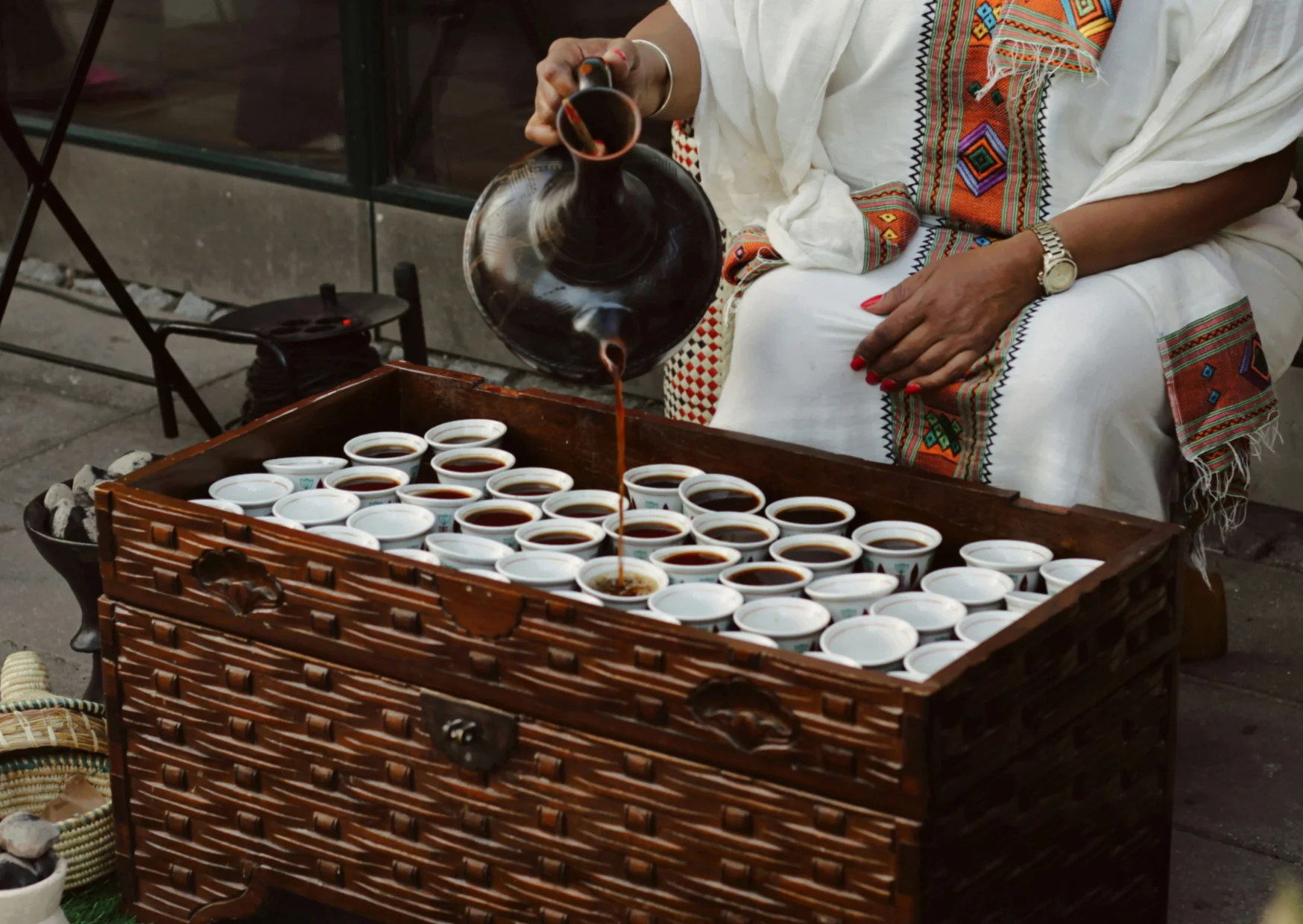
Travel Guide
Explore the Ethiopian coffee tour experience, from coffee farms and processing to traditional ceremonies and famous growing regions.
An Ethiopian coffee tour experience takes travelers beyond the finished cup and into the farms, communities, processing traditions, and social customs that surround coffee in Ethiopia. The supplied source presents the country as having a deep coffee culture that remains closely connected with everyday life and agricultural communities.
Coffee grows across several Ethiopian highland regions, where differences in climate, elevation, landscape, cultivation, and processing contribute to distinctive characteristics. A traveler can therefore experience coffee not as one uniform Ethiopian product but as an agricultural crop shaped by place.
Coffee tours can include farm visits, walks through coffee gardens, conversations with farmers, processing demonstrations, washing-station visits, tastings, and participation in traditional coffee ceremonies.
The experience combines agriculture with history, culture, hospitality, and local livelihoods.
The supplied source describes Ethiopia as holding a special place in global coffee history.
Coffee cultivation and preparation have long-standing cultural connections within the country.
These traditions continue to shape both everyday life and tourism experiences.
The source recounts the popular Ethiopian tradition of Kaldi, a goat herder said to have noticed that his goats became energetic after eating red berries.
This story is widely associated with coffee folklore.
Importantly, the supplied material also states that historians debate the story.
It should therefore be understood as a popular tradition rather than presented as established historical fact.
Whatever the historical origin of the Kaldi story, the source’s central point is that coffee is deeply connected with Ethiopian heritage.
Cultivation, preparation, serving, and social interaction all contribute to that relationship.
Visitors experience coffee as culture rather than merely as a commercial beverage.
The supplied source states that coffee supports many farming communities.
Small-scale farmers grow coffee across several highland regions.
For these communities, coffee is connected with land, labor, household livelihoods, and local economies.
Small farms are central to the experience described in the source.
Visitors may see coffee growing alongside other crops.
This can create agricultural landscapes very different from large industrial plantations.
A farm visit allows travelers to see where the coffee journey begins.
Instead of encountering beans only after roasting, visitors can see coffee trees, cherries, and growing environments.
Guides and farmers can explain the work involved before processing even begins.
The supplied source describes walking through coffee gardens as a typical part of the experience.
These walks can reveal how coffee trees grow within the surrounding landscape.
Visitors can observe shade, vegetation, soil, and farming practices.
During harvest, travelers may see ripe coffee cherries.
The source emphasizes the importance of carefully selecting ripe cherries.
This demonstrates how quality decisions begin at the farm rather than only during roasting.
Farmers need to identify cherries ready for harvesting.
Careful selection requires time and experience.
A tour can help visitors understand why producing high-quality coffee involves substantial manual work.
The supplied material states that many farms use traditional farming methods.
The exact practices vary by location and producer.
Visitors should therefore listen to individual farmers rather than assuming every Ethiopian coffee farm operates identically.
Picking is only one stage.
After harvesting, coffee cherries must be processed so that the beans can eventually be dried, prepared, roasted, ground, and brewed.
Processing can strongly influence the characteristics of the final coffee.
The source identifies three processing approaches: washed, natural, and honey processing.
Each handles the coffee cherry differently.
Coffee tours and washing-station visits can help travelers understand these distinctions.
During natural processing, the supplied source states that farmers dry the whole coffee cherries before removing the outer layers.
The fruit remains around the bean during drying.
Visitors may see cherries spread out for drying depending on the farm and season.
Washed coffee undergoes additional processing before drying.
The source does not provide a detailed technical sequence.
Its main point is that washed processing differs from the natural method and can influence the resulting coffee characteristics.
Honey processing is also named in the supplied material.
The source does not explain the method in detail.
A tour of a farm or processing station can therefore provide a useful opportunity to ask producers how they use the term and what their specific process involves.
The supplied source specifically mentions washing-station visits.
These facilities allow visitors to see the stages between harvested cherries and prepared coffee beans.
For serious coffee enthusiasts, processing can be as interesting as the farm itself.
The source states that careful processing affects the final flavor.
Two coffees grown in similar environments may develop different characteristics depending on how they are processed.
This helps explain why origin alone does not determine the entire cup profile.
One of the most culturally significant experiences described is the Ethiopian coffee ceremony.
The source presents it as an important social tradition rather than a quick tasting.
Preparation takes time and creates space for conversation and hospitality.
The ceremony typically begins with roasting green coffee beans.
The supplied material describes the aroma filling the room during roasting.
Visitors experience a stage that normally occurs long before coffee reaches a café table.
After roasting, the beans are ground.
This keeps preparation visible from beginning to end.
The process emphasizes the work behind each serving.
The ground coffee is then brewed.
The ceremony is deliberate rather than hurried.
Travelers accustomed to ordering coffee in seconds may find the slower rhythm particularly memorable.
The supplied source states that guests enjoy several small servings.
The ceremony is therefore structured around time together rather than one large drink.
Conversation becomes part of the experience.
Hospitality is central to the coffee ceremony.
Coffee provides a reason for people to sit together.
Visitors can therefore learn about social relationships as much as brewing techniques.
The source describes the ceremony as creating space for friendship and community connection.
This is why reducing it to a tasting would miss much of its meaning.
The preparation and shared time are integral parts of the tradition.
The supplied material identifies several important coffee-growing regions.
These include Sidama, Yirgacheffe, Guji, and Jimma.
Addis Ababa is also recommended for travelers wanting to experience coffee culture without traveling far into producing regions.
Sidama is named among Ethiopia’s well-known coffee-growing areas.
Its climate and highland environment contribute to its coffee identity.
A visit can combine agricultural learning with wider cultural and nature experiences.
Yirgacheffe is another region emphasized in the source.
It is internationally associated with Ethiopian coffee.
Traveling there allows visitors to connect a familiar coffee-origin name with actual farms and communities.
Guji is also listed among leading coffee regions.
The supplied source emphasizes that different regions produce beans with distinctive characteristics.
Visitors can therefore compare coffee from several areas during a longer journey.
The source describes the Jimma area as having a long connection with coffee production.
Travelers interested in coffee history and agriculture can incorporate the region into a specialist itinerary.
The precise farm experiences depend on local arrangements.
Not every visitor has time to travel to distant coffee-growing areas.
The supplied source therefore highlights Addis Ababa as a practical place to experience Ethiopian coffee culture.
This can work particularly well during a shorter city stay.
Coffee ceremonies and cafés can introduce visitors to preparation and social traditions even when they cannot visit a farm.
The experience will differ from seeing coffee production directly.
Both can nevertheless contribute to understanding Ethiopian coffee culture.
Coffee tourism can fit naturally into a wider cultural itinerary.
Travelers can visit communities, markets, historical places, and natural attractions while exploring coffee-growing regions.
This creates more variety than a trip focused exclusively on tasting.
The highland landscapes in which coffee grows can themselves be attractive.
Walking through farms introduces visitors to vegetation and rural scenery.
The source specifically suggests combining coffee experiences with nature activities.
The supplied material states that coffee tourism can support farming communities when visitors choose responsible local operators.
Travelers can therefore consider who benefits from the tour they purchase.
Direct engagement with local producers can add meaning to the experience.
Conversations with farmers help visitors understand the realities behind coffee production.
Topics may include harvesting, processing, weather, farming methods, and the work required throughout the growing cycle.
The source emphasizes these interactions as a central part of coffee tourism.
A cup of coffee can appear simple when served at a café.
Farm visits reveal the many stages that come before brewing.
Growing, maintaining trees, harvesting, sorting, processing, drying, roasting, grinding, and brewing all contribute to the final drink.
Coffee tasting becomes more meaningful after seeing the production process.
A traveler can connect flavor with a particular region, processing method, farm, or experience.
This turns tasting into part of a larger story.
Visitors should approach farms as working agricultural environments.
Permission, local guidance, and respect for farmers’ time are important.
Photography should also be handled respectfully, particularly when people are the subject.
The supplied source mentions seeing ripe coffee cherries during harvest season but does not provide exact harvest months.
Accordingly, this article should not invent a universal Ethiopian harvest calendar.
Travelers seeking a specific farm activity should confirm seasonal conditions with the operator.
Travelers deeply interested in coffee may want several days across different producing regions.
Comparing farms and processing methods can reveal considerable variation.
A specialist guide can help connect these experiences.
A traveler does not need technical coffee knowledge to enjoy the experience.
Farm walks, ceremonies, scenery, and conversations can be engaging even for someone who simply enjoys an occasional cup.
The cultural element is equally important.
The Ethiopian Coffee Tour Experience: Coffee, Culture & Farms follows coffee from the landscapes where it grows to the social traditions surrounding its preparation.
The supplied source highlights farm visits, coffee gardens, harvest activities, processing methods, washing stations, farmer interactions, and the traditional Ethiopian coffee ceremony.
Natural, washed, and honey processing are identified among methods visitors may learn about, while Sidama, Yirgacheffe, Guji, and Jimma are highlighted as notable coffee-growing regions.
Travelers with less time can experience aspects of Ethiopian coffee culture in Addis Ababa.
Perhaps the greatest value of an Ethiopian coffee tour experience is the perspective it provides. After walking through a coffee garden, watching cherries being processed, meeting farmers, and sitting through a traditional ceremony, a freshly brewed cup becomes connected with land, labor, hospitality, community, and heritage rather than existing simply as a finished drink.

Nshongi Gorilla Family in Bwindi: History, Location and Trekking Guide The Nshongi Gorilla Family holds an important place…
Read article →
Mishaya Gorilla Family in Bwindi: History, Trekking and What to Know The Mishaya Gorilla Family is one of…
Read article →
Semuliki Hot Springs Visit Guide: What to Expect Semuliki Hot Springs offers one of the most unusual natural…
Read article →
Kidepo Valley Remote Safari Guide: What to Expect Kidepo Valley National Park offers one of Uganda's most remote…
Read article →