

Nshongi Gorilla Family in Bwindi
Nshongi Gorilla Family in Bwindi: History, Location and Trekking Guide The Nshongi Gorilla Family holds an important place…
Read article →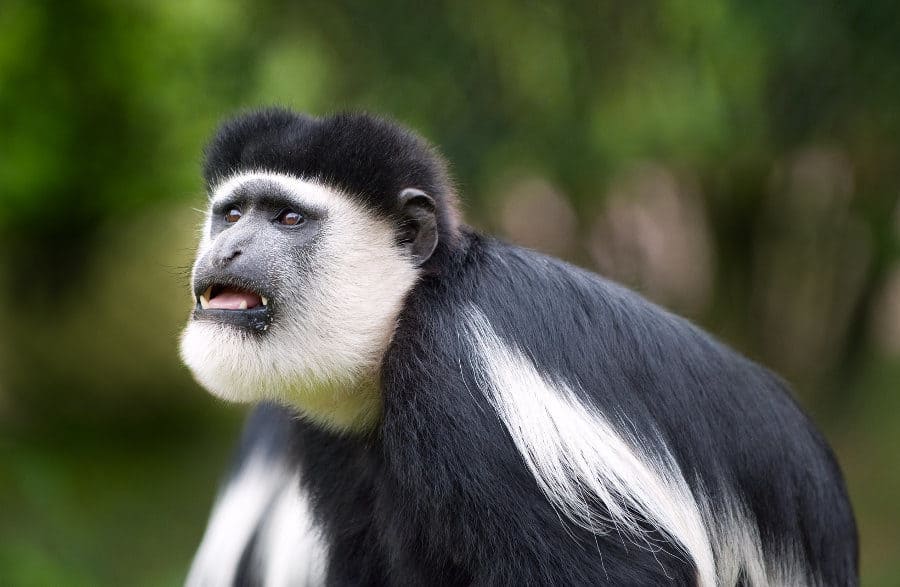
Travel Guide
Discover Colobus monkey facts, including diet, habitat, small thumbs, behavior, conservation, and where to see these African primates.
Searching for Columbus Monkey Facts commonly leads travelers to information about one of Africa’s most distinctive forest primates: the colobus monkey. As the supplied source explains, “Columbus monkey” is a name that commonly appears online, while colobus monkey is the correct term.
These monkeys are immediately recognizable because of their striking coats, long tails, expressive faces, and tree-dwelling lifestyle. Different colobus species occur across Africa, including in Uganda, Kenya, Tanzania, Rwanda, and parts of Central Africa.
The black-and-white colobus is among the best-known forms. Its contrasting coloration makes it particularly noticeable when it moves through green forest vegetation.
Appearance, however, is only part of what makes the animal interesting. Some of the most fascinating Colobus monkey facts involve its reduced thumbs, specialized plant-based diet, social behavior, and remarkable adaptation to life in the forest canopy.
Colobus monkeys belong to the genus Colobus and closely related groups of African monkeys.
The supplied source particularly emphasizes black-and-white colobus monkeys.
These primates are adapted to forest environments and spend much of their time above the ground.
Their dark bodies can be contrasted by extensive white hair, including a white mantle and a long tail in some forms.
This appearance makes them among the most photogenic primates travelers may encounter during an African forest safari.
Unlike animals that spend most of their time on the forest floor, colobus monkeys are strongly associated with trees.
Their bodies and movement reflect this arboreal lifestyle.
An arboreal animal spends a substantial part of its life in trees.
For colobus monkeys, the forest canopy provides food, resting areas, travel routes, and a degree of protection.
Moving through trees requires different physical abilities from moving across open ground.
Branches vary in thickness and stability, gaps must sometimes be crossed, and food can occur at different heights.
The supplied source describes colobus monkeys as agile animals capable of moving efficiently through this complex environment.
Their long limbs and fingers contribute to that ability.
One of the most unusual Colobus monkey facts concerns the hands.
The source states that colobus monkeys have greatly reduced thumbs compared with many other primates.
At first this may seem like a disadvantage.
Humans rely heavily on thumbs for gripping and manipulating objects.
Colobus monkeys, however, have evolved for a very different lifestyle.
Their hands, long fingers, and limbs support rapid movement through branches.
The reduced thumb is therefore presented in the source as part of their adaptation to canopy travel rather than simply a missing feature.
Watching colobus monkeys move can demonstrate how well suited they are to life above the ground.
They grip branches, shift their weight, and leap between parts of the canopy.
A forest that looks tangled and difficult from a human perspective becomes a network of travel routes for the monkeys.
Their physical form allows them to use this three-dimensional environment efficiently.
Movement also helps them reach food sources that may be separated across different trees.
For safari visitors, observing colobus monkeys in motion can be far more revealing than seeing an individual sitting still.
The supplied source describes colobus monkeys as primarily leaf eaters.
Leaves make up an important part of their diet, but they can also consume flowers, fruits, buds, and other plant material.
A leaf-based diet creates a challenge because fibrous vegetation can be difficult to digest.
Colobus monkeys possess a specialized digestive system that helps them process this food.
The source explains that specialized stomach compartments contribute to breaking down tough plant material.
This allows colobus monkeys to use food resources that many other primates may not digest as efficiently.
The ability to process fibrous vegetation has important ecological advantages.
Leaves can be abundant in forest habitats even when preferred fruits are less available.
A monkey capable of using these resources has access to a broad supply of plant food.
The digestive system therefore plays a major role in the colobus monkey’s forest adaptation.
Visitors watching a group may see individuals spending long periods feeding.
This seemingly simple behavior reflects a highly specialized relationship between the animal and its environment.
According to the supplied source, colobus monkeys occur in forest and woodland habitats.
These can include lowland forest, montane forest, and riverine environments.
Different habitats provide varying combinations of trees, vegetation, food, and shelter.
The monkeys’ dependence on forest structure means that healthy tree cover is particularly important.
When forests are cleared or fragmented, animals that rely on canopy connections can lose both feeding areas and movement routes.
This relationship between colobus monkeys and trees is central to understanding their ecology.
The source identifies Uganda as one of the countries where travelers can encounter black-and-white colobus monkeys.
It particularly mentions Kibale National Park and other forested areas containing diverse primate populations.
Kibale is widely associated in the supplied material with primate experiences.
A traveler entering such a forest may focus initially on one target species, but the presence of colobus monkeys can add considerable interest.
Their movement high in the trees and distinctive coloration can make them rewarding subjects for both wildlife observation and photography.
The supplied source also identifies Kenya and Tanzania as countries where colobus monkeys can be encountered.
This means travelers do not necessarily need to build a safari entirely around primates to have an opportunity to observe them.
Forest and woodland areas incorporated into a broader East African journey may provide sightings.
The experience differs from watching large savannah animals.
Colobus monkeys require visitors to look upward, listen for movement, and pay attention to the canopy.
A knowledgeable guide can be particularly useful in locating animals that might otherwise remain unnoticed.
Rwanda and several Central African countries are also mentioned in the source as part of the broader distribution of different colobus species.
This geographic spread demonstrates the diversity of forest habitats occupied by these primates.
Not every location contains exactly the same species or population.
Travelers interested in a particular type of colobus should therefore understand which forests support it.
For general wildlife enthusiasts, however, the wider distribution means colobus encounters can complement gorilla, chimpanzee, birding, or forest-focused safaris across several destinations.
The supplied source describes colobus monkeys as social animals living in groups.
Group size can vary according to species and habitat.
Living socially provides several advantages.
Individuals can maintain contact while feeding, respond collectively to potential danger, and raise young within a group environment.
Social life also requires communication.
The source identifies calls and body movements among the methods used by colobus monkeys to interact.
Observing a group therefore reveals relationships and communication that may not be obvious when watching a single animal.
Forest environments can make visual communication difficult because leaves and branches obstruct views.
Calls can help animals remain aware of other group members even when vegetation separates them.
Body movement and other social signals also contribute when monkeys are closer together.
Young animals learn within this environment.
Their interactions with mothers and other group members gradually introduce them to the movement, feeding, and social patterns needed for adult life.
Communication is therefore not simply an interesting behavior. It supports the practical functioning of the group.
The source states that young monkeys remain dependent on their mothers during early development.
This dependence is important because life in the canopy requires physical coordination and social learning.
Young animals need time to develop the skills necessary to move safely and find food.
Remaining close to an adult provides protection during this vulnerable period.
For wildlife watchers, interactions between mothers and young can be among the most engaging behaviors to observe.
They demonstrate that colobus groups are structured social communities rather than random collections of animals.
Living in a group can also improve protection.
More individuals means more opportunities to detect threats.
One animal may notice danger before another.
Calls or sudden movement can then alert the rest of the group.
Dense forests contain predators and other hazards, so shared awareness can be valuable.
The group structure also allows individuals to feed while remaining part of a wider network of vigilance.
This is one reason social behavior is such an important component of Colobus monkey facts.
The supplied source identifies habitat loss as a major threat to many colobus populations.
Forest clearing can remove feeding areas and divide previously connected habitats.
For a tree-dependent primate, fragmentation can be particularly serious.
A continuous canopy allows movement between feeding and resting areas.
When forest is broken into isolated patches, animals may have fewer options.
Protecting colobus monkeys therefore depends heavily on protecting the forests themselves.
Conservation of habitat benefits many other species at the same time.
The source states that responsible primate tourism can contribute to conservation when travelers use ethical operators and follow wildlife guidelines.
Tourism can create economic value around protected forests.
Guides, accommodation providers, communities, and conservation programs may all benefit when visitors travel specifically to experience wildlife responsibly.
However, the quality of tourism matters.
Wild primates should not be treated as pets or approached carelessly.
Visitors should follow the instructions of guides and respect the animals’ space.
Colobus monkeys represent an important part of Africa’s forest biodiversity.
Their specialized diet connects them closely with vegetation.
Their physical adaptations allow them to move through forest canopies, while their social behavior creates complex group relationships.
Protecting them also means protecting habitat used by many other animals.
This makes the colobus a useful reminder that forest conservation is rarely about saving only one species.
An intact forest supports interconnected communities of plants and wildlife.
Travelers hoping to see colobus monkeys should approach forest wildlife viewing patiently.
Dense vegetation can make sightings brief or partially obscured.
Listening for calls and watching movement in the canopy can help.
Binoculars may be particularly useful because animals can remain high above the ground.
Photography can be challenging for the same reason.
Instead of becoming frustrated by branches and leaves, visitors can appreciate that the forest itself is part of the encounter.
The monkeys are being observed within the environment to which they are naturally adapted.
Although the page title uses Columbus Monkey Facts, the supplied source explains that colobus monkey is the correct name.
These African primates are remarkable for their black-and-white appearance, long tails, reduced thumbs, canopy agility, leaf-based diet, specialized digestive systems, and strong social lives.
They occur in forest habitats across several African countries, including Uganda, Kenya, Tanzania, Rwanda, and parts of Central Africa.
Their dependence on healthy forests also makes habitat protection essential.
For travelers exploring Africa’s primate destinations, colobus monkeys offer an opportunity to look beyond gorillas and chimpanzees and discover another fascinating example of how primates have adapted to forest life.

Nshongi Gorilla Family in Bwindi: History, Location and Trekking Guide The Nshongi Gorilla Family holds an important place…
Read article →
Mishaya Gorilla Family in Bwindi: History, Trekking and What to Know The Mishaya Gorilla Family is one of…
Read article →
Semuliki Hot Springs Visit Guide: What to Expect Semuliki Hot Springs offers one of the most unusual natural…
Read article →
Kidepo Valley Remote Safari Guide: What to Expect Kidepo Valley National Park offers one of Uganda's most remote…
Read article →