

Nshongi Gorilla Family in Bwindi
Nshongi Gorilla Family in Bwindi: History, Location and Trekking Guide The Nshongi Gorilla Family holds an important place…
Read article →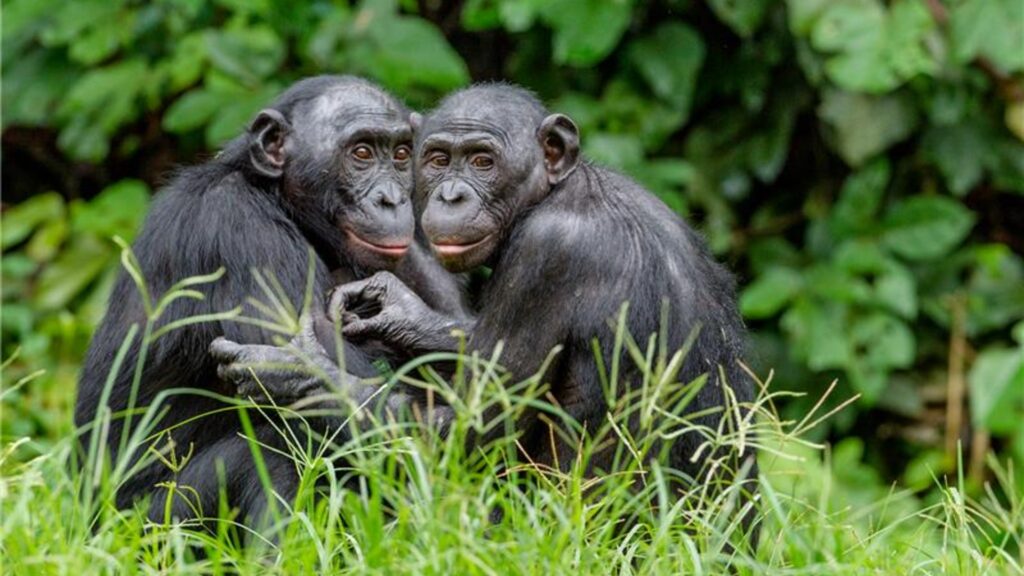
Travel Guide
Discover fascinating bonobo facts from the DRC, including their habitat, social behavior, diet, conservation status and relationship to humans.
Bonobos are among Africa’s most fascinating primates and one of humanity’s closest living relatives. Unlike chimpanzees, whose natural distribution extends across several African countries, wild bonobos occur naturally only in the Democratic Republic of the Congo (DRC). This restricted geographical range makes the country’s forests globally important for bonobo conservation.
Understanding key bonobo facts in the DRC reveals an animal with complex social relationships, remarkable intelligence, distinctive community structures, and an important ecological role in the Congo Basin.
Perhaps the most important fact about bonobos is their extremely limited natural distribution.
Wild bonobos are endemic to the Democratic Republic of the Congo. Their range lies mainly within lowland forests south of the Congo River and north of the Kasai River system.
The Congo River creates a major geographical barrier between bonobos and populations of common chimpanzees farther north.
This distribution means that protecting bonobos in the wild is inseparable from protecting the forests of the DRC.
Bonobos belong to the great ape family alongside chimpanzees, gorillas, orangutans, and humans.
Their scientific name is Pan paniscus, while the common chimpanzee is Pan troglodytes.
For many years, bonobos were sometimes described as pygmy chimpanzees. The term can be misleading because bonobos are a distinct species rather than simply smaller chimpanzees.
They generally have relatively slender bodies, long legs, dark faces, and distinctive hair that often appears naturally parted across the head.
Bonobos and chimpanzees are humanity’s closest living evolutionary relatives.
This relationship has made both species important to research examining primate behavior, cognition, communication, social relationships, and evolutionary history.
Similarity, however, should not obscure the fact that bonobos are wild animals with their own evolutionary history and ecological requirements.
Their value extends far beyond their genetic relationship with humans. They are an irreplaceable component of Congo Basin biodiversity.
One of the most frequently discussed characteristics of bonobo society is the importance of relationships among females.
Female bonobos can form strong alliances and social bonds that influence group dynamics. These relationships distinguish bonobo communities in important ways from the social patterns observed among common chimpanzees.
Bonobo societies are still complex, and simplified descriptions can easily become misleading. Individual relationships, age, kinship, ecological conditions, and community circumstances all influence behavior.
Researchers therefore continue studying wild communities to understand these dynamics more completely.
Bonobos live in communities whose members regularly divide into smaller temporary groups and later reunite.
This flexible pattern allows individuals to adjust their activities according to food availability, social relationships, reproductive circumstances, and other factors.
Grooming is an important part of social life. It helps maintain relationships and provides opportunities for individuals to interact peacefully.
Bonobos also communicate through vocalizations, facial expressions, body postures, gestures, and physical contact.
Popular descriptions often portray bonobos as completely peaceful animals. Reality is more complicated.
Bonobos can display aggression and competition, but researchers have documented social behaviors that can help reduce tension and manage relationships.
This has made bonobos particularly interesting to scientists investigating the evolution of cooperation, conflict management, and social behavior.
It is more accurate to describe bonobo society as sophisticated and socially flexible than to claim that bonobos never experience aggression.
Fruit forms a major part of the bonobo diet, but these apes consume a wider range of foods.
Depending on availability, they may eat leaves, shoots, seeds, flowers, herbs, fungi, invertebrates, and other resources.
They can also consume animal protein.
Feeding patterns vary according to forest conditions and seasonal availability. Because bonobos travel through large forest areas searching for food, healthy connected habitats are essential to their survival.
Fruit-eating primates can contribute to seed dispersal.
Bonobos consume fruits and later deposit seeds elsewhere as they travel through the forest. This process can contribute to forest regeneration and plant distribution.
Protecting bonobos therefore supports more than a single charismatic species. Conservation also protects forests containing countless plants, birds, insects, mammals, and other organisms.
Healthy Congo Basin forests additionally provide ecosystem services important to people and the global climate.
Bonobos are skilled climbers and spend significant periods in trees, where they feed, rest, travel, and construct sleeping nests.
They also move extensively on the ground.
Their anatomy allows them to climb efficiently while using several forms of terrestrial movement.
Watching bonobos navigate their forest environment demonstrates how well adapted they are to the structurally complex habitats of the Congo Basin.
Like other great apes, bonobos construct nests.
They bend and arrange branches and vegetation to create platforms for resting and sleeping, generally in trees.
Nest construction provides researchers with useful information. Surveys of nests can help scientists investigate bonobo distribution and population density in areas where direct observation is difficult.
Because wild bonobos can be challenging to locate in dense forest, indirect signs such as nests, feeding remains, vocalizations, and tracks become important research tools.
Young bonobos depend heavily on their mothers and spend years learning the skills required for survival.
Juveniles observe feeding choices, movement through the forest, social interactions, and communication within their community.
Long developmental periods are characteristic of great apes and allow considerable time for learning.
Strong mother-offspring relationships can continue even as younger bonobos become increasingly independent.
Bonobos demonstrate sophisticated cognitive abilities.
Research has documented their capacity for problem-solving, social learning, communication, memory, and understanding relationships between individuals.
Studies in captive environments have also explored symbolic communication and other aspects of cognition.
Researchers must nevertheless be cautious when generalizing from individual animals or captive studies to all wild bonobos. Behavior is influenced by environment, experience, social setting, and individual differences.
The Congo River is one of Africa’s greatest geographical features and has played an important role in primate evolution.
Its enormous width and powerful flow create a formidable natural barrier.
Bonobos occur primarily south of the river, while common chimpanzees occupy areas north and east of their range.
Scientists continue studying how historical changes in rivers, forests, and climate contributed to the evolutionary separation of different primate populations.
Bonobos are classified as endangered.
Their restricted distribution makes them particularly vulnerable to habitat loss and fragmentation. Forest conversion, infrastructure development, human settlement, and other pressures can reduce or divide suitable habitat.
Illegal hunting also poses a threat. Great apes reproduce slowly, meaning populations can take a long time to recover when adult animals are lost.
Young bonobos may additionally become victims of illegal wildlife trafficking when adults are killed.
Political instability and limited resources for conservation can make protection particularly challenging in some areas.
Travelers interested in bonobos may encounter references to Lola ya Bonobo, a sanctuary located near Kinshasa.
The sanctuary cares for rescued bonobos, including animals affected by illegal wildlife trafficking and bushmeat hunting.
It also plays an educational and conservation role by increasing understanding of bonobos and the threats they face.
A sanctuary experience differs fundamentally from observing fully wild bonobos in natural forest habitat. Visitors should understand this distinction when comparing primate experiences in the DRC.
Bonobo tourism is far less developed than mountain gorilla tourism in Rwanda and Uganda.
The remote nature of much bonobo habitat, logistical challenges, conservation sensitivities, and changing security conditions mean that visiting wild populations requires careful planning.
Travelers should rely on current official guidance and reputable conservation or tourism organizations before arranging travel in the DRC.
Conditions can change, making up-to-date information particularly important.
Bonobos matter scientifically because they provide insight into great ape evolution, behavior, cognition, and social organization. They matter ecologically because they form part of the extraordinary biodiversity of the Congo Basin.
Most importantly, they have intrinsic conservation value as a species found naturally in only one country on Earth.
These bonobo facts from the DRC demonstrate why conserving the Democratic Republic of the Congo’s forests is essential. Protecting bonobos requires habitat conservation, enforcement against illegal hunting and trafficking, support for local communities, sustained scientific research, and long-term international cooperation. Their survival is inseparable from the future of one of Africa’s greatest forest ecosystems.

Nshongi Gorilla Family in Bwindi: History, Location and Trekking Guide The Nshongi Gorilla Family holds an important place…
Read article →
Mishaya Gorilla Family in Bwindi: History, Trekking and What to Know The Mishaya Gorilla Family is one of…
Read article →
Semuliki Hot Springs Visit Guide: What to Expect Semuliki Hot Springs offers one of the most unusual natural…
Read article →
Kidepo Valley Remote Safari Guide: What to Expect Kidepo Valley National Park offers one of Uganda's most remote…
Read article →