

Nshongi Gorilla Family in Bwindi
Nshongi Gorilla Family in Bwindi: History, Location and Trekking Guide The Nshongi Gorilla Family holds an important place…
Read article →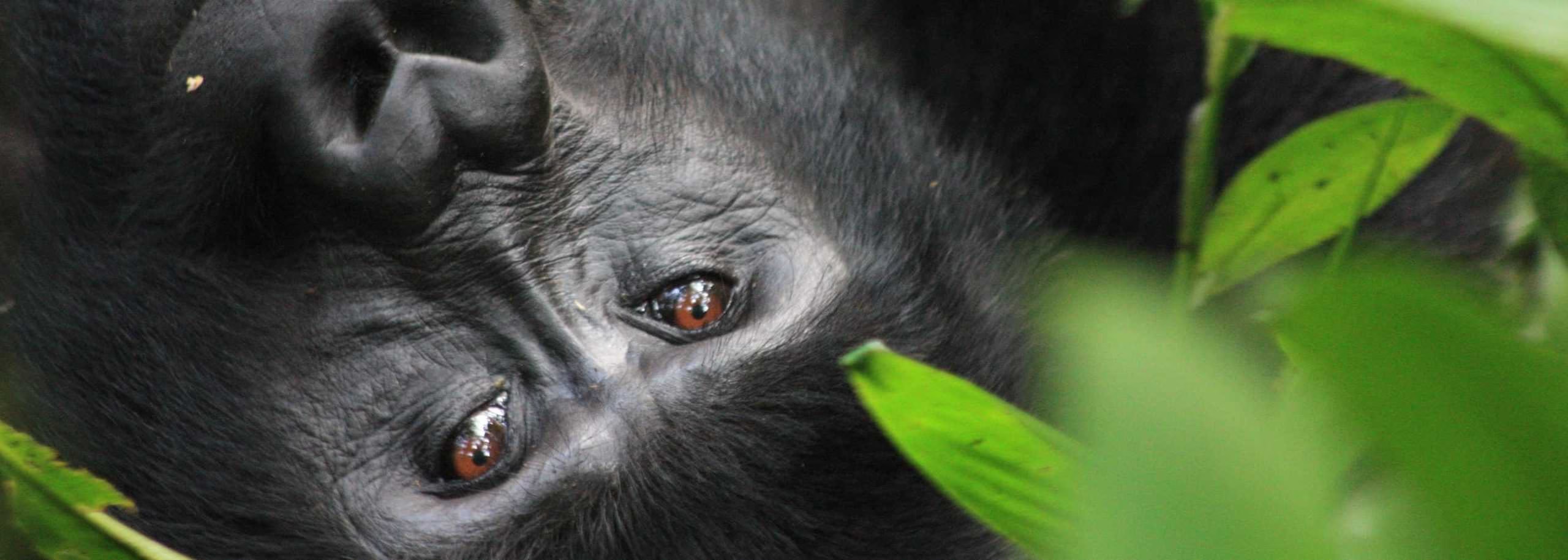
Travel Guide
Explore the unique features of a mountain gorilla’s nose, from nose prints used for identification to their role in breathing, emotion, and conservation.
A mountain gorilla nose may seem like a small detail on an animal famous for immense strength, complex family relationships and expressive behavior. Yet the nose is one of the most useful physical features for people who study and monitor individual gorillas.
Look closely at a mountain gorilla’s face and you will notice a pattern of wrinkles and ridges around the nostrils. These patterns differ between individuals.
Researchers and trackers can use these distinctive features as part of the process of identifying particular gorillas.
For visitors on a gorilla trek in Uganda or Rwanda, understanding this detail can transform the encounter. Instead of seeing only a group of similar-looking animals, travelers begin to understand how experienced conservation teams recognize individuals and follow their lives over many years.
One of the most fascinating aspects of the mountain gorilla nose is the pattern around the nostrils.
The wrinkles and ridges can form distinctive shapes that help trained observers tell individuals apart.
This is sometimes compared with the uniqueness of human fingerprints.
For researchers monitoring habituated gorilla families, reliable identification is essential.
A conservation team needs to know whether all expected family members are present, whether an individual has moved between groups and whether a particular gorilla is showing changes in appearance or behavior.
The face therefore becomes an important source of identification.
Wildlife monitoring becomes much more powerful when researchers can distinguish individual animals.
Simply knowing that ten gorillas were observed is less informative than knowing exactly which ten gorillas were present.
Individual identification allows teams to build long-term records.
Researchers can document births, deaths, transfers between groups, changes in dominance and family relationships.
They can also recognize when an individual has not been seen and may require additional attention.
For a species living in social groups, this level of detail helps conservationists understand population dynamics rather than relying only on broad estimates.
One advantage of visual identification is that it can be conducted without physically handling an animal.
Researchers can observe a gorilla’s face, compare photographs and use known characteristics to confirm identity.
This reduces the need for unnecessary interference.
The principle is particularly valuable in gorilla conservation because the goal is to monitor animals while allowing them to remain wild.
Habituated gorillas accept carefully controlled human presence, but conservation teams still minimize disturbance.
A recognizable mountain gorilla nose therefore provides useful information through observation alone.
Mountain gorillas have broad, relatively flat noses with large nostrils.
This feature forms part of the powerful facial structure that gives gorillas their unmistakable appearance.
The nose sits above strong jaws adapted to processing a plant-based diet that can include leaves, shoots, stems and other vegetation.
Although visitors naturally notice the size of a silverback’s body first, the face becomes increasingly interesting during a longer observation.
Small details around the nose, brow, ears and eyes can help distinguish individuals.
Experienced trackers learn these differences through repeated daily observation.
Like other mammals, gorillas rely on their noses as part of normal respiration.
Mountain gorillas spend much of their lives moving through forest vegetation, feeding and traveling within their home ranges.
A large adult silverback carries considerable body mass, while younger gorillas can be surprisingly energetic as they climb and play.
The broad nostrils form an obvious part of the respiratory anatomy visible to observers.
Visitors may notice changes in breathing after movement or during moments of excitement.
However, travelers should avoid interpreting every facial movement as a specific emotional message without guidance from knowledgeable researchers or rangers.
Gorillas communicate using a combination of posture, vocalizations, gestures and facial expressions.
The region around the nose contributes to the overall appearance of these expressions.
Movement around the nostrils, lips and eyes can accompany alertness or other behavioral states.
Interpreting gorilla behavior requires context.
A single facial movement should not automatically be assigned a human emotion.
Experienced field teams consider the animal’s posture, vocalizations, surrounding individuals and the situation as a whole.
For tourists, this is another reason to listen carefully to ranger explanations during a trek.
Understanding individual faces matters because mountain gorillas live in structured social groups.
A family can include a dominant silverback, adult females, younger males, juveniles and infants.
Relationships develop over time.
Mothers care for infants, youngsters play with one another, adults groom, and the dominant silverback plays an important protective role.
Researchers who recognize each animal can follow these relationships.
They can document which female gives birth, how juveniles develop and how group composition changes.
Identification therefore connects directly with understanding gorilla society.
The supplied source also highlights smell as part of a gorilla’s sensory world.
Gorillas can use olfactory information alongside sight and hearing.
Smell can contribute to awareness of food, other animals and the surrounding environment.
However, gorillas should not be imagined as relying exclusively on scent in the way some mammals do.
Their behavior depends on multiple senses and complex social communication.
For visitors, the important point is that the nose is not merely an identifying pattern visible to researchers. It is also a functional part of how a gorilla experiences its environment.
Trackers play a fundamental role in gorilla tourism and conservation.
Their work begins long before tourists arrive.
Teams monitor gorilla families, follow signs in the forest and maintain knowledge about the animals’ movements.
When visitors begin trekking, guides use information from field teams and physical signs such as trails, vegetation and nesting locations to help locate the assigned family.
Once gorillas are encountered, recognizing individuals helps guides explain who visitors are observing.
A face that initially looks unfamiliar can become meaningful when a guide identifies the silverback, mother, juvenile or infant and explains the animal’s history.
Photography can help document facial features.
Clear images of the nose and face provide records that can be compared over time.
Researchers and conservation teams use systematic approaches rather than depending on casual tourist photographs, but good visual records remain valuable.
Tourists can also use photographs to remember individuals encountered during their trek.
Instead of returning home with a collection of anonymous gorilla pictures, travelers can note the names provided by their guide.
The distinctive mountain gorilla nose can then help them recognize the same individual across different images.
A gorilla trek provides the opportunity to observe these details in a natural setting.
Uganda offers mountain gorilla trekking in Bwindi Impenetrable National Park and Mgahinga Gorilla National Park.
Rwanda offers trekking in Volcanoes National Park.
The day begins with a briefing before visitors enter the forest with professional guides and trackers.
After the assigned family is located, standard trekking provides a limited observation period.
Rather than concentrating only on wide photographs, spend some time looking carefully at individual faces.
You may begin to see why experienced field teams can distinguish one gorilla from another.
Visitors must follow strict rules around mountain gorillas.
Standard trekking groups are limited, and visitors are instructed to maintain the required distance wherever possible.
Gorillas occasionally move closer on their own. If that happens, tourists should remain calm and follow their ranger’s directions rather than touching the animal.
Flash photography is prohibited.
Visitors showing signs of contagious illness may be prevented from trekking because gorillas can be vulnerable to human diseases.
Food and drinks should not be consumed close to the animals.
These regulations protect the same individuals that researchers work so carefully to identify and monitor.
A permit is required to participate in gorilla trekking.
Uganda’s standard gorilla trekking permit costs USD 800 per person, while Rwanda’s standard permit costs USD 1,500 per person.
Uganda also offers the Gorilla Habituation Experience in the Rushaga area of Bwindi, with a permit price of USD 1,500 per person.
The minimum age for gorilla trekking is 15.
Permits are limited, making early booking important, especially during popular travel periods.
Travelers should coordinate the permit with accommodation and transportation because the trekking location determines where they need to stay.
Long-term conservation depends on accurate information.
If researchers know individual gorillas, they can create detailed histories.
A birth is not simply recorded as another gorilla appearing in the population. Researchers can identify the mother and follow the infant’s development.
If an individual disappears from a group, teams know exactly which gorilla is missing.
When a young male changes groups or begins living independently, researchers can track that transition.
Distinctive facial characteristics, including nose patterns, therefore contribute to a much larger conservation picture.
Individual recognition can also support health monitoring.
When teams observe the same gorillas regularly, they become familiar with normal appearance and behavior.
Changes can then be easier to notice.
This does not mean the nose alone provides a diagnosis. Rather, reliable identification ensures observations are attached to the correct individual.
Veterinary and conservation professionals can use a combination of field observations and specialist knowledge when deciding whether intervention is required.
The ability to say precisely which animal is affected is obviously more useful than knowing only that an unidentified gorilla appeared unusual.
Habituation allows trained teams to observe designated gorilla families at controlled distances without causing the same response that completely unfamiliar human presence might trigger.
This makes regulated tourism possible and also supports detailed monitoring.
Habituation does not make gorillas tame.
They remain wild animals that choose where to move, what to eat and how to interact.
Visitors must therefore respect all ranger instructions.
The ability to observe a mountain gorilla nose closely is a privilege created by years of patient conservation work rather than evidence that the animal has become domesticated.
Many travelers begin a gorilla trek hoping to photograph a large silverback.
Seeing a silverback is undeniably impressive, but concentrating only on the dominant male can cause visitors to overlook much of the family’s story.
Look at adult females and the infants near them.
Observe juveniles playing or testing their climbing skills.
Notice differences in facial structure and size.
Watch how individual gorillas respond to one another.
These details turn a wildlife sighting into an opportunity to understand a functioning primate society.
Named and monitored gorillas accumulate individual histories.
Researchers may know an animal’s approximate or exact birth history, maternal relationships, group changes and offspring.
This transforms population monitoring from anonymous numbers into detailed knowledge of real family groups.
For visitors, hearing these stories can make the trekking experience considerably more meaningful.
A guide may point out an individual and explain its relationship to the silverback or another member of the family.
Once you begin noticing the unique facial details, those relationships become easier to follow.
The mountain gorilla nose demonstrates how seemingly small anatomical details can become valuable to conservation.
Its distinctive pattern helps experienced observers distinguish individuals, supporting long-term monitoring of gorilla families.
The nose also forms part of the gorilla’s breathing, sensory experience and expressive face.
For tourists, it provides another reason to spend part of the precious observation period looking rather than simply photographing.
During your next gorilla trek, pay attention to the ridges and patterns around each animal’s nostrils. Listen as your ranger identifies individual family members and explains their relationships.
A mountain gorilla is not simply one member of a species. Each animal is an individual with its own history, family relationships and recognizable physical characteristics.
Sometimes one of the most fascinating clues to that individuality is right in the middle of its face.

Nshongi Gorilla Family in Bwindi: History, Location and Trekking Guide The Nshongi Gorilla Family holds an important place…
Read article →
Mishaya Gorilla Family in Bwindi: History, Trekking and What to Know The Mishaya Gorilla Family is one of…
Read article →
Semuliki Hot Springs Visit Guide: What to Expect Semuliki Hot Springs offers one of the most unusual natural…
Read article →
Kidepo Valley Remote Safari Guide: What to Expect Kidepo Valley National Park offers one of Uganda's most remote…
Read article →