

Nshongi Gorilla Family in Bwindi
Nshongi Gorilla Family in Bwindi: History, Location and Trekking Guide The Nshongi Gorilla Family holds an important place…
Read article →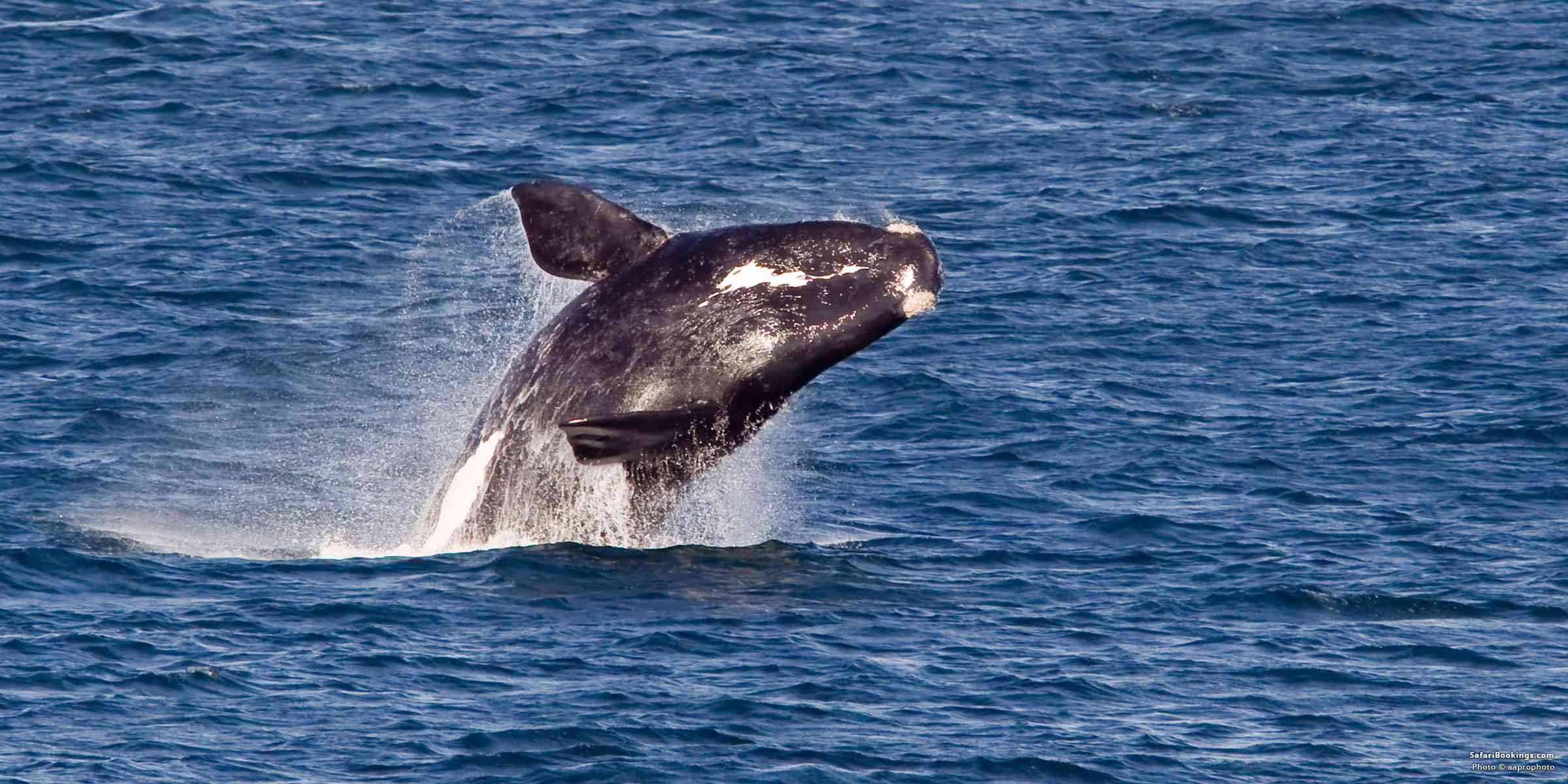
Travel Guide
Discover five fascinating facts about Southern Right Whales, from their unique callosities to their long migration journeys and acrobatic displays.
Southern right whales are among the most recognizable large whales found in Southern Hemisphere waters. Their massive bodies, distinctive heads and seasonal coastal movements make them particularly interesting to wildlife travelers exploring parts of southern Africa.
Unlike a conventional land safari, whale watching requires visitors to read the ocean.
A dark shape, sudden blow or splash may be the first sign that an enormous animal is nearby.
Patience is essential because whales are wild and their movements cannot be scheduled precisely.
Understanding their biology makes these encounters considerably more meaningful. Their distinctive callosities, migration patterns, social behavior and historical relationship with commercial whaling all contribute to the story of the species.
One of the most distinctive features of Southern right whales is the roughened skin growth found on their heads.
These areas are known as callosities.
Their pattern can differ between individuals, creating recognizable markings that researchers can use when identifying whales from photographs.
This is especially valuable because researchers cannot simply attach permanent visible labels to every wild whale.
Natural markings effectively provide an identification system.
Callosities are located around areas of the whale’s head, including near the mouth and blowholes.
Their appearance can be influenced by small organisms living on the roughened skin.
From a distance, the patterns may look pale against the whale’s darker body.
Researchers using good-quality photographs can compare these patterns over time.
Individual identification makes long-term population studies possible.
When researchers recognize the same whale in different years, they can begin constructing a life history.
They may document where the animal travels, whether a female returns with calves and how frequently individuals appear in particular regions.
This information helps scientists understand population structure and movement.
A simple photograph can therefore become valuable scientific data when collected systematically.
Southern right whales move between different habitats according to seasonal needs.
Feeding and breeding areas are not necessarily the same.
Whales may travel considerable distances between productive feeding grounds and waters used for mating, calving or raising young.
These movements create seasonal whale-watching opportunities.
A coastline that has few whales during one part of the year can become much more active during another.
Migration allows whales to use different environments for different biological purposes.
Feeding areas provide access to suitable prey.
Breeding and nursery areas may offer conditions better suited to reproduction and young calves.
The precise movements of individuals vary.
Researchers use identification, surveys and other scientific methods to understand these patterns.
Travelers hoping to see Southern right whales need to consider season carefully.
A destination may be excellent for whale watching only during part of the year.
Historical patterns provide useful planning guidance, but wildlife remains unpredictable.
Weather and sea conditions also influence whether a boat trip can operate safely.
Visitors should allow flexibility rather than scheduling one short opportunity and assuming a sighting is guaranteed.
The enormous size of a southern right whale does not prevent dramatic surface behavior.
Whales may breach, lifting much of their bodies out of the water before crashing back into the sea.
They may also display their tails, slap the water or roll near the surface.
These behaviors create spectacular wildlife encounters.
However, tourists should avoid assuming that every whale-watching trip will include dramatic action.
A breach is among the most impressive whale behaviors to witness.
The whale propels itself upward and emerges partly or extensively from the water.
For photographers, predicting exactly where a second breach will occur is difficult.
Keeping the camera ready while also watching the broader water surface improves the chances of capturing the moment.
Sometimes the best approach is simply to watch.
A whale lifting its tail before diving creates another memorable sight.
Tail shape and markings can sometimes provide identification information.
Photographers should use fast shutter speeds if conditions allow.
A wider composition can also be effective because it shows the whale in relation to the ocean rather than isolating only the body.
Breeding areas can provide opportunities to observe females with calves.
Young whales depend heavily on their mothers.
The relationship provides protection and nutrition during an important developmental period.
Responsible whale watching becomes particularly important around mothers and calves.
Boats should follow applicable approach regulations and avoid behavior that causes animals to change direction repeatedly.
A young whale may appear curious, but human operators still carry responsibility for maintaining appropriate distance.
Repeated close approaches can create disturbance.
Wildlife tourism should allow whales to determine their own behavior.
A natural interaction observed from an appropriate distance is more meaningful than an encounter produced by chasing animals.
Mother-calf pairs can reveal subtle behavior.
Travelers may notice synchronized swimming, resting or surfacing patterns.
Spending time with one pair from a respectful distance can be more rewarding than racing between several sightings.
Good guides interpret what visitors are observing without making unsupported claims about the animals’ emotions.
The term “right whale” is connected with the history of commercial whaling.
These whales were considered desirable targets by historical whalers because of characteristics that made them profitable to hunt.
That history placed enormous pressure on right whale populations.
Understanding the origin of the name transforms it from a simple label into a reminder of the scale of historical exploitation.
Modern whale tourism represents a profound change in how many communities economically interact with whales.
Instead of deriving value from killing them, destinations can generate tourism income by keeping whales alive and protecting marine environments.
Boat operators, guides, accommodation providers and restaurants may all benefit from seasonal whale tourism.
This creates an economic incentive for conservation.
Protection from commercial hunting does not remove every threat.
Large marine animals live in oceans affected by human activity.
Entanglement in fishing equipment, vessel interactions, pollution and environmental changes can create risks.
Conservation therefore requires continued monitoring.
Protective laws alone cannot solve every problem if new pressures develop.
In some destinations, coastal geography allows visitors to observe whales from shore.
Land-based viewing has several advantages.
It creates little direct disturbance and can be accessible to travelers who do not enjoy boats.
Binoculars improve the experience.
Elevated viewpoints can help visitors scan larger areas of water.
Patience remains essential.
Boat trips can provide closer perspectives when conducted responsibly.
Choose operators that follow local wildlife-viewing regulations.
Captains should not chase whales, block their movement or repeatedly approach too closely.
Responsible operators recognize that animal welfare takes priority over satisfying demands for a closer photograph.
Whale photography requires anticipation.
Keep the camera ready before the whale surfaces.
A moderate or telephoto lens can be useful, but extremely tight framing can make it difficult to follow a moving animal.
Use a fast shutter speed for breaches and splashes.
Protect equipment from spray.
Most importantly, do not judge the success of the trip entirely by photographs.
The Southern right whales story combines natural history with conservation history.
Their callosity patterns allow individual identification. Their seasonal migrations connect distant marine habitats. Their enormous bodies can perform dramatic surface displays, while mothers and calves reveal a quieter side of whale behavior.
Their historical exploitation also demonstrates how profoundly human activity can affect wildlife populations.
Today, responsible whale watching gives travelers an opportunity to appreciate these animals alive in their natural environment.
The best encounter is one in which the whales continue behaving naturally while visitors observe from a respectful distance—turning an extraordinary wildlife sighting into a reason to value and protect the oceans on which these giants depend.

Nshongi Gorilla Family in Bwindi: History, Location and Trekking Guide The Nshongi Gorilla Family holds an important place…
Read article →
Mishaya Gorilla Family in Bwindi: History, Trekking and What to Know The Mishaya Gorilla Family is one of…
Read article →
Semuliki Hot Springs Visit Guide: What to Expect Semuliki Hot Springs offers one of the most unusual natural…
Read article →
Kidepo Valley Remote Safari Guide: What to Expect Kidepo Valley National Park offers one of Uganda's most remote…
Read article →