

Nshongi Gorilla Family in Bwindi
Nshongi Gorilla Family in Bwindi: History, Location and Trekking Guide The Nshongi Gorilla Family holds an important place…
Read article →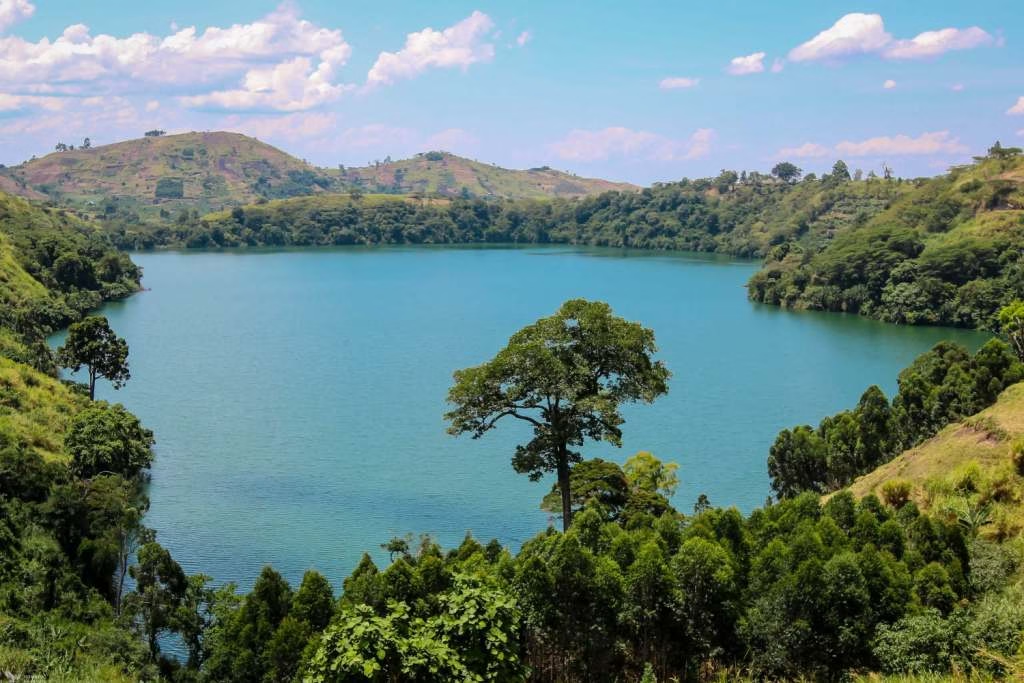
Travel Guide
Explore Lake Nyinambuga in Uganda's Kabarole District—a tranquil crater lake renowned for its natural beauty, rich biodiversity, and cultural significance. Learn about its formation, attractions, and how to visit.
Lake Nyinambuga is presented in the supplied source as a scenic crater lake surrounded by the green hills of western Uganda’s Kabarole District. Part of the wider Ndali-Kasenda crater lake system, it combines natural scenery, geological interest, biodiversity, cultural traditions, and opportunities for quiet outdoor exploration.
Unlike destinations dominated by large safari vehicles or tightly scheduled wildlife activities, Lake Nyinambuga offers a slower experience. Visitors can walk through the surrounding countryside, watch birds, spend time beside the water, learn about local traditions, and appreciate the volcanic landscape that shaped this part of western Uganda.
The supplied source describes the lake as having clear waters and lush surroundings. It also gives Lake Nyinambuga wider national visibility by stating that its landscape is featured on the back of Uganda’s 20,000-shilling banknote.
For travelers exploring Fort Portal and western Uganda, the lake can therefore add a peaceful crater-lake experience to an itinerary that may also include forests, mountains, national parks, and community encounters.
Lake Nyinambuga forms part of the Ndali-Kasenda crater lake system.
The wider region contains a collection of volcanic features that contribute to its distinctive rolling landscape.
Traveling through this part of Kabarole gives visitors repeated views of hills, crater depressions, vegetation, farms, and water bodies.
Lake Nyinambuga is one of the places where that geological story can be experienced at close range.
The supplied source states that Lake Nyinambuga was formed through volcanic activity more than a millennium ago.
According to that framing, volcanic processes caused the ground to collapse, creating a depression that eventually filled with rainwater.
The result is the crater lake seen today.
This geological background gives the lake greater significance than its scenery alone.
Western Uganda’s crater-lake landscapes show how geological processes can continue shaping tourism long after the volcanic activity itself has ended.
The depressions now hold water, support ecosystems, influence local land use, and attract visitors.
Understanding this origin can make a simple walk around the lake more interesting.
The supplied source places Lake Nyinambuga at approximately 1,200 meters above sea level.
Elevation contributes to the character of the surrounding hills and vegetation.
Travelers moving through the region experience a landscape that feels quite different from Uganda’s flatter savannah parks.
The source describes the lake as covering approximately 2.5 square kilometers.
This figure is retained from the supplied material.
The lake’s manageable scale makes it particularly suitable for travelers who want to combine scenic observation with walking and community experiences.
The supplied source highlights the lake’s clear water as one of its defining visual characteristics.
Water quality and changing light can influence how the lake appears throughout the day.
Early morning and later afternoon can provide particularly attractive conditions for landscape photography.
The lake is not presented only as a geological feature.
The source describes the surrounding ecosystem as supporting fish, primates, and numerous birds.
Vegetation around the crater provides habitat while also contributing to the green scenery for which the region is known.
The supplied material identifies tilapia and catfish among fish associated with the lake.
These species form part of the aquatic ecosystem.
Visitors interested in local ecology can learn how crater lakes support life despite being relatively contained water systems.
Nearby forested areas are described as supporting monkeys.
A sighting should be treated as a natural opportunity rather than something guaranteed.
Visitors should observe primates quietly and avoid feeding them.
Wildlife remains most rewarding when natural behavior is preserved.
Baboons are another primate mentioned in the source.
Their presence demonstrates the connection between the lake and surrounding terrestrial habitats.
The experience at Lake Nyinambuga therefore extends beyond what is visible on the water itself.
Birding is one of the main activities recommended in the supplied source.
The combination of water, vegetation, cultivated landscapes, and nearby forest creates varied conditions for birds.
Travelers should carry binoculars and allow time for slow observation.
The source specifically identifies the grey-crowned crane, Uganda’s national bird, among species visitors may encounter.
Its distinctive golden crest makes it one of the country’s most recognizable birds.
Any sighting should be enjoyed from a respectful distance.
Hiking and nature walks provide one of the best ways to experience Lake Nyinambuga.
The supplied source describes scenic trails with panoramic views.
Walking allows visitors to appreciate changes in elevation and vegetation that can be overlooked when traveling entirely by vehicle.
A nature walk can be adapted to the traveler’s available time and physical ability.
Some visitors may prefer a relaxed walk focusing on photography and birds.
Others may want a longer exploration of the surrounding hills.
Local guidance can add useful context about the landscape.
Elevated sections around crater lakes can provide broad views across the water and neighboring countryside.
These viewpoints help visitors understand the shape of the crater.
They are also among the most attractive locations for landscape photography.
Lake Nyinambuga’s combination of water, hills, vegetation, and rural scenery makes it naturally photogenic.
Photographers can experiment with reflections, wide landscapes, details of plant life, and community scenes where permission is granted.
The supplied source’s reference to the lake appearing on a Ugandan banknote further emphasizes its visual appeal.
The supplied source presents swimming and relaxation as possible activities because of the lake’s clear water and peaceful environment.
Travelers interested in swimming should still obtain local guidance about current conditions and suitable access points before entering the water.
The source does not provide detailed safety information.
Swimming is not necessary to enjoy Lake Nyinambuga.
Simply spending time near the shore can be rewarding.
The quiet atmosphere makes the lake suitable for travelers seeking a break between more demanding safari activities.
The source places considerable emphasis on the lake’s cultural importance to the Batooro people.
It describes beliefs associating the lake with spirits and deities.
Traditional ceremonies are also said to take place along the shores in connection with blessings and protection.
These beliefs should be approached respectfully as part of local cultural tradition.
Community interaction can provide a deeper understanding of Lake Nyinambuga.
A guide or community member can explain traditions, stories, and the relationship between people and the landscape.
Travelers should listen rather than treating cultural beliefs as performances.
The source describes traditional ceremonies connected with the lake.
Visitors should not assume such ceremonies are tourist activities.
If an opportunity to learn about cultural practices arises, local customs and community guidance should determine what is appropriate.
One of the most distinctive claims in the supplied material is that Lake Nyinambuga’s landscape appears on the back of Uganda’s 20,000-shilling banknote.
Within the source’s framing, this gives the lake national visual significance in addition to its local cultural importance.
It can be an interesting detail for travelers exploring the area.
The source locates the lake near Fort Portal, approximately 15 kilometers west of the town.
It describes a route using the A109 road toward Nyakabale.
Near Nyinambuga Primary School, travelers turn onto a dirt road and continue approximately five kilometers to the lake.
These directions come directly from the supplied source and should be confirmed locally before travel.
Fort Portal provides a practical base for exploring the crater-lake region.
Travelers can stay in or around the city and make excursions into the surrounding countryside.
This makes Lake Nyinambuga relatively easy to combine with other western Uganda experiences.
The final approach described in the source uses a dirt road.
Road conditions can vary with weather.
Travelers should therefore allow enough time and use transport appropriate to current conditions.
Local drivers can be particularly useful when routes are unfamiliar.
The supplied source specifically recommends Ndali Lodge for travelers wishing to stay overnight.
It describes the lodge as offering comfortable accommodation and attractive views of the lake and surrounding landscape.
Current facilities, availability, and exact location should be confirmed when booking.
An overnight stay can provide more time to experience the quieter periods of the day.
Early morning may bring bird activity and mist, while evening can produce attractive light over the surrounding hills.
Travelers interested in photography may particularly appreciate this slower schedule.
The source recommends combining the lake with Kibale Forest.
This pairing creates a contrast between crater-lake scenery and tropical forest experiences.
Travelers can therefore build a western Uganda itinerary containing both geological and primate-focused attractions.
Queen Elizabeth National Park is another destination identified in the supplied material.
Adding a savannah wildlife safari after the crater-lake region increases the ecological variety of the journey.
The transition from hills and lakes to open wildlife landscapes can be particularly rewarding.
The source also recommends the Rwenzori Mountains.
These mountains add another dramatic landscape to western Uganda.
A wider itinerary can therefore move between crater lakes, forests, savannahs, and mountain environments.
Lake Nyinambuga suits travelers who enjoy scenery without requiring constant entertainment.
Nature lovers can appreciate vegetation, water, hills, birds, and smaller wildlife.
The experience is more about immersion in the landscape than chasing a checklist of major attractions.
Birdwatchers can make the lake a focused stop.
Water-associated birds and species using nearby vegetation create varied possibilities.
An experienced local guide may help identify calls and species that casual visitors overlook.
The Batooro traditions described in the source give the lake cultural depth.
Travelers interested in local beliefs and heritage can learn how landscapes become part of community identity.
Respectful engagement is essential.
Lake Nyinambuga combines volcanic history, crater-lake scenery, biodiversity, outdoor activities, and cultural significance within western Uganda’s Kabarole District.
The supplied source describes the lake as part of the Ndali-Kasenda crater system and states that it formed through volcanic processes more than a millennium ago. Its waters and surrounding habitats support fish, primates, and birds, while the surrounding hills provide opportunities for hiking and photography.
The lake also carries cultural importance for the Batooro people, with traditional beliefs and ceremonies connected to its shores.
Travelers can explore through nature walks, birdwatching, cultural experiences, photography, relaxation, and, where locally confirmed as appropriate, swimming.
Its proximity to Fort Portal also allows Lake Nyinambuga to fit naturally into journeys that include Kibale Forest, Queen Elizabeth National Park, and the Rwenzori Mountains.
For visitors seeking a quieter side of western Uganda, the lake offers a combination of scenery and living culture within one of the country’s distinctive crater-lake landscapes.

Nshongi Gorilla Family in Bwindi: History, Location and Trekking Guide The Nshongi Gorilla Family holds an important place…
Read article →
Mishaya Gorilla Family in Bwindi: History, Trekking and What to Know The Mishaya Gorilla Family is one of…
Read article →
Semuliki Hot Springs Visit Guide: What to Expect Semuliki Hot Springs offers one of the most unusual natural…
Read article →
Kidepo Valley Remote Safari Guide: What to Expect Kidepo Valley National Park offers one of Uganda's most remote…
Read article →