

Nshongi Gorilla Family in Bwindi
Nshongi Gorilla Family in Bwindi: History, Location and Trekking Guide The Nshongi Gorilla Family holds an important place…
Read article →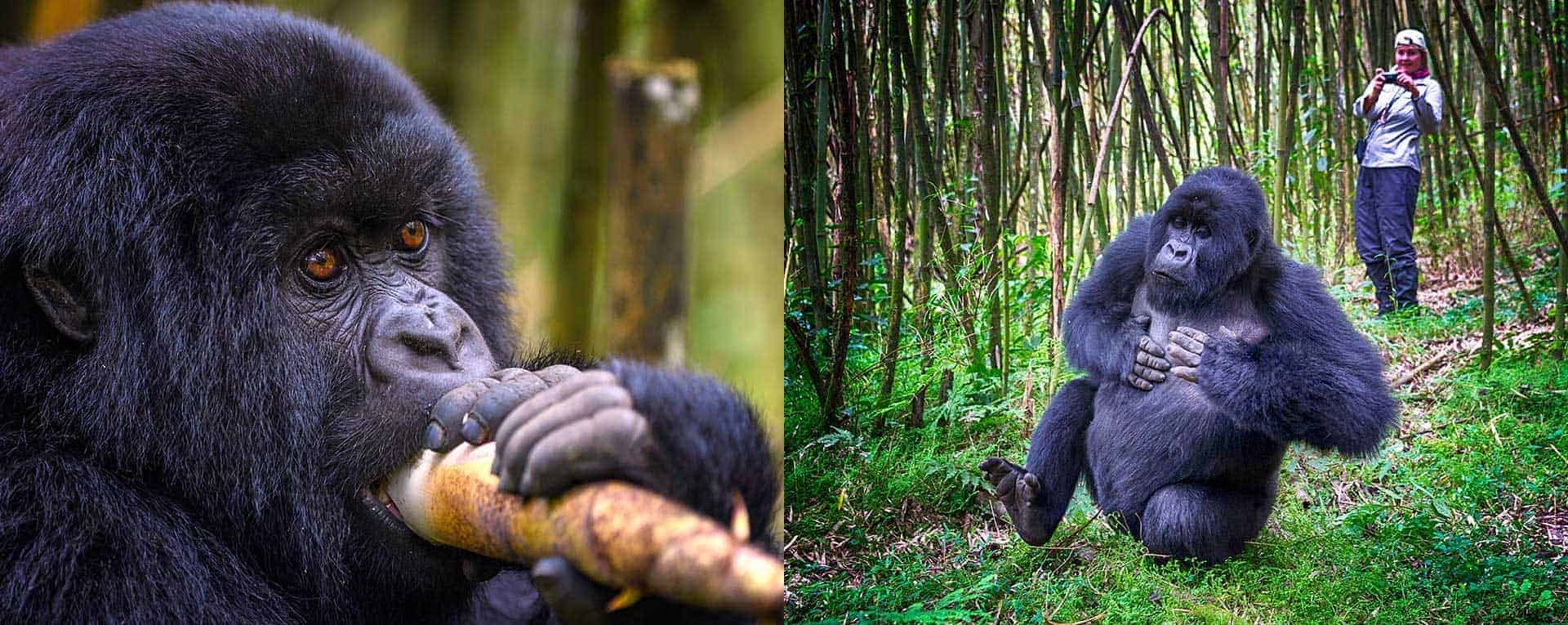
Travel Guide
Explore the impressive intelligence of gorillas. Learn about their problem-solving, communication, social behaviors, and emotional depth in this fascinating look at their cognitive abilities.
How Smart Are Gorillas is a fascinating question because gorilla intelligence is expressed in many different ways. The supplied source emphasizes their ability to solve problems, communicate, remember information, learn from experience, use tools, and manage complex social relationships.
Gorillas do not need to behave exactly like humans for their intelligence to be significant.
Their abilities make sense within the demands of gorilla life. They need to locate food, navigate their environment, communicate with family members, respond to conflict, protect young, recognize social relationships, and adapt when circumstances change.
Some evidence comes from observations of wild gorillas, while other examples in the supplied material come from gorillas living in captivity.
Looking at these different abilities together gives a richer picture of gorilla cognition than focusing on one isolated test.
Intelligence cannot be reduced to a single behavior.
An animal may demonstrate cognitive ability through memory, problem-solving, communication, social understanding, or the use of objects.
The source presents gorillas as capable in several of these areas.
This is important because the daily life of a gorilla involves many different decisions.
Finding food requires knowledge of the environment.
Living in a family group requires social awareness.
Responding to unfamiliar circumstances requires flexibility.
Gorilla intelligence is therefore best understood as a collection of abilities that help them function within their physical and social world.
One of the clearest examples in the supplied source is tool use.
The material notes that gorillas do not use tools as frequently or as elaborately as chimpanzees, but they have nevertheless been observed using objects to solve practical problems.
One example involves using sticks to test the depth of water before crossing.
This behavior is significant because the stick becomes more than an ordinary object.
The gorilla uses it to gain information about an environment before making a decision.
The source also refers to leaves being used in connection with shelters and nests.
These examples illustrate practical interaction with available materials.
Tool use can demonstrate an understanding that an object can help achieve a particular goal.
A stick used to investigate water provides information that the gorilla cannot obtain as easily simply by looking at the surface.
The behavior therefore connects an object with a problem.
This does not mean every gorilla uses tools in the same way.
It does show that gorillas are capable of flexible behavior when circumstances create an opportunity.
Tool use becomes particularly interesting because it challenges the assumption that gorillas rely only on physical strength.
Their survival also depends on observation and decision-making.
The supplied material also associates leaves with gorilla nesting behavior.
Nests provide places for rest and sleep.
Constructing one requires interaction with surrounding vegetation.
A gorilla must select and arrange available materials rather than simply lying wherever it happens to stop.
Nest construction is part of ordinary gorilla life, but ordinary behavior can still demonstrate cognitive ability.
Animals constantly make practical decisions about comfort, safety, and their environment.
For visitors watching gorillas in the wild, seeing a family resting can therefore provide an opportunity to think about how these animals interact with the forest around them.
Another major part of the answer to How Smart Are Gorillas involves communication.
The source describes gorillas as using vocalizations, body language, and facial expressions.
Communication allows information to move through a social group.
A gorilla’s posture may signal one thing, while a vocalization communicates something else.
Facial expressions can also contribute to interactions.
These signals are important because gorillas live in groups where individuals need to respond to one another.
A social species benefits from being able to express warnings, tension, reassurance, excitement, or other states without every interaction becoming physical.
The supplied source refers to grunts, roars, and other sounds.
Different situations can produce different vocal responses.
A quiet interaction within a family is very different from a moment of conflict or alarm.
For travelers fortunate enough to observe gorillas, sound can be one of the most memorable parts of the encounter.
A gorilla does not need to speak human language for its vocal behavior to carry meaning.
The important point is that members of the group respond to signals produced by others.
Communication is therefore part of the social intelligence required for group life.
Gorillas also communicate visually.
Body position, movement, gestures, and facial expressions can all contribute to social interactions.
A large silverback, for example, does not need to engage physically in every situation to influence the group.
Other gorillas can respond to his behavior and presence.
Young gorillas also learn through social interaction.
Play provides opportunities to develop coordination while learning how other individuals respond.
Understanding body language is therefore not merely an interesting extra ability. It helps maintain relationships within the group.
The supplied source mentions that some gorillas in captivity have been taught sign language to communicate with humans.
This is presented as evidence of their ability to learn complex symbols.
Captive research differs from observing gorillas in the wild because humans create the learning environment.
Nevertheless, the source uses these examples to illustrate the gorilla’s capacity for learning associations and using learned signals.
Such cases have contributed greatly to public interest in gorilla intelligence.
They also remind people that communication does not have to depend on spoken words.
Problem-solving is another ability emphasized in the source.
Captive gorillas have been observed solving puzzles or working out how to access food.
The material also mentions examples such as figuring out how to unlock gates.
These situations require more than raw strength.
The animal must interact with the problem and determine which actions lead toward the desired result.
A gorilla may need to manipulate objects, remember previous attempts, or change strategy.
This flexibility is a central characteristic of intelligent behavior.
Many problem-solving behaviors depend on understanding that one action can produce another outcome.
The stick-and-water example demonstrates this clearly in the supplied source.
Using the stick provides information before crossing.
Puzzle solving similarly involves discovering that a particular action produces access to a reward.
The more an animal can connect actions with consequences, the more effectively it can respond to unfamiliar situations.
This does not require human-style reasoning.
It represents cognition adapted to the animal’s own needs and environment.
The source describes gorillas as having good memories and being capable of learning from experience.
Memory is fundamental to survival.
An animal benefits from remembering where food can be found, which routes are useful, and how previous situations unfolded.
The supplied material specifically notes that gorillas can remember locations of food sources.
For an animal living in a forest environment where resources may be spread across a large area, this can be highly useful.
Remembering rather than constantly rediscovering information saves both time and energy.
The source also states that gorillas can recognize individual humans and other animals over time.
Recognition is particularly important within gorilla society.
Group members have continuing relationships rather than meeting one another as strangers every day.
Individuals need to know their social partners.
Relationships between a silverback, adult females, younger gorillas, and infants all contribute to group dynamics.
Memory therefore supports social intelligence as well as practical navigation and feeding.
The supplied material refers to studies in which gorillas learned new tasks and retained the knowledge.
Learning means behavior can change based on experience.
An animal does not have to rely only on instinctive responses.
When a gorilla discovers an effective solution, remembering it can make future problem-solving easier.
This capacity helps explain why gorillas can adapt to changing situations.
The same principle is visible in young animals, which develop skills over time through observation, interaction, and experience.
Gorillas are social animals living in close family groups.
The source describes these groups as commonly being led by a dominant male known as a silverback.
Group life creates complex challenges.
Individuals need to cooperate, manage tension, protect young, maintain relationships, and respond to leadership.
A solitary animal can avoid many of these social demands.
A gorilla cannot.
Its daily environment includes other individuals whose behavior matters.
Social intelligence is therefore central to understanding gorilla cognition.
The silverback occupies an important position within the family.
His role involves more than physical size.
Group leadership requires awareness of what is happening among members and around the family.
A silverback may respond to threats, intervene during tension, or influence group movement.
Other gorillas also need to understand his signals.
This creates a network of relationships rather than a simple hierarchy based only on strength.
Watching a gorilla family can therefore reveal subtle social interactions that may not be obvious during the first few minutes of an encounter.
The source specifically identifies cooperation and conflict resolution as examples of gorilla social behavior.
Any social group experiences moments of disagreement.
If every conflict escalated into serious physical fighting, group life would become costly.
Social signals and established relationships can help manage tension.
Cooperation is equally important.
Family members share space and respond to common circumstances.
Young animals grow within this social environment and gradually learn how to interact appropriately.
These abilities illustrate intelligence operating through relationships rather than individual problem-solving alone.
The supplied source attributes a wide range of emotional behavior to gorillas, including joy, sadness, grief, and affection.
It also describes situations in which group members may show concern when another gorilla is injured.
Within the source’s framing, these responses are part of the animals’ emotional intelligence.
Strong bonds develop between individuals.
These relationships help explain why changes within a family group can affect other members.
For visitors, observing gentle interactions between adults and young gorillas often provides a particularly powerful insight into the social character of the species.
Young gorillas are often active and playful.
Play is not simply entertainment.
It creates opportunities to practice movement, social interaction, and boundaries.
Young animals can learn how others respond to different behaviors.
They develop coordination and gain experience within the relative security of the family.
This makes play another useful window into gorilla intelligence.
It combines physical development with social learning.
For people observing a gorilla family, playful juveniles can therefore reveal much about how skills develop over time.
The examples in the supplied source come from both wild and captive contexts.
This distinction matters.
Wild gorillas solve problems created by natural environments: finding food, navigating forest, maintaining group relationships, and responding to environmental challenges.
Captive gorillas may encounter human-designed puzzles, gates, symbols, or communication experiments.
Both settings can reveal cognitive abilities, but the circumstances are different.
Together, they illustrate how gorillas can learn and adapt in multiple environments.
The source’s answer to How Smart Are Gorillas is clear: their intelligence is demonstrated through a broad combination of abilities.
They use tools in some circumstances, communicate through sound and body language, solve practical problems, remember information, learn new tasks, maintain complex social relationships, and display strong emotional responses.
Their intelligence should not be measured solely by how closely they imitate humans.
Gorillas have cognitive abilities suited to their own lives as large, social primates.
Understanding those abilities makes observing them more meaningful.
A gorilla resting, feeding, communicating, playing, or responding to another group member is not simply performing an instinctive routine. Each behavior can reveal part of a sophisticated social and cognitive world that makes gorillas among Africa’s most fascinating primates.

Nshongi Gorilla Family in Bwindi: History, Location and Trekking Guide The Nshongi Gorilla Family holds an important place…
Read article →
Mishaya Gorilla Family in Bwindi: History, Trekking and What to Know The Mishaya Gorilla Family is one of…
Read article →
Semuliki Hot Springs Visit Guide: What to Expect Semuliki Hot Springs offers one of the most unusual natural…
Read article →
Kidepo Valley Remote Safari Guide: What to Expect Kidepo Valley National Park offers one of Uganda's most remote…
Read article →