

Nshongi Gorilla Family in Bwindi
Nshongi Gorilla Family in Bwindi: History, Location and Trekking Guide The Nshongi Gorilla Family holds an important place…
Read article →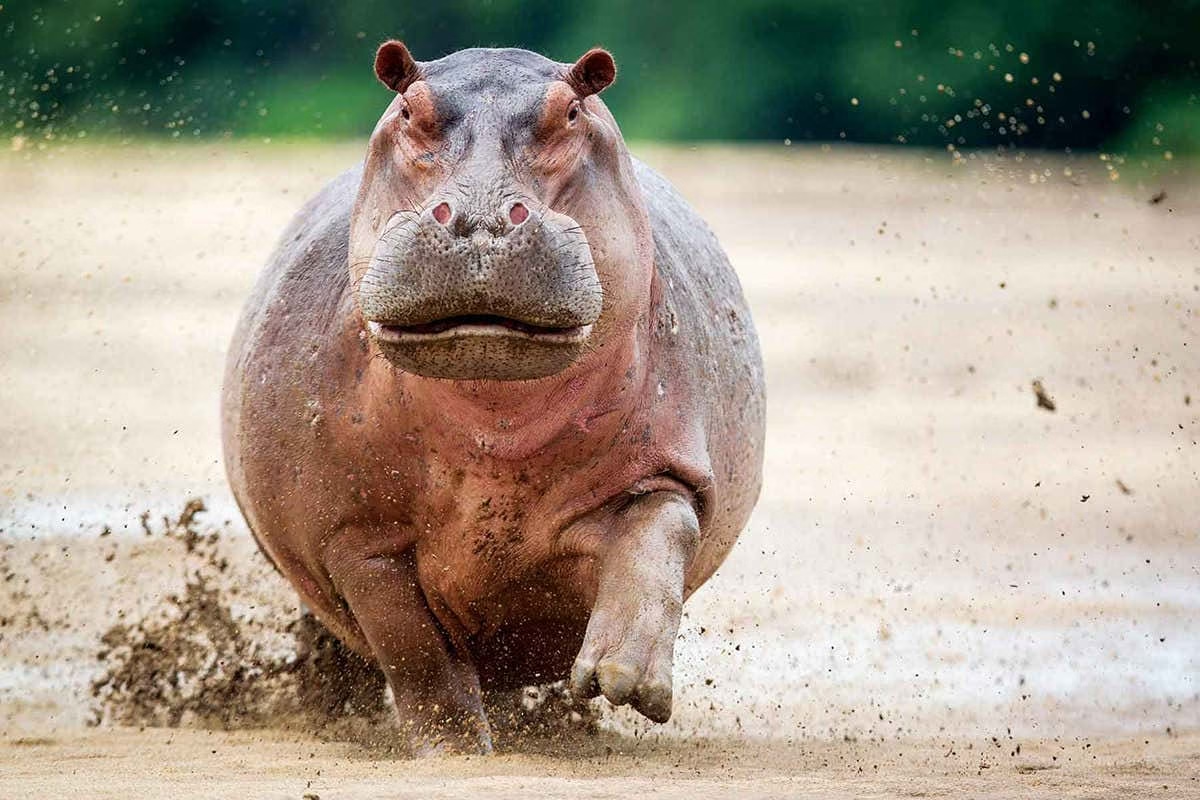
Travel Guide
Learn how fast hippos can run on land and move in water. Discover what makes these massive animals so quick and why their speed makes them dangerous.
Anyone asking how fast can hippos run is usually surprised that an animal with such a massive body can move quickly on land. Hippopotamuses may look slow while resting in water, but their appearance can be misleading. On land, they can accelerate rapidly enough to make approaching one extremely dangerous.
The more important lesson is not memorizing one speed figure.
It is understanding that hippos are powerful wild animals that require substantial space.
Safari visitors should never test how quickly a hippo can move by approaching one on foot.
Their combination of size, strength and speed makes respectful wildlife-viewing distances essential.
A hippopotamus has a heavy, barrel-shaped body supported by relatively short legs.
This creates the impression that it should move slowly.
However, hippos can travel surprisingly quickly across land over short distances.
Published estimates of maximum speed vary according to source and measurement method, but the practical conclusion remains unchanged: a person should never assume they can safely outrun an approaching hippo.
Wild animals do not normally perform controlled speed tests.
Researchers and observers therefore rely on field measurements, estimates and documented behavior.
Different publications may provide different maximum figures.
Rather than treating one number as universally exact, travelers should understand the broader fact that hippos can accelerate rapidly.
For safari safety, whether a particular individual reaches one quoted maximum speed or another makes little practical difference.
Hippos leave water to feed and move between suitable habitats.
Their movement on land can be purposeful and surprisingly energetic.
At night they may travel away from water while feeding.
Visitors staying near rivers or lakes should therefore follow lodge instructions concerning nighttime movement.
A hippo encountered away from water deserves substantial space.
The movement of hippos has been studied because their gait differs from the conventional image people associate with running animals.
Their locomotion can involve rapid movement in which their enormous bodies are propelled efficiently across the ground.
For a tourist, the technical definition of the gait matters less than its practical effect.
The animal can close distance quickly.
Trying to outrun a hippo is not a sensible safety strategy.
A person should avoid creating the situation in the first place.
Stay inside the safari vehicle where required.
Follow guides during walking activities.
Never place yourself between a hippo and water.
If traveling around a lodge near hippo habitat after dark, use escorts where instructed.
The question how fast can hippos run often leads to another misconception: that hippos swim rapidly underwater.
Hippos are highly adapted to aquatic life, but their underwater movement is not simply the same as conventional swimming.
They can move along the bottom and propel themselves through shallow aquatic environments.
Their comfort in water should never be interpreted as harmlessness.
Water helps hippos manage daytime heat and protects their skin from prolonged sun exposure.
Groups may spend many daylight hours in rivers or lakes.
As temperatures fall, individuals become more active and may leave the water to feed.
This daily rhythm explains why travelers can observe large concentrations of hippos in aquatic habitats during daytime boat safaris.
Despite their intimidating mouths and large canine teeth, hippos primarily feed on plant material.
They commonly graze on grasses.
Being herbivorous does not make an animal safe.
Hippos can behave aggressively when threatened, surprised or blocked from moving between land and water.
Diet and temperament are separate issues.
Male hippos can be territorial in aquatic environments.
Visitors may observe open-mouth displays, vocalizations and confrontations.
These behaviors are fascinating from a safe distance.
Boat operators and guides understand how to navigate around groups without provoking unnecessary disturbance.
Passengers should never encourage a captain to move dangerously close for photographs.
Female hippos with young require particular respect.
Like many large mammals, mothers can respond strongly to perceived threats.
Visitors should avoid positioning themselves between a mother and calf.
From a boat or safari vehicle, guides can select an appropriate viewing position while allowing the animals to behave naturally.
Travelers staying beside rivers and lakes sometimes underestimate the possibility of hippos walking through areas away from the shoreline after dark.
This is why some safari lodges require guests to be escorted between rooms and dining areas at night.
Those rules are not theatrical additions to the safari experience.
They reflect genuine wildlife behavior.
Boat safaris provide excellent opportunities to observe hippos.
Murchison Falls and Queen Elizabeth National Park in Uganda are among destinations where river or channel activities can reveal hippo behavior.
Visitors may see groups resting, surfacing or interacting.
Keeping appropriate distance allows observation without forcing animals to move.
A telephoto lens allows photographers to capture hippos without approaching too closely.
Images of yawning animals are popular because they reveal the enormous mouth and teeth.
However, what looks like a yawn may be connected with display behavior rather than tiredness.
Guides can help interpret what is happening.
The wide-open mouth is one of the species’ most recognizable displays.
It exposes large teeth and can communicate dominance or warning.
Visitors should not interpret every open mouth as an invitation for a dramatic close photograph.
Wildlife behavior should be observed rather than provoked.
Walking near hippo habitat requires experienced local guidance.
Dense vegetation can reduce visibility.
A hippo surprised at close range can react quickly.
Never follow informal tracks toward a river simply because they appear to offer a better viewpoint.
Those paths may be used by wildlife.
Safari vehicles provide greater protection, but drivers still need to avoid blocking animals.
A hippo moving across land should be given room.
The objective is not to force it into changing direction.
Responsible wildlife viewing allows the animal to decide where it moves.
Boat captains should maintain appropriate distances from groups.
Hippos can submerge and reappear elsewhere, making their movement difficult for inexperienced visitors to predict.
Passengers should remain seated or follow crew instructions.
Trying to lean over the side for a photograph can create unnecessary risk.
Experienced guides understand local wildlife behavior.
They recognize warning signs and know where encounters are more likely.
Listening to them is more useful than relying on social-media videos showing unusually close interactions.
A dramatic viral clip does not establish safe wildlife-viewing practice.
Hippos connect terrestrial and aquatic environments through their daily movements and feeding behavior.
They spend substantial time in water but feed largely on land.
This movement influences ecological relationships around rivers and lakes.
Observing them therefore provides insight into more than one impressive animal.
The safest answer to how fast can hippos run is that they can move much faster on land than their appearance suggests, and published maximum-speed estimates should never be used to calculate whether a person could escape one.
Safari safety depends on prevention.
Keep distance, use professional guides, respect nighttime lodge rules and never block a hippo’s route.
Seeing a hippopotamus from a boat or safari vehicle can be an extraordinary wildlife experience. Appreciating its speed and strength simply makes that encounter safer and encourages visitors to treat one of Africa’s most powerful large mammals with the respect it deserves.

Nshongi Gorilla Family in Bwindi: History, Location and Trekking Guide The Nshongi Gorilla Family holds an important place…
Read article →
Mishaya Gorilla Family in Bwindi: History, Trekking and What to Know The Mishaya Gorilla Family is one of…
Read article →
Semuliki Hot Springs Visit Guide: What to Expect Semuliki Hot Springs offers one of the most unusual natural…
Read article →
Kidepo Valley Remote Safari Guide: What to Expect Kidepo Valley National Park offers one of Uganda's most remote…
Read article →