

Nshongi Gorilla Family in Bwindi
Nshongi Gorilla Family in Bwindi: History, Location and Trekking Guide The Nshongi Gorilla Family holds an important place…
Read article →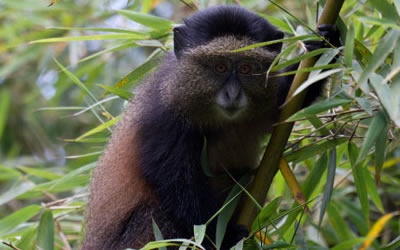
Travel Guide
Discover the best places for golden monkey tracking, including Volcanoes National Park, Mgahinga, and Virunga. Plan your East African adventure today!
Golden Monkey Tracking provides travelers with an opportunity to search for one of the most distinctive primates associated with the Albertine Rift and Virunga highlands. Their golden-orange coloring, quick movements and social behavior create a wildlife experience quite different from observing mountain gorillas.
Golden monkeys often move actively through vegetation while feeding.
This can make photography challenging but also gives the trek an energetic character.
Travelers planning a golden monkey experience should understand that availability, permit arrangements and access conditions depend on the individual destination.
Volcanoes National Park in Rwanda and Mgahinga Gorilla National Park in Uganda are among the established destinations associated with golden monkey tourism. The wider Virunga landscape also provides important habitat, although travelers considering the Democratic Republic of Congo should verify current official access and travel conditions before making plans.
Volcanoes National Park is one of the best-known destinations for Golden Monkey Tracking.
The park’s bamboo-rich mountain habitat supports these colorful primates.
Many travelers combine the activity with mountain gorilla trekking.
The two experiences are different enough to complement one another.
Gorilla encounters often involve slower observation, while golden monkeys can be highly active.
Visitors normally begin with a briefing before entering the forest with guides.
The difficulty of the activity varies according to where the monkeys are located and current trail conditions.
Travelers should prepare for mud and rain.
The mountain environment can change quickly even when the morning begins with clear weather.
Golden monkeys can move rapidly.
Photographers may need faster shutter speeds than they use for resting gorillas.
Forest light can still be limited, creating a technical challenge.
A camera capable of handling higher ISO settings is useful.
Visitors should avoid using prohibited techniques or interfering with monkey behavior simply to create photographs.
Travelers spending several nights around Volcanoes National Park can allocate different days to different primate experiences.
This is preferable to trying to schedule too many demanding activities within one day.
Gorilla trekking remains highly regulated and requires a specific permit.
Golden monkey arrangements should be confirmed separately.
Uganda’s Mgahinga Gorilla National Park is another important destination for Golden Monkey Tracking.
The park forms part of the Virunga mountain landscape and protects bamboo and other habitats used by golden monkeys.
Mgahinga can be particularly appealing to travelers interested in combining primates with volcano scenery and hiking.
Uganda is famous for mountain gorillas and chimpanzees, but golden monkeys add another dimension to its primate tourism.
Their appearance and behavior differ significantly.
Visitors who have already trekked gorillas may appreciate observing a smaller, faster-moving species.
The experience also introduces travelers to another part of Uganda’s southwestern mountain environment.
Where specialized golden monkey habituation experiences are officially offered, they differ from standard tracking.
Travelers should confirm the current activity, permit type and duration before booking.
The word “habituation” should not be used interchangeably with ordinary tracking.
Different experiences can have different regulations and visitor structures.
Golden monkeys are associated with the wider Virunga ecosystem, which crosses national boundaries.
This landscape includes protected areas in Rwanda, Uganda and the Democratic Republic of Congo.
Political borders do not correspond to ecological boundaries.
Conservation therefore benefits from regional thinking.
Travelers, however, must follow the entry, security and tourism regulations of whichever country they plan to visit.
Travel conditions in eastern Democratic Republic of Congo can change.
Anyone considering primate tourism there should consult current official travel guidance and confirm whether the intended protected area is open to visitors.
Historical availability does not guarantee current accessibility.
Security decisions should be based on up-to-date information rather than old travel reports.
Bamboo is an important feature of golden monkey habitat in parts of the Virunga region.
The monkeys feed on different available plant materials and other foods.
Their movement through dense vegetation can make sightings lively.
Visitors may hear activity before obtaining a clear view.
Patience and attention to guide instructions improve the experience.
Golden monkeys are social primates.
Watching several individuals move through vegetation reveals interactions that may be missed when visitors focus only on obtaining one close portrait.
Young animals can be particularly active.
A broader observation of the group provides more insight into how the monkeys use their habitat.
Strong walking shoes or hiking boots are recommended.
Long trousers and long sleeves provide protection from vegetation.
Rain gear should remain accessible.
Gloves may be useful in muddy or densely vegetated conditions.
A small backpack can carry water, camera equipment and other essentials.
The mountain forests associated with golden monkeys receive substantial rainfall.
Trails can become muddy.
Visitors should not allow rain to surprise them simply because they are traveling during a generally drier season.
Waterproof protection for electronics is useful throughout the year.
Golden monkey tracking can involve walking on uneven mountain terrain.
The exact difficulty varies.
Basic fitness improves comfort.
Travelers with mobility concerns should discuss them before booking so they can understand the likely demands and determine whether the activity is appropriate.
Guides do far more than locate primates.
They interpret behavior, identify plants and explain the forest environment.
They also ensure that visitors follow conservation rules.
Listening to a guide turns the trek into an educational experience rather than simply a search for photographs.
Golden monkeys are wild animals.
Visitors should not feed or touch them.
Follow distancing instructions.
Keep voices controlled and avoid sudden movements.
If masks or other health protocols are required, follow them.
Primate tourism must prioritize animal welfare.
A golden monkey trek can form part of a broader Uganda or Rwanda itinerary.
In Rwanda, travelers may continue to Lake Kivu or Akagera.
In Uganda, Mgahinga can be combined with Bwindi, Queen Elizabeth National Park or other southwestern destinations.
The itinerary should allow realistic transfer times.
Families should confirm the current minimum-age requirement for the specific golden monkey activity before booking.
Do not assume that rules are identical to gorilla trekking.
Activities involving primates can have separate regulations.
Families should also consider whether younger travelers are comfortable walking through wet mountain terrain.
Golden monkey tourism creates additional economic value around protecting mountain forests.
These forests also support numerous other species.
The monkeys therefore contribute to a broader conservation model in which wildlife tourism provides reasons to maintain habitat.
Visitor numbers still need responsible management so that tourism itself does not become a source of excessive disturbance.
The best Golden Monkey Tracking destination depends on the rest of the itinerary.
Travelers already trekking gorillas in Rwanda may find Volcanoes National Park the logical choice.
Those exploring southwestern Uganda may prefer Mgahinga.
Travel to the Democratic Republic of Congo requires particularly careful verification of current conditions and park operations.
The most important consideration is not collecting countries. It is choosing a destination where the activity can be experienced responsibly and safely.
Golden monkeys may receive less international attention than mountain gorillas, but their energetic behavior, distinctive coloring and mountain habitat make them one of the Virunga region’s most rewarding primate encounters.

Nshongi Gorilla Family in Bwindi: History, Location and Trekking Guide The Nshongi Gorilla Family holds an important place…
Read article →
Mishaya Gorilla Family in Bwindi: History, Trekking and What to Know The Mishaya Gorilla Family is one of…
Read article →
Semuliki Hot Springs Visit Guide: What to Expect Semuliki Hot Springs offers one of the most unusual natural…
Read article →
Kidepo Valley Remote Safari Guide: What to Expect Kidepo Valley National Park offers one of Uganda's most remote…
Read article →