

Nshongi Gorilla Family in Bwindi
Nshongi Gorilla Family in Bwindi: History, Location and Trekking Guide The Nshongi Gorilla Family holds an important place…
Read article →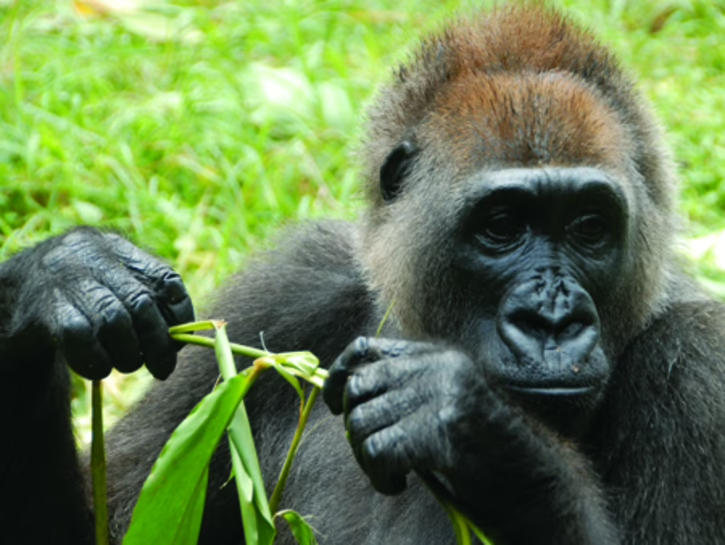
Travel Guide
Learn about Cross River gorillas, the rarest gorilla subspecies in Africa. Discover their habitat, behavior, population, and conservation efforts in Nigeria and Cameroon.
Cross River gorillas-rare gorilla specie are presented in the supplied source as some of Africa’s most elusive and threatened primates. Scientifically identified in the source as Gorilla gorilla diehli, Cross River gorillas survive in a relatively small mountainous region along the border between Nigeria and Cameroon.
The supplied material describes them as the world’s rarest gorilla subspecies and states that fewer than 300 individuals remain. Their limited population is spread across fragmented forest areas, creating major challenges for conservation, research, and long-term habitat protection.
Unlike primates living in areas frequently visited by tourists, Cross River gorillas are described as highly secretive and generally avoid human contact. This behavior, combined with rugged terrain and fragmented habitat, makes direct observation difficult.
Their story is therefore less about conventional gorilla tourism and more about conservation, habitat connectivity, community involvement, scientific monitoring, and the protection of remote forest landscapes.
The supplied source places Cross River gorillas within dense montane and lowland forests in the Cross River region of Nigeria and Cameroon.
These forests occupy rugged terrain.
Steep slopes, thick vegetation, and difficult access can make field monitoring challenging, but these same geographical characteristics can also provide some separation from heavily populated areas.
The gorillas depend on forests for feeding, movement, shelter, and reproduction.
Protecting those forests is therefore inseparable from protecting the animals themselves.
Cross River gorillas are associated with rugged forested terrain rather than the swampy and lowland environments described in the source for some western lowland gorillas.
Mountain landscapes create natural barriers.
Valleys, ridges, agricultural areas, settlements, and roads can influence how animals move between forest sections.
When suitable forest becomes isolated, gorilla groups may have fewer opportunities to move safely between habitats.
Habitat fragmentation is one of the central themes in the supplied material.
Rather than occupying one continuous protected forest, Cross River gorillas are described as living in separate forest patches.
The source states that they occur in at least 12 isolated forest patches across Nigeria and Cameroon.
Fragmentation complicates conservation because protecting one forest does not automatically provide safe movement between all populations.
A continuous forest provides wildlife with more options for finding food, moving between areas, and interacting with other groups.
When forest is divided into isolated sections, those movements become more difficult.
The supplied source links the small and fragmented population with increased vulnerability.
Conservation must therefore consider the wider landscape rather than focusing only on locations where gorillas are currently observed.
Cross River gorillas share the powerful appearance associated with gorillas generally.
The source describes them as having dark brown to black hair, broad chests, and pronounced brow ridges.
Adult males develop the silver coloration across the back associated with mature male gorillas.
The supplied material describes Cross River gorillas as slightly smaller and less robust than western lowland gorillas.
These differences can be subtle for a casual observer.
A mature male silverback can occupy an important leadership position within a gorilla group.
The source describes groups as usually containing a dominant male, females, and offspring.
The silverback’s role is therefore connected with group structure rather than appearance alone.
Understanding these relationships helps move discussion beyond the common image of a large male gorilla standing by himself.
According to the supplied source, Cross River gorillas live in groups of approximately 2 to 20 individuals.
These groups are described as tight-knit.
A typical group may include a dominant silverback, several females, and younger gorillas.
The exact composition can vary.
Because these gorillas are difficult to observe directly, the source emphasizes that behavioral research remains more limited than for gorilla populations that experience more regular human observation.
One of the defining characteristics emphasized in the source is their avoidance of people.
Cross River gorillas are described as highly elusive.
This can make conservation monitoring more complicated because researchers may need to rely on indirect signs as well as direct sightings.
Their secretive behavior should also be respected rather than viewed as a problem to overcome for tourism.
The supplied material describes the diet as primarily vegetarian.
Cross River gorillas consume fruits, leaves, seeds, and stems.
Availability of these foods can vary with habitat and season.
A healthy forest must therefore provide more than physical cover.
It needs sufficient botanical diversity to sustain gorillas throughout changing conditions.
Fruit can form an important part of the diet when available.
Fruit-producing trees therefore contribute directly to habitat quality.
Forest loss can reduce feeding options even when some tree cover remains.
This illustrates why conservation needs to consider the ecological quality of a forest, not simply the number of hectares containing trees.
Leaves, seeds, and stems provide additional food sources.
The ability to use several plant foods allows gorillas to respond to seasonal availability.
However, flexibility does not eliminate dependence on suitable habitat.
Extensive degradation can still reduce the quantity and diversity of available food.
The source identifies Cross River gorillas as critically endangered.
It connects this status with a very small population, fragmented habitat, poaching, and human pressure.
The conservation challenge is intensified because the gorillas occur across an international border.
Effective protection therefore requires cooperation between different authorities and communities.
Logging, agriculture, and human settlement are identified as major causes of habitat loss.
When forests are cleared or divided, gorillas lose feeding and movement areas.
The problem is not limited to complete forest destruction.
Even partial fragmentation can influence how safely animals move between areas.
Agricultural expansion can create conflict where farms approach wildlife habitat.
The supplied source mentions retaliatory killing connected with crop raiding.
This demonstrates why conservation cannot focus exclusively on animals.
Communities need practical strategies for living close to protected wildlife.
Logging can change forest structure and create access into previously remote areas.
The source identifies it as a contributor to habitat fragmentation.
Protecting important forest corridors can therefore become an essential component of gorilla conservation.
The supplied source lists poaching as another major threat.
It states that gorillas may be targeted for bushmeat or killed in retaliation for crop damage.
With such a small population, the loss of even a limited number of animals can have serious consequences.
Anti-poaching work is therefore particularly important.
A population of fewer than 300 individuals, as stated in the supplied source, creates additional vulnerability.
Small populations have less room to absorb losses.
Disease, habitat destruction, or direct killing can therefore have disproportionate effects.
The source also links low population numbers with potential genetic challenges.
Small wildlife populations can be particularly vulnerable when disease affects several individuals.
Although the supplied source does not provide detailed disease-management procedures, it identifies disease vulnerability as one consequence of low population numbers.
Reducing unnecessary human disturbance is therefore important.
The source identifies anti-poaching patrols as one conservation response.
Patrol teams can monitor forests, identify illegal activities, and support enforcement.
Their work can be difficult because Cross River gorilla habitat includes rugged and remote terrain.
Long-term conservation requires consistent protection rather than occasional intervention.
Habitat restoration is another conservation measure highlighted in the supplied material.
Restoring degraded forest can improve habitat quality and potentially strengthen connections between isolated areas.
This is a long-term process.
Trees and wider forest ecosystems require time to recover.
Because the gorillas occur in both Nigeria and Cameroon, cross-border collaboration is particularly important.
Wildlife does not recognize political boundaries.
A gorilla group moving through forest habitat may cross from one administrative area into another.
Conservation policies therefore need coordination across the wider ecosystem.
The source highlights community engagement as part of conservation progress.
People living around gorilla habitat interact most directly with the forests being protected.
Conservation strategies are more sustainable when local communities have meaningful roles and benefits.
Education, employment, sustainable livelihoods, and locally supported forest protection can all strengthen conservation relationships.
The supplied material includes eco-tourism initiatives among conservation approaches.
Given the gorillas’ elusive behavior and vulnerability, tourism needs to be carefully managed.
The conservation value lies in creating incentives for forest protection rather than forcing close encounters with animals that naturally avoid people.
The supplied source identifies organizations including the WWF, San Diego Zoo Wildlife Alliance, and local forest agencies as playing roles in safeguarding Cross River gorillas.
Their work is presented alongside local and governmental conservation efforts.
Protecting such a small and geographically fragmented population requires cooperation among multiple stakeholders.
Direct observation is challenging because the gorillas avoid humans and occupy difficult terrain.
Researchers cannot necessarily follow them as easily as habituated primates in established tourism destinations.
This means conservation knowledge may depend on patient monitoring and indirect evidence.
Their elusiveness makes every reliable piece of information valuable.
Travelers familiar with mountain gorilla trekking in Uganda or Rwanda may associate gorilla conservation with controlled tourist encounters.
Cross River gorillas represent a different situation.
The supplied source emphasizes their avoidance of people.
Their conservation should therefore be understood on its own terms rather than assuming every gorilla population should become a trekking attraction.
Protecting Cross River gorillas ultimately means protecting forests.
Food plants, movement routes, nesting areas, and social interactions all depend on functioning habitat.
A gorilla cannot be conserved separately from the landscape that supports it.
This is why habitat restoration and protection receive such emphasis in the source.
Cross River gorillas-rare gorilla specie survive within a limited and fragmented forest landscape along the Nigeria-Cameroon border. The supplied source describes fewer than 300 remaining individuals and identifies them as the rarest gorilla subspecies.
They occupy rugged montane and lowland forests, live in relatively small social groups, and feed mainly on fruits, leaves, seeds, and stems. Their secretive nature makes direct research difficult.
Habitat loss, agriculture, logging, poaching, retaliatory killing, small population size, and isolation are identified as major conservation concerns.
Anti-poaching patrols, habitat restoration, community engagement, ecotourism initiatives, and cross-border cooperation provide important responses.
The future of Cross River gorillas depends not on creating more human contact but on maintaining enough protected and connected forest for these elusive primates to continue living naturally across Nigeria and Cameroon.

Nshongi Gorilla Family in Bwindi: History, Location and Trekking Guide The Nshongi Gorilla Family holds an important place…
Read article →
Mishaya Gorilla Family in Bwindi: History, Trekking and What to Know The Mishaya Gorilla Family is one of…
Read article →
Semuliki Hot Springs Visit Guide: What to Expect Semuliki Hot Springs offers one of the most unusual natural…
Read article →
Kidepo Valley Remote Safari Guide: What to Expect Kidepo Valley National Park offers one of Uganda's most remote…
Read article →