

Nshongi Gorilla Family in Bwindi
Nshongi Gorilla Family in Bwindi: History, Location and Trekking Guide The Nshongi Gorilla Family holds an important place…
Read article →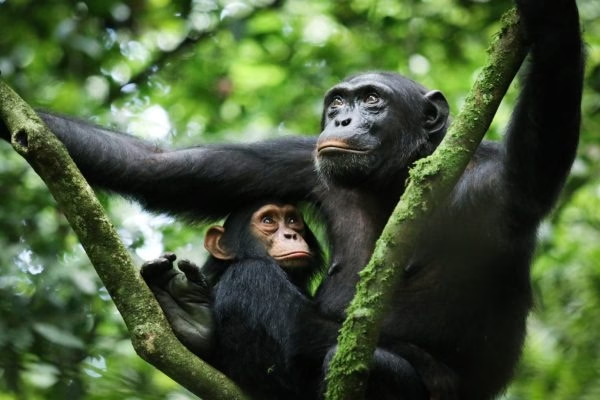
Travel Guide
Learn how long chimpanzee tracking takes in Rwanda’s Nyungwe Forest. Discover trek duration, what to expect, and how to plan this unforgettable primate experience.
Travelers asking how long is chimpanzee trekking in Rwanda are usually trying to determine how much of the day they should reserve for a Nyungwe Forest primate experience. The source frames the answer around trek duration, what visitors should expect, and how they can plan appropriately.
The most important planning principle is that chimpanzee tracking takes place in a natural forest environment. Chimpanzees move freely, and the time required to find them cannot be treated like the duration of a scheduled museum visit.
Travelers should therefore avoid building an itinerary that depends on finishing at one exact minute.
The supplied source asks how long is chimpanzee trekking but does not provide a fixed number of hours in the metadata.
For that reason, a precise duration should not be invented.
The length of the tracking experience can be influenced by the location and movement of the chimpanzees, the terrain, forest conditions, and the organization of the activity.
Travelers should confirm the current reporting time and operating arrangements for their actual trekking date.
What can be planned with confidence is the need for flexibility.
Visitors should reserve a meaningful portion of the day rather than arranging another time-sensitive activity immediately afterward.
Even when tracking goes smoothly, travelers still need to consider briefing, movement into the forest, the tracking itself, the regulated wildlife encounter, and the return.
Transport between accommodation and the relevant activity point also needs to be included in the day’s schedule.
This is why travelers should ask for the complete door-to-door timing rather than only the estimated walking duration.
Chimpanzee tracking is an active forest experience.
Visitors should expect to walk on natural terrain rather than a paved tourism route.
Conditions can vary with weather. Rain can make sections muddier or more slippery, while forest humidity can make physical activity feel more demanding.
Strong walking footwear is therefore important.
Long trousers and long sleeves can provide practical protection against vegetation.
A lightweight rain jacket should remain accessible even when the morning appears clear.
Travelers should carry a manageable daypack.
Water according to the activity arrangements, personal medication, and camera equipment are common priorities.
Unnecessary weight can make walking more tiring.
Reasonable physical preparation can improve the experience.
Visitors do not need to approach the activity as an athletic competition, but regular walking before the trip can help them feel more comfortable on uneven ground.
The pace should follow professional guidance.
Chimpanzees can move through the forest, and tracking may require visitors to respond accordingly.
Travelers should remain with the group and avoid moving independently in search of a better view.
Understanding how long is chimpanzee trekking also means thinking about the encounter itself.
Once chimpanzees are located, visitors must follow the current viewing and health rules communicated by the responsible guides.
Chimpanzees are wild primates.
They should never be touched or fed.
Visitors should control noise and avoid behavior that interferes with natural activity.
Health precautions deserve particular attention because humans are visiting the animals’ habitat.
Travelers who become unwell should communicate honestly with the safari operator or responsible authorities rather than assuming they can proceed normally.
Photography can be challenging in forest conditions.
Light levels may be lower than in open landscapes, vegetation can obstruct views, and chimpanzees may move quickly.
Visitors should prepare cameras before entering the forest.
Knowing how to adjust basic settings allows the traveler to respond without spending the entire encounter looking at menus and screens.
A phone can also produce meaningful photographs, but visitors should avoid moving closer simply because the device lacks the reach of a longer camera lens.
Wildlife rules remain more important than image quality.
Sometimes the best approach is to stop photographing for a few moments.
Listening to chimpanzee vocalizations and observing social behavior directly can create memories that photographs cannot fully reproduce.
Chimpanzee tracking should be integrated realistically into the wider Rwanda journey.
Travelers should avoid combining the activity with an excessively demanding transfer immediately afterward unless the logistics genuinely allow it.
An additional night can make the itinerary more comfortable.
Visitors who arrive the day before can rest, prepare equipment, and begin the tracking day without the stress of a long early-morning transfer.
After the activity, they can return to their accommodation, eat, rest, and review photographs rather than immediately packing for another destination.
This slower structure can be particularly useful for photographers and travelers who want to appreciate the forest beyond one primate encounter.
Families should confirm age requirements before planning the activity.
Accommodation suitability does not mean every guest automatically qualifies for chimpanzee tracking.
The current rules should be checked when permits and activities are arranged.
Travelers should also verify current permit arrangements, reporting procedures, and any equipment recommendations before departure.
The supplied source does not specify these operational details, and they may change.
The question how long is chimpanzee trekking therefore does not have a single guaranteed answer supported by the supplied metadata.
The activity takes place around wild chimpanzees in a dynamic forest environment, making flexibility essential.
Rather than planning around an exact finishing time, travelers should reserve enough of the day for briefing, forest tracking, the wildlife encounter, and the return.
Appropriate footwear, rain protection, physical preparation, responsible health behavior, and realistic scheduling all contribute to a better experience.
Nyungwe’s chimpanzees are the central attraction, but the forest itself is part of the journey.
Travelers who allow sufficient time can experience the activity without constantly checking the clock, making the encounter more relaxed, responsible, and memorable.

Nshongi Gorilla Family in Bwindi: History, Location and Trekking Guide The Nshongi Gorilla Family holds an important place…
Read article →
Mishaya Gorilla Family in Bwindi: History, Trekking and What to Know The Mishaya Gorilla Family is one of…
Read article →
Semuliki Hot Springs Visit Guide: What to Expect Semuliki Hot Springs offers one of the most unusual natural…
Read article →
Kidepo Valley Remote Safari Guide: What to Expect Kidepo Valley National Park offers one of Uganda's most remote…
Read article →