

Nshongi Gorilla Family in Bwindi
Nshongi Gorilla Family in Bwindi: History, Location and Trekking Guide The Nshongi Gorilla Family holds an important place…
Read article →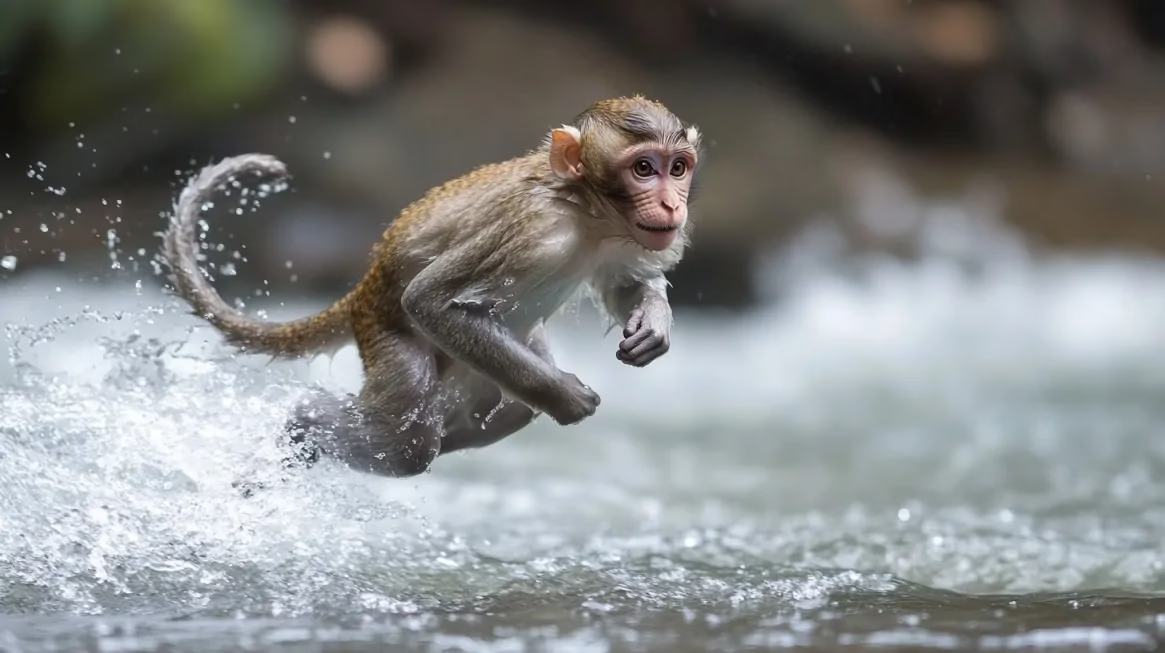
Travel Guide
Can monkeys swim? Learn which species swim well, why they enter water, and how their aquatic behavior differs across habitats.
The simple answer to can monkeys swim is yes for many species, but swimming behavior varies greatly across the monkey world. The supplied source explains that some monkeys are capable and confident swimmers, while others rarely enter deep water and do not display the same degree of aquatic adaptation.
This variation is important because the word “monkey” covers many species living in dramatically different environments.
A monkey inhabiting mangroves and river systems faces different ecological conditions from one spending most of its life high in a forest canopy. As a result, interaction with water can range from occasional wading to regular swimming and diving.
The source particularly highlights proboscis monkeys and long-tailed macaques as strong swimmers.
According to the supplied source, not all monkeys swim regularly.
Some species have little reason to enter deep water, while others live in habitats where rivers, mangroves, swamps, or coastal environments make aquatic movement useful.
Swimming ability should therefore be considered species by species rather than generalized across all monkeys.
The supplied source broadly describes New World monkeys, found in Central and South America, as generally less inclined to swim.
This does not mean that every individual or species is physically incapable of entering water.
Rather, the source emphasizes that regular swimming is not equally characteristic across monkey groups.
The source describes Old World monkeys from Africa and Asia as showing greater diversity in their relationship with water.
Some species live close to rivers or coastal habitats and have developed behaviors that include swimming, diving, or foraging around water.
This ecological diversity produces some of the most striking examples of aquatic behavior among primates.
The supplied material describes a swimming style resembling a dog paddle.
The monkey coordinates movements of the limbs to move through the water while generally keeping the head positioned for breathing.
The precise technique naturally varies according to species and circumstances.
Entering water does not always mean full swimming.
Some monkeys may simply wade through shallow areas.
Others may cross deeper channels where they need to paddle.
Distinguishing between these behaviors helps avoid exaggerated claims about how aquatic a species actually is.
The source notes that some water-adapted monkeys can dive.
Diving allows them to move below the surface temporarily, whether for travel, escape, or food-related behavior.
Species adapted to aquatic environments are naturally more comfortable doing this than monkeys that rarely encounter deep water.
The supplied source also mentions monkeys jumping from trees into water.
Such behavior demonstrates how water can become part of movement through an environment.
In habitats where trees overhang rivers or mangrove channels, land, canopy, and water can form one connected landscape.
The proboscis monkey, native to Borneo according to the source, is one of the strongest examples of a monkey adapted to water.
It is particularly associated with riverine and mangrove environments.
The supplied material describes the species as a strong swimmer capable of crossing rivers and channels.
The source refers to adaptations of the hands and feet that assist proboscis monkeys around water.
These features fit the species’ environment, where waterways can separate feeding areas and other parts of its habitat.
Swimming therefore serves a practical ecological purpose.
A river can represent either a barrier or a travel route.
For proboscis monkeys, swimming allows movement between habitat areas that would otherwise be separated.
This demonstrates how behavior can evolve in response to landscape.
The supplied source identifies the long-tailed macaque as another strong swimmer.
This species occurs in Southeast Asia and can inhabit areas close to rivers, mangroves, and coastlines.
Its relationship with water can include both movement and feeding.
According to the source, long-tailed macaques may forage for aquatic foods such as shellfish or crabs.
This behavior demonstrates that water can provide food as well as a route of travel.
A species comfortable around aquatic environments can exploit resources unavailable to monkeys that avoid water.
The Japanese macaque, often called the snow monkey, provides a different example.
The supplied source does not characterize it primarily as a swimming specialist.
Instead, it highlights the species’ well-known comfort with water through bathing behavior.
Japanese macaques are famous for using hot springs in cold conditions.
Bathing should not be confused with specialized swimming.
Nevertheless, the behavior demonstrates that some primates can develop a strong and repeated relationship with water.
The source identifies several possible reasons: escaping predators, finding food, crossing rivers, and cooling down.
These motivations demonstrate that swimming is generally functional.
Monkeys do not need to be aquatic animals for water to become useful within particular habitats.
Water may sometimes provide an escape route.
A monkey capable of swimming can cross a channel that may present a more difficult obstacle for a pursuing threat.
Whether this strategy is useful depends on the species and environment.
Foraging is another important motivation.
Where aquatic or shoreline resources are available, monkeys able to exploit them gain access to additional food.
Long-tailed macaques provide the clearest example in the supplied source.
Rivers can divide forests and feeding grounds.
Swimming allows certain monkeys to cross these barriers.
This can be important for accessing food, social groups, or safe resting areas.
The supplied source also identifies cooling as a possible reason monkeys enter water.
In hot climates, wading or swimming can provide relief.
Again, this behavior depends on the species and its familiarity with water.
The source makes an important distinction: most monkeys are not natural swimmers in the same sense as specialized aquatic animals.
Many can swim when necessary, but regular swimming may be learned, opportunistic, or associated with particular habitats.
Some species, however, are much more naturally comfortable in water.
The supplied source suggests that young monkeys in some species may learn aquatic behavior by observing adults.
This fits the wider importance of social learning among primates.
Young animals can acquire practical skills by watching experienced group members.
Swimming behavior illustrates the adaptability of monkeys.
Primates occupy forests, mountains, wetlands, mangroves, cities, and many other environments.
Behavior changes according to the challenges and opportunities presented by those habitats.
The supplied source also addresses monkeys kept around humans.
It states that some may learn to swim if raised around water but emphasizes risks such as panic and drowning.
The source therefore does not support assuming that any monkey placed in water will automatically swim safely.
Animals should never be forced into deep water merely to test whether they can swim.
Even a species with some swimming ability can become stressed or exhausted.
Observing natural behavior provides a far more meaningful understanding of aquatic ability.
Perhaps the most important lesson is that there is no single answer applicable to every monkey species.
The proboscis monkey’s relationship with water is very different from that of a monkey whose ecology is almost entirely arboreal.
Species, habitat, and individual experience all matter.
So, Can Monkeys Swim? The supplied source supports a qualified yes. Many monkeys possess the physical ability to swim, but the frequency, skill, and importance of swimming vary greatly among species.
Proboscis monkeys and long-tailed macaques provide strong examples of monkeys adapted to environments where swimming can be important. Japanese macaques demonstrate another form of comfort around water through bathing, while many other monkeys rarely enter deep water.
Monkeys may swim to cross rivers, escape danger, obtain food, or cool themselves.
Their varied relationship with water demonstrates the remarkable behavioral diversity of primates and shows how different species adapt to the environments in which they live.

Nshongi Gorilla Family in Bwindi: History, Location and Trekking Guide The Nshongi Gorilla Family holds an important place…
Read article →
Mishaya Gorilla Family in Bwindi: History, Trekking and What to Know The Mishaya Gorilla Family is one of…
Read article →
Semuliki Hot Springs Visit Guide: What to Expect Semuliki Hot Springs offers one of the most unusual natural…
Read article →
Kidepo Valley Remote Safari Guide: What to Expect Kidepo Valley National Park offers one of Uganda's most remote…
Read article →