

Nshongi Gorilla Family in Bwindi
Nshongi Gorilla Family in Bwindi: History, Location and Trekking Guide The Nshongi Gorilla Family holds an important place…
Read article →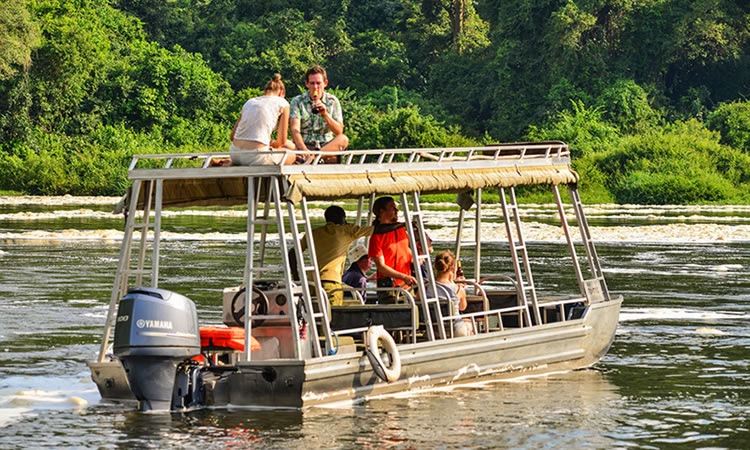
Travel Guide
Discover five reasons why you should visit Murchison Falls National Park. Experience incredible wildlife, boat safaris, waterfalls, and cultural encounters in Uganda’s top safari destination.
Travelers who Visit Murchison Falls National Park can combine a powerful waterfall, savannah wildlife, Nile boat journeys, birdwatching, forest environments, and cultural experiences within one destination. Located in northwestern Uganda, the park is presented in the supplied source as Uganda’s largest national park and one of the country’s most spectacular wildlife areas.
The park’s identity is closely connected with the Nile.
The river moves through the protected landscape, supports wildlife along its banks, and eventually forces its way through the narrow gorge that creates Murchison Falls.
Yet the waterfall is only one reason to visit.
Game drives across the savannah reveal large mammals, boat trips provide a water-level perspective, and the wider region offers birding and cultural experiences.
These five reasons explain why the destination can support a varied Uganda safari rather than a single sightseeing stop.
The first reason to Visit Murchison Falls National Park is the natural feature from which the park takes its name.
The supplied source describes the Nile squeezing through a gorge approximately 7 meters wide before plunging about 43 meters.
The narrowing of such a major river into a confined rocky channel creates the dramatic force associated with the falls.
Visitors experience not only the sight of the water but also its sound and movement.
One way to experience Murchison Falls is from a boat approaching along the Nile.
The perspective gradually changes as the boat moves upstream.
Wildlife along the banks provides interest during the journey, while the waterfall becomes the destination toward the end of the cruise.
Seeing the river before it reaches the narrow gorge helps visitors understand the scale of the transformation.
A broad waterway is suddenly forced through a dramatically restricted channel.
The supplied source also refers to viewing the falls from the top.
This perspective emphasizes the constriction of the river and the force of the water.
The experience differs considerably from seeing the falls from downstream.
Rather than looking toward the falling water from a distance, visitors can appreciate how the river approaches and enters the narrow gorge.
Including both perspectives can create a more complete understanding of the waterfall.
Many national parks are known primarily for particular wildlife species.
Murchison combines major wildlife viewing with an exceptional physical landscape.
The waterfall gives the destination an identity that is immediately recognizable.
Even travelers who have visited several African savannah parks may find that the Nile and falls make Murchison feel different.
The river influences wildlife, scenery, activities, and the movement of visitors through the park.
The second reason highlighted by the source is wildlife.
It states that Murchison Falls National Park hosts more than 76 mammal species.
Elephants, lions, giraffes, buffaloes, and leopards are among the animals specifically mentioned.
Uganda kobs and oribis are also identified grazing across the plains.
For travelers seeking a conventional East African game drive, the park therefore provides a broad range of safari possibilities.
Game drives allow visitors to cover large areas of the park.
The supplied source particularly highlights the Buligi sector in the north for wildlife viewing.
A guided safari vehicle can explore open plains, tracks, and other habitats while searching for animals.
Experienced guides help identify wildlife and interpret behavior.
They can also notice tracks, calls, and movements that visitors may overlook.
Large herbivores create some of the most memorable Murchison safari scenes.
Elephants may appear alone or in groups, while giraffes stand conspicuously above surrounding vegetation.
Their size makes them attractive photographic subjects, but observation becomes more interesting when visitors pay attention to behavior.
Feeding, movement, interactions, and responses to the environment all reveal more than a simple portrait.
The source includes lions and leopards among the park’s predators.
These animals can be more difficult to locate than large herbivores.
Patience is therefore important.
Predators may rest for long periods or remain partly hidden by vegetation.
An experienced guide can improve the chances of finding wildlife, but natural sightings should never be treated as guaranteed.
Uganda kobs and oribis are among the antelopes mentioned in the supplied material.
They contribute to the wider savannah ecosystem and should not be overlooked while searching for larger animals.
Watching herbivores can also reveal predator-prey relationships and social behavior.
A rewarding safari pays attention to the complete landscape rather than only the largest species.
The third reason to visit is the Nile boat safari.
This activity provides a completely different perspective from a game drive.
Instead of moving across savannah tracks, visitors travel along the river while observing wildlife using the banks and water.
The source identifies hippos, crocodiles, elephants, buffaloes, and numerous birds among the animals associated with this experience.
Hippos are strongly associated with the river environment.
A boat safari allows visitors to observe them in the habitat where they spend much of their time.
Their behavior should be viewed from an appropriate distance under the direction of the boat crew.
Wild animals can be unpredictable, and responsible tourism prioritizes safety and minimal disturbance.
The supplied source also mentions crocodiles.
They may be observed around suitable sections of the river and banks.
Their presence reinforces the importance of the Nile as a complete ecosystem rather than simply a scenic waterway.
Visitors traveling by boat can see how aquatic and terrestrial wildlife use the same landscape differently.
Elephants and buffaloes may gather near the riverbanks according to the source.
Such encounters can produce excellent photography because animals are viewed against water rather than only dry savannah.
The river also creates a natural gathering point.
During a boat trip, guests can watch for movement along both banks instead of concentrating solely on the water itself.
The source describes the cruise as approaching the base of Murchison Falls.
This gives the journey a natural climax.
The landscape and wildlife encountered along the way build toward the increasingly dramatic river scenery.
For many travelers, the combination of wildlife observation and the waterfall makes the boat safari one of the defining Murchison experiences.
A more relaxed sunset cruise is also mentioned in the supplied material.
Late-afternoon light can transform the appearance of the river.
A sunset outing may focus less on reaching a particular destination and more on scenery, wildlife, and atmosphere.
For travelers spending several nights in the park, combining different boat experiences can provide useful variety.
Birdlife is the fourth major reason highlighted in the source.
The supplied material states that Murchison Falls National Park supports more than 450 bird species.
The variety is connected with the park’s different habitats, including riverbanks, savannahs, and forests.
Birdwatchers can therefore encounter very different species without leaving the wider destination.
The shoebill is among the notable birds mentioned in the source.
Its unusual appearance makes it particularly sought after by birders and photographers.
As with all wildlife, sightings are not guaranteed.
Searching for specialized species often requires patience and appropriate habitat.
The process of looking can reveal many other birds that might otherwise be overlooked.
The African fish eagle is another species listed in the supplied material.
Its association with rivers and lakes makes the Nile an appropriate environment in which to look for it.
The bird’s distinctive form and behavior make it a rewarding subject for observation.
Binoculars are particularly valuable during boat safaris because birds may perch some distance from the vessel.
The source also mentions the Goliath heron, saddle-billed stork, and malachite kingfisher.
These species demonstrate the range of bird sizes and ecological roles found around the park.
A visitor does not need to be an expert birder to appreciate the diversity.
A knowledgeable guide can help identify species and explain their behavior.
The supplied source highlights the Nile and Budongo Forest as particularly useful birding areas.
The contrast between river and forest habitats increases the range of species that can be encountered.
Travelers with a strong birding interest should allocate sufficient time rather than trying to combine serious birdwatching with a rushed general safari.
The fifth reason in the source extends beyond wildlife.
Murchison Falls and its surrounding region have cultural and historical dimensions that can broaden a safari.
The supplied material mentions the Bomu Women’s Group, Budongo Forest, and historical connections with early explorers.
These experiences add human and historical context to the journey.
The source describes the Bomu Women’s Group as providing insights into local traditions, dance, and crafts.
Community experiences can help visitors understand life around a conservation area.
They should be approached respectfully.
The goal should be genuine learning and exchange rather than treating people as another attraction on a safari checklist.
Budongo Forest lies on the southern edge of the park within the source’s framing.
It is described as containing ancient mahogany trees and chimpanzees.
The forest provides a dramatic ecological contrast with the open savannah.
Travelers can therefore experience different habitats within the broader Murchison region.
The supplied material refers to early explorers, including Sir Samuel Baker, in relation to the region.
These historical references add another layer to the landscape.
Visitors interested in history can learn how outside exploration and documentation became associated with the falls.
Historical interpretation is most useful when understood alongside the much longer local human history of the area.
The strongest Murchison itinerary does not necessarily treat each attraction independently.
A morning game drive can reveal savannah wildlife.
A boat cruise later can show hippos, crocodiles, birds, and animals approaching the river.
Another period can focus on the waterfall itself, while cultural or forest experiences broaden the trip further.
This variety is one of the destination’s major strengths.
Trying to experience the entire park in a rushed visit can reduce the quality of the safari.
Wildlife observation benefits from patience.
Boat activities operate on their own schedules, while reaching different parts of the park takes time.
Multiple nights allow travelers to experience different environments without spending every hour moving between activities.
Photographers have a wide range of subjects.
The falls provide dramatic landscape imagery.
Savannah game drives offer large mammals and predators.
The Nile creates opportunities for wildlife reflections and water-based scenes.
Birdlife adds another layer.
The key is to allow enough time for natural behavior rather than expecting every subject to appear immediately.
The supplied source presents Murchison as suitable for travelers using different budgets and safari styles.
Its attraction does not depend entirely on one form of accommodation or activity.
Nature lovers may focus on wildlife and birds.
Adventure-oriented visitors may be drawn toward the waterfall and varied landscapes.
Photographers can combine scenery with animal behavior.
This versatility helps explain the park’s broad appeal.
There are several compelling reasons to Visit Murchison Falls National Park within the supplied source.
The Nile creates the park’s dramatic centerpiece as it passes through a seven-meter gorge and drops approximately 43 meters. Savannah areas support elephants, lions, giraffes, buffaloes, leopards, antelopes, and other wildlife. Boat safaris reveal hippos, crocodiles, birds, and animals along the riverbanks.
More than 450 bird species are identified in the source, while cultural and forest experiences add depth beyond conventional game viewing.
The real strength of Murchison is the way these experiences fit together. A visitor does not need to choose between waterfalls, wildlife, rivers, birds, forests, and culture. With enough time and thoughtful planning, they can become different chapters of the same Uganda safari.

Nshongi Gorilla Family in Bwindi: History, Location and Trekking Guide The Nshongi Gorilla Family holds an important place…
Read article →
Mishaya Gorilla Family in Bwindi: History, Trekking and What to Know The Mishaya Gorilla Family is one of…
Read article →
Semuliki Hot Springs Visit Guide: What to Expect Semuliki Hot Springs offers one of the most unusual natural…
Read article →
Kidepo Valley Remote Safari Guide: What to Expect Kidepo Valley National Park offers one of Uganda's most remote…
Read article →