

Nshongi Gorilla Family in Bwindi
Nshongi Gorilla Family in Bwindi: History, Location and Trekking Guide The Nshongi Gorilla Family holds an important place…
Read article →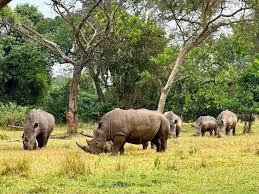
Travel Guide
This 2-day safari offers a short but unforgettable experience in Murchison Falls National Park, Uganda’s largest and most iconic park.
A 2-day Murchison Falls tour provides a compact introduction to one of Uganda’s major wildlife landscapes. The supplied itinerary combines a road journey north, rhino tracking at Ziwa Rhino Sanctuary, a visit to the top of Murchison Falls, a morning game drive, and a Nile boat cruise before returning to Kampala or Entebbe.
Because the safari lasts only two days, the schedule is naturally active.
Travelers should expect early starts and substantial movement between activities. The advantage is that a short itinerary still introduces several very different experiences.
Rhinos are encountered during a guided activity at Ziwa. Savannah wildlife becomes the focus during the game drive. The Nile then introduces hippos, crocodiles, birds, and views toward the waterfall.
The result is a concentrated safari designed for travelers who have limited time but still want more than a single wildlife activity.
The first day begins early after breakfast, when travelers meet their guide and driver.
The route heads north toward the Murchison Falls region.
Leaving early is important because the day contains several activities before reaching the overnight lodge.
The road journey also introduces visitors to landscapes outside Kampala or Entebbe.
Settlements, farmland, and changing vegetation become part of the experience as the safari moves toward northern Uganda.
The supplied itinerary includes a stop at Ziwa Rhino Sanctuary for rhino tracking.
The source explains that rhinos were reintroduced after Uganda’s earlier population had been eliminated by poaching.
This gives the activity a conservation context in addition to its wildlife appeal.
Tracking takes place under professional guidance.
Visitors should follow all instructions carefully because rhinos remain large wild animals even within a managed conservation environment.
Approaching a wildlife experience on foot creates a very different atmosphere from viewing animals through a vehicle.
Travelers become more aware of distance, sound, wind, vegetation, and ranger instructions.
The objective is not to approach as closely as possible.
A successful rhino encounter depends on maintaining appropriate space and observing the animals without causing unnecessary disturbance.
Professional guides determine how the group moves and where visitors can safely stand.
The supplied source notes that the rhino activity may also provide opportunities for birding and seeing primates.
This means visitors should remain observant even when rhinos are the primary objective.
Smaller wildlife often receives less attention during a short safari because travelers focus on famous species.
Taking time to notice birds and other animals creates a richer understanding of the habitat.
After the sanctuary experience, the itinerary continues toward Masindi, where the source includes a lunch stop.
This break is useful after the morning drive and tracking activity.
A short safari can become tiring when every hour is filled with movement, so meal stops also provide necessary rest.
After lunch, travelers continue toward Murchison Falls National Park.
Arrival at the park marks another change in the journey.
The landscape becomes increasingly associated with protected wildlife habitat and the Nile.
The supplied source describes Murchison Falls as a major Ugandan park with elephants, buffaloes, hippos, crocodiles, and extensive birdlife among its wildlife interests.
The first day’s principal park attraction is the top of the falls.
The supplied itinerary takes visitors to the top of Murchison Falls, where the Nile is forced through a narrow gorge before dropping dramatically.
The source describes a plunge of approximately 40 meters.
The exact visual impact is difficult to communicate through measurements alone.
Water that appears broad and relatively calm elsewhere becomes compressed, turbulent, loud, and powerful.
Visitors experience spray, sound, and continuous movement.
Murchison Falls is not simply a scenic viewpoint added to a wildlife safari.
The waterfall demonstrates the relationship between geology and the Nile.
The river’s character changes as it is forced into a restricted channel.
Standing near the top allows travelers to appreciate this transformation directly.
Photography can record the scene, but the sound and physical force of the water are major parts of the experience that photographs cannot reproduce fully.
The supplied source provides several accommodation examples.
Luxury options include Paraa Safari Lodge and Nile Safari Lodge. Mid-range examples include Pakuba Safari Lodge and Fort Murchison, while budget examples include Red Chilli Rest Camp and Murchison River Lodge.
These properties are examples within the supplied itinerary rather than mandatory choices.
Travelers should select accommodation according to budget, availability, and convenience for the next morning’s game drive.
The second day begins before dawn according to the supplied itinerary.
Guests should therefore prepare camera equipment, clothing, binoculars, and other essentials before going to sleep.
A morning game drive can provide some of the most rewarding wildlife viewing of the safari.
Being ready to leave on time ensures that the limited two-day itinerary is used efficiently.
Day two begins with a game drive across the park’s savannah.
The supplied source identifies elephants, lions, hyenas, giraffes, Uganda kobs, buffaloes, and warthogs among animals visitors may encounter.
It also mentions the possibility of species such as bushbucks, leopards, and sitatungas.
Wildlife sightings remain unpredictable.
The list should therefore be understood as animals associated with the broader experience rather than a guarantee that every species will appear during one drive.
Large mammals such as elephants and giraffes can provide memorable sightings against the open landscape.
Visitors should avoid rushing from one animal to another simply to increase the number of species recorded.
Watching behavior can be more rewarding.
An elephant herd interacting or a giraffe feeding quietly may provide a stronger experience than a brief glimpse obtained while constantly moving.
Uganda kobs and buffaloes contribute significantly to the savannah wildlife community.
Antelopes can reveal changes in alertness when predators are nearby, while buffaloes may appear alone or in groups.
These herbivores are not simply background animals.
They form an essential part of the ecological relationships that make predator sightings possible.
Predators are often among the most desired sightings.
The supplied source lists lions and leopards among possible wildlife encounters.
Finding them requires patience.
A lion may be hidden in grass or resting, while a leopard’s coloration and behavior can make it difficult to detect.
Experienced guides improve the search by understanding habitat and animal behavior.
Even so, sightings cannot be guaranteed.
After the morning game drive, the itinerary returns to the lodge for lunch.
This break creates a transition between the savannah experience and the afternoon river activity.
Travelers can rest, prepare camera equipment, and change what they carry before boarding the boat.
The safari then moves from land-based wildlife viewing to the Nile.
The supplied source includes a boat cruise along the Nile as one of the defining experiences of the second day.
The river provides habitat for animals and birds that may not be observed in the same way during a game drive.
Traveling by boat also creates a slower wildlife-viewing rhythm.
Instead of scanning a broad savannah, visitors concentrate on the water, shoreline, vegetation, and animals using the river.
Hippos are among the major animals highlighted by the source.
They spend substantial periods in water and may be encountered in groups.
Visitors should observe them only from an appropriate distance under the direction of the boat crew.
Despite their often calm appearance in water, hippos are powerful wild animals.
Responsible viewing requires respecting their space.
The source also identifies crocodiles as a common focus during the cruise.
They may be seen on banks or partly submerged.
Their stillness and camouflage can make them difficult to notice initially.
Guides can help visitors identify animals that blend into the surrounding environment.
Crocodiles add another predator to the safari, but this time within the river ecosystem rather than the savannah.
The supplied itinerary highlights kingfishers, cormorants, goliath herons, and the shoebill stork among birding interests.
A specific species such as the shoebill should not be treated as guaranteed.
The wider value of the cruise lies in the diversity of river-associated birds.
Binoculars can help travelers observe birds perched or feeding at a distance.
The slower movement of the boat can also provide useful photography opportunities.
The cruise continues toward the area near the base of Murchison Falls.
The source refers to the Devil’s Cauldron and emphasizes the photography opportunities created by the dramatic landscape.
This viewpoint complements the previous day’s experience at the top.
Visitors now approach the waterfall from the river rather than standing above it.
Seeing both perspectives helps communicate the scale of the Nile and the gorge.
The boat provides opportunities to photograph hippos, crocodiles, birds, riverbanks, and the waterfall.
Travelers should keep equipment manageable because wildlife can appear on either side of the boat.
Constantly changing lenses may mean missing brief moments.
It is often more effective to prepare suitable equipment before departure and concentrate on observation.
Passengers should also avoid blocking other travelers’ views.
After the boat cruise, the supplied itinerary begins the return journey toward Kampala or Entebbe, with arrival expected in the evening.
This creates a long final day.
Travelers should therefore recognize that the two-day format prioritizes efficiency over a relaxed pace.
Those with more time may prefer a longer Murchison Falls itinerary, but the two-day journey remains useful for visitors working within a restricted schedule.
The supplied source lists transportation in a 4×4 safari vehicle, an English-speaking guide, park entry fees, rhino tracking at Ziwa, the top-of-the-falls visit, the Nile boat cruise, game drives, accommodation, meals according to the itinerary, and bottled drinking water among the inclusions.
Travelers should confirm their final booking details because individual packages may vary.
Written confirmation helps prevent misunderstandings about what has actually been paid for.
The source identifies international flights, visa fees, travel insurance, personal expenses such as tips, drinks and laundry, and optional activities not listed in the itinerary as exclusions.
Understanding exclusions is as important as understanding inclusions.
Travelers can then budget properly before arrival rather than discovering additional costs during the safari.
A 2-day Murchison Falls tour is best suited to travelers whose time is limited but who still want a varied introduction to Uganda’s wildlife.
The itinerary is active rather than leisurely.
Within two days it combines rhino tracking, waterfall scenery, savannah game viewing, and a Nile cruise.
Travelers wanting slower game drives and more relaxation should consider spending additional time in the park.
Those comfortable with an intensive schedule can experience a surprising amount within the two-day format.
The 2 Days Murchison Falls Safari compresses several distinctive Uganda experiences into a short journey.
Day one combines the drive north, rhino tracking at Ziwa, lunch in Masindi, and the powerful view from the top of Murchison Falls. Day two begins with a savannah game drive before shifting to the Nile for hippos, crocodiles, birdlife, and views toward the base of the falls.
The itinerary is demanding because of its short duration, but it also provides exceptional variety.
For travelers with limited time who want to experience several different aspects of Uganda’s wildlife and landscapes, this compact Murchison Falls journey offers a focused introduction to the country’s northern safari circuit.

Nshongi Gorilla Family in Bwindi: History, Location and Trekking Guide The Nshongi Gorilla Family holds an important place…
Read article →
Mishaya Gorilla Family in Bwindi: History, Trekking and What to Know The Mishaya Gorilla Family is one of…
Read article →
Semuliki Hot Springs Visit Guide: What to Expect Semuliki Hot Springs offers one of the most unusual natural…
Read article →
Kidepo Valley Remote Safari Guide: What to Expect Kidepo Valley National Park offers one of Uganda's most remote…
Read article →