

Nshongi Gorilla Family in Bwindi
Nshongi Gorilla Family in Bwindi: History, Location and Trekking Guide The Nshongi Gorilla Family holds an important place…
Read article →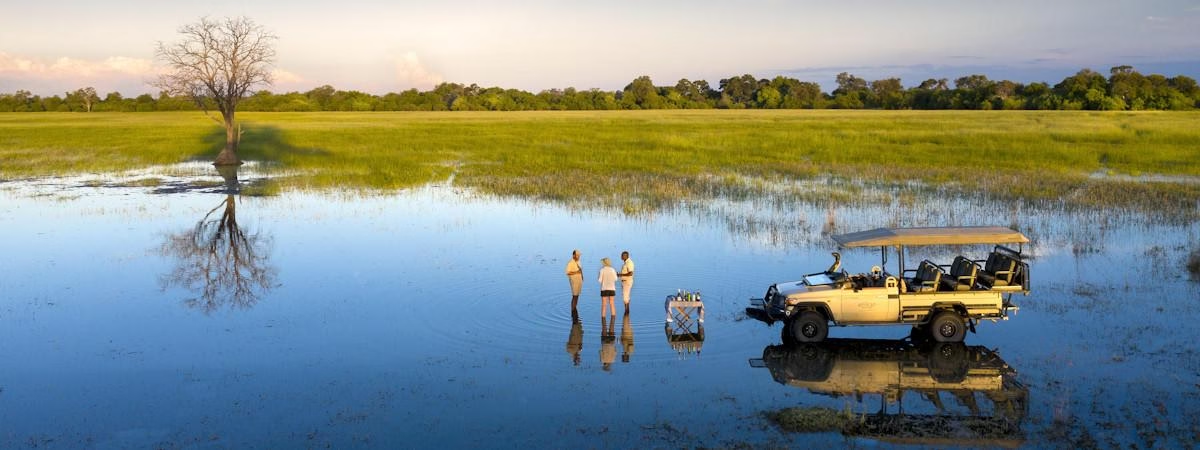
Travel Guide
Discover 10 fascinating facts about Botswana’s Okavango Delta, one of the world’s most unique inland deltas and a UNESCO World Heritage Site.
The Okavango Delta in Botswana is one of Africa’s most distinctive natural landscapes. Water flowing from distant highlands spreads across an inland basin rather than continuing to the sea, creating channels, lagoons, islands, floodplains, and wildlife habitats within an otherwise dry region. The result is a safari destination where the character of the landscape changes with the arrival and retreat of seasonal water.
The supplied source highlights ten Okavango Delta Facts that explain why the region attracts wildlife enthusiasts, photographers, birdwatchers, and travelers interested in wilderness.
Its unusual hydrology is only part of the story. The delta supports large mammals, hundreds of bird species, rare animals, and several styles of safari, including game drives, boat trips, and traditional mokoro excursions.
Understanding these characteristics makes it easier to appreciate why the Okavango is much more than an ordinary wetland.
One of the most important Okavango Delta Facts is that its water does not flow onward into an ocean or sea.
The supplied source describes the Okavango as the world’s largest inland delta. Instead of reaching a coastline, the river spreads into the Kalahari landscape.
Water divides into a complicated network of channels and lagoons, surrounding islands and creating extensive wetland habitats.
This unusual relationship between water and dry land gives the Okavango its distinctive appearance.
The contrast between the delta and the wider Kalahari environment is central to its ecological importance.
Water arriving in a comparatively dry region transforms the landscape.
Channels support aquatic life, floodplains provide feeding areas, and islands create different vegetation zones.
The delta is therefore not one uniform habitat.
A safari may move between open water, reed-lined channels, woodland, islands, and seasonally flooded plains.
Each environment can support a different combination of wildlife.
The second remarkable fact described by the source concerns the timing of the flood.
The supplied material states that the Okavango Delta floods between May and September.
The water, however, originates from rainfall in Angola months earlier.
This delay creates one of the delta’s most interesting natural patterns.
Water arrives in Botswana when the surrounding region is moving through its dry season, producing an expanding oasis at a time when water becomes increasingly valuable to wildlife.
The delta’s seasonal transformation cannot be understood by looking only at local rainfall.
Water has already traveled a long distance before spreading across Botswana.
The delayed arrival means that conditions upstream influence what visitors eventually experience in the delta.
As water advances, previously dry areas may become channels or shallow floodplains.
Wildlife responds to these changes by moving toward suitable feeding and drinking areas.
The seasonal flood means that the Okavango does not look exactly the same throughout the year.
Routes accessible by vehicle at one stage may become surrounded by water at another.
Water-based activities become particularly important as channels fill.
This variation is one reason repeat visitors can experience the delta differently on separate journeys.
The landscape itself is dynamic.
The supplied source states that during peak flooding the delta hosts more than 200,000 large mammals.
It specifically mentions elephants, lions, buffaloes, hippos, and leopards.
The seasonal availability of water creates an important refuge as surrounding areas become drier.
For safari visitors, this concentration of wildlife is one of the principal attractions.
However, animals remain free-ranging, so sightings vary according to location, water levels, time of day, and natural movement.
Elephants are particularly well suited to the delta’s combination of water, woodland, and open areas.
A safari may reveal them moving between islands, feeding near vegetation, or approaching water.
Their size makes them impressive anywhere, but observing elephants against the wetland environment gives the encounter a distinctive character.
Photographers can use reflections, channels, and open floodplains to create images very different from those produced in dry savannah settings.
Hippos are another major component of the wetland environment highlighted in the source.
Channels and lagoons provide suitable aquatic habitat.
Travelers exploring by boat or mokoro should always follow the instructions of experienced guides because wildlife encounters on water require appropriate knowledge and distance.
The objective is observation without interfering with natural behavior.
The source describes the Okavango Delta as one of the safari destinations associated with opportunities to see the Big Five: lion, leopard, elephant, buffalo, and rhino.
It specifically identifies Moremi Game Reserve within the wider delta landscape as an important wildlife-viewing area.
For travelers, the significance of this is not simply completing a checklist.
The delta’s real appeal comes from seeing wildlife within a complex ecosystem shaped by seasonal water.
Moremi is highlighted in the supplied material for game viewing.
The combination of dry and wet habitats supports varied wildlife experiences.
Game drives can complement water-based exploration, giving visitors access to areas and species that may be difficult to observe from a boat.
A well-designed Okavango safari often benefits from using more than one form of transport.
Focusing only on the Big Five can cause visitors to overlook much of what makes the delta extraordinary.
Antelopes, smaller mammals, reptiles, birds, and aquatic species all contribute to the ecosystem.
The changing relationship between land and water is itself worth observing.
Travelers who broaden their attention generally gain a deeper appreciation of the destination.
The fifth of the supplied Okavango Delta Facts concerns birdlife.
The source describes the delta as supporting more than 400 bird species.
It mentions the African fish eagle, Pel’s fishing owl, malachite kingfisher, and wattled crane among notable examples.
The combination of water, reeds, woodland, grassland, and islands creates habitats for a wide variety of birds.
A mokoro or boat can provide an excellent perspective for birdwatching.
Moving quietly through channels allows visitors to observe species associated with water and vegetation along the banks.
Binoculars are extremely useful.
Photographers may also appreciate the lower perspective from a watercraft, although equipment should be protected carefully from splashes and moisture.
Birding in the delta is not only visual.
Calls can reveal species hidden in reeds or trees.
An experienced guide may identify birds long before visitors see them.
Taking time to stop and listen adds another dimension to the safari.
This slower pace is particularly compatible with mokoro exploration.
The supplied source highlights the mokoro as one of the characteristic ways to explore the Okavango.
These traditional dugout-style canoes allow travelers to move quietly through shallow waterways.
Unlike a vehicle safari, a mokoro excursion places visitors close to the water’s surface.
Reeds rise on either side, birds move through the channels, and the pace becomes deliberately slow.
The relative quiet of a mokoro changes how the landscape is experienced.
There is no engine dominating the soundscape.
Visitors can hear water, birds, insects, and movement in surrounding vegetation.
The activity is less about covering large distances and more about experiencing detail.
It provides a useful contrast with faster game drives.
The source refers to hippos, crocodiles, and waterbirds in relation to water-based exploration.
Such animals must be treated with appropriate distance and caution.
Professional local guidance is essential.
The value of the experience lies in entering the wetland respectfully rather than trying to approach wildlife as closely as possible.
The supplied source states that the Okavango Delta expands to more than 15,000 square kilometers during peak flooding.
Its exact size changes with seasonal water levels.
This enormous scale is difficult to appreciate from a single viewpoint.
Even a multi-day safari explores only a portion of the wider system.
The size helps explain why different parts of the delta can offer different experiences.
As floodwaters spread, they change access and habitat.
Some areas become more suitable for boating, while others retain enough dry ground for vehicle-based exploration.
Wildlife distribution can shift accordingly.
This means that planning an Okavango safari should consider both location and season.
A camp that provides one style of experience at a particular water level may offer something different later.
The eighth fact in the source concerns the river itself.
It states that the Okavango River travels more than 1,600 kilometers.
The river begins in Angola, passes through the region identified in the source as Namibia’s Caprivi Strip, and eventually reaches Botswana.
Instead of continuing to an ocean, the water spreads into the inland delta.
This long journey connects landscapes across several countries.
The water experienced by a visitor in Botswana has therefore traveled through a much larger regional system.
This demonstrates why wetlands cannot always be understood solely within political borders.
Conditions upstream influence ecosystems downstream.
The delta is the final expression of a river journey beginning far to the northwest.
The supplied source states that UNESCO recognized the Okavango Delta as a World Heritage Site in 2014.
It connects this recognition with the delta’s ecological importance, wildlife diversity, and relatively pristine landscapes.
World Heritage status emphasizes that the significance of the delta extends beyond its role as a tourism destination.
It is an ecosystem of international conservation importance.
Safari tourism can create economic reasons to maintain wildlife habitats, but visitor activity also needs to be managed responsibly.
Travelers should follow guidance concerning wildlife distances, waste, noise, and movement.
A wilderness destination remains attractive precisely because its ecological character has been preserved.
Responsible tourism therefore supports the qualities that bring visitors to the delta in the first place.
The final fact highlighted in the source is the Okavango’s role as a stronghold for uncommon and threatened wildlife.
The supplied material specifically mentions African wild dogs, sitatungas, and wattled cranes.
Each depends on particular ecological conditions.
The delta’s remoteness and conservation efforts are presented in the source as important factors supporting these species.
African wild dogs are among the predators associated with the delta.
Their social behavior and active hunting style can make sightings memorable.
However, visitors should never expect a guaranteed encounter.
Wild dogs move across large areas, and finding them can require patience.
A sighting becomes particularly rewarding because it occurs within the natural movement of the animals.
The source describes sitatunga as a rare swamp-dwelling antelope.
Its association with wetland habitat demonstrates how the Okavango supports animals adapted to environments very different from open savannah.
Observing specialized species helps visitors understand that the delta’s biodiversity is closely tied to its water system.
The supplied material recommends mokoro trips, boats, and 4×4 game drives.
Each reveals something different.
Vehicles cover greater distances across accessible land.
Boats navigate deeper waterways.
Mokoros provide a quieter, more intimate experience in suitable channels.
Combining these methods can create a more complete understanding of the delta.
The interaction between wildlife, water, vegetation, and changing light makes the delta particularly attractive for photographers.
Reflections can add depth to wildlife images.
Birds provide constant subjects, while landscapes can be photographed from boats, vehicles, and camps.
Patience remains essential.
The best photographs often result from waiting for natural behavior rather than rushing from one sighting to another.
The seasonal nature of the delta should shape planning.
Travelers interested particularly in extensive waterways may focus on periods associated with higher flood levels in the supplied source.
Others may prioritize mixed game-drive and water experiences.
The ideal itinerary depends on interests, available time, and the particular area being visited.
These ten Okavango Delta Facts reveal why Botswana’s famous wetland offers such an unusual safari experience.
It is an inland delta where water disappears into the Kalahari rather than reaching the sea. Seasonal flooding arrives after a long journey from Angola and transforms a vast landscape at the height of the surrounding dry season.
The delta supports large mammals, more than 400 bird species according to the source, and rare wildlife including African wild dogs, sitatungas, and wattled cranes. Its channels can be explored by mokoro and boat, while game drives reveal wildlife across drier areas.
Its enormous scale, seasonal transformation, international conservation importance, and variety of safari experiences make the Okavango much more than a place to check animals off a list. It is a landscape where water determines movement, habitat, wildlife, and the entire rhythm of the safari.

Nshongi Gorilla Family in Bwindi: History, Location and Trekking Guide The Nshongi Gorilla Family holds an important place…
Read article →
Mishaya Gorilla Family in Bwindi: History, Trekking and What to Know The Mishaya Gorilla Family is one of…
Read article →
Semuliki Hot Springs Visit Guide: What to Expect Semuliki Hot Springs offers one of the most unusual natural…
Read article →
Kidepo Valley Remote Safari Guide: What to Expect Kidepo Valley National Park offers one of Uganda's most remote…
Read article →