
18 Day Mid-range Safari
18-Day Mid-range Birdwatching in Ruhengeri for Photographers
Join an 18-day mid-range Rwanda birdwatching safari for photographers, exploring Ruhengeri, Nyungwe, Akagera, wetlands and montane forests.
- Mid-range Experience Mid-range Lodges & Hotels
- Wildlife Safari An unforgettable encounter
- Kigali Experience Culture, dining & relaxation
- Tailor-Made Customised for you
Overview
Beginning the Birding Safari in Kigali
Slug/Page URL: https://www.visitrwandagorilla.com/safaris/day-18-mid-range-birdwatching-ruhengeri-photographers/ Content Type: Safari
An 18-Day Rwanda Birdwatching Safari designed for photographers provides enough time to explore several of the country's most important habitats while allowing patience at productive birding locations. Instead of concentrating entirely on large mammals, this journey focuses attention on wetlands, savannah, montane rainforest, cultivated highlands and the volcanic landscapes surrounding Ruhengeri.
Rwanda's compact geography makes it possible to experience considerable ecological variety during one overland itinerary. Akagera National Park introduces open-country and wetland species, Nyungwe Forest provides opportunities for montane forest birds, and the Volcanoes region around Ruhengeri adds high-altitude habitats.
For photographers, eighteen days create an important advantage: time. Excellent bird photography rarely happens according to a rigid schedule. Waiting for favourable light, a bird to emerge from vegetation or an interesting behavioural moment often produces better results than constantly moving to the next destination.
Kigali can provide the first introduction to Rwanda's birdlife. Hotel gardens, urban wetlands and greener areas around the city can hold a surprising variety of species.
A gentle birding session after arrival is preferable to an exhausting full-day excursion. It allows photographers to organize equipment, adjust camera settings and become familiar with common species.
The first day can also be used to discuss photographic priorities with the guide. Some travellers may want portraits of colourful birds, while others may be interested in flight photography, environmental images or rare regional species.
Clarifying these goals helps shape the pace of the safari.

Why Rwanda Appeals to Bird Photographers
Rwanda sits within a region of exceptional biological diversity. Its changing elevations create habitats ranging from low-lying wetlands to high mountain forest.
This means photographers can encounter dramatically different backgrounds during the same journey.
Savannah birds may be photographed against open grassland in Akagera, while forest species in Nyungwe require an entirely different approach. Around Ruhengeri, bamboo, montane vegetation and agricultural landscapes create further opportunities.
A Rwanda photography safari therefore rewards travellers who enjoy adapting their technique to changing conditions.
Birding in Akagera National Park
Akagera National Park birdwatching is particularly rewarding because the park combines savannah, woodland, lakes and wetlands.
Game drives can reveal raptors, rollers, bee-eaters, kingfishers, storks, herons and numerous smaller species. Exact sightings vary by season and habitat.
Photographers should resist the temptation to focus only on rare birds. Common species often provide exceptional photographic opportunities when they are close, active or positioned in attractive light.
A private vehicle makes this easier because the photographer can wait rather than being pressured to move immediately.
Wetland Photography in Akagera
A boat excursion provides access to another photographic environment. Waterbirds can be observed along shorelines and around wetland vegetation.
Photographing from a boat requires different techniques from working on land. Movement must be considered when selecting shutter speed, particularly with longer lenses.
Travellers should protect equipment from spray and sudden weather changes.
The boat also creates opportunities to photograph hippos, crocodiles and wider landscapes, making it useful even when bird activity temporarily slows.
Large Mammals as Secondary Subjects
Although the itinerary emphasizes birds, Akagera's mammals should not be ignored. Elephants, giraffes, zebras, buffaloes and antelopes can provide strong photographic subjects.
Predator sightings may also occur.
Wildlife photography becomes more interesting when photographers capture animals within their environment rather than concentrating exclusively on close portraits.
An elephant crossing open savannah or a giraffe framed against distant hills can communicate more about Akagera than a tightly cropped image alone.
Moving Through Rwanda's Agricultural Landscapes
The journey between national parks passes through extensive farmland and rural communities. These landscapes also support birds.
Roadside birding should always be conducted safely, with stops made only where appropriate.
Photographers can use these transfers to capture environmental images showing the relationship between birds and human-modified habitats.
The journey also reveals how species composition changes as elevation increases.
Nyungwe Forest Birdwatching
Nyungwe birdwatching is one of the major highlights of an eighteen-day itinerary. The montane rainforest supports a rich bird community, including species associated with the Albertine Rift.
Forest photography is challenging. Light levels can be low, vegetation is dense and birds may move quickly through the canopy.
These difficulties make patience essential.
A specialist bird guide can help locate birds through calls and knowledge of feeding areas, but photographers still need to work carefully to obtain clear images.
Photography Challenges in Rainforest
Forest photography demands realistic expectations. A bird may be visible for only a few seconds before disappearing behind leaves.
High ISO settings and wider apertures are often necessary because of limited light.
Photographers should prioritize a sufficiently fast shutter speed for moving subjects rather than worrying excessively about perfectly clean low-ISO files.
Modern cameras handle higher sensitivity better than many travellers expect, while motion blur cannot easily be corrected afterwards.
Forest Trails and Equipment
Carrying too much equipment can become exhausting on Nyungwe's trails. A practical telephoto zoom often provides more flexibility than several large prime lenses.
A second camera body can be useful but adds weight.
Rain protection is essential. Even during relatively dry periods, montane forests can produce sudden showers and high humidity.
Lens cloths and dry storage should remain easily accessible rather than buried at the bottom of the main luggage.
Primates as Photographic Opportunities
Nyungwe is famous for primates as well as birds. Eligible travellers may include chimpanzee trekking, creating opportunities to photograph one of Africa's most charismatic primates.
Chimpanzee photography can be difficult because subjects may move rapidly through dense vegetation.
Photographers need to follow all viewing regulations and avoid allowing the desire for an image to interfere with responsible wildlife observation.
Other monkeys encountered during forest excursions can also provide interesting subjects.
The Canopy Walk and Landscape Photography
The Nyungwe Canopy Walk provides a different photographic perspective. Rather than concentrating solely on individual birds, photographers can capture broad rainforest landscapes.
Mist, layered hills and dramatic clouds can transform the scene.
Wide-angle and standard focal lengths become more useful here than very long telephoto lenses.
Travellers should secure equipment carefully while crossing the suspended walkway and remain considerate of other visitors who also need space.
Lake Kivu Birding and Photography
After Nyungwe, Lake Kivu provides a more relaxed photographic environment.
Shorelines, gardens and nearby vegetation can support birds, while the lake itself offers landscape opportunities. Sunrise and sunset may produce attractive light across the surrounding hills.
A boat excursion can create additional chances to photograph waterbirds and local fishing activity.
The slower pace also gives photographers time to review files, charge batteries and clean equipment before continuing north.
Photographing People Respectfully
A photography-focused journey through Rwanda will naturally create opportunities for cultural images. Photographers should approach these moments differently from wildlife photography.
Permission and respect are essential when photographing individuals.
A guide can help facilitate communication rather than encouraging travellers to photograph people from a distance without interaction.
Strong travel photography often develops from genuine engagement rather than secretive snapshots.
Ruhengeri and the Virunga Landscape
Arriving in Ruhengeri and Musanze introduces one of Rwanda's most dramatic photographic environments.
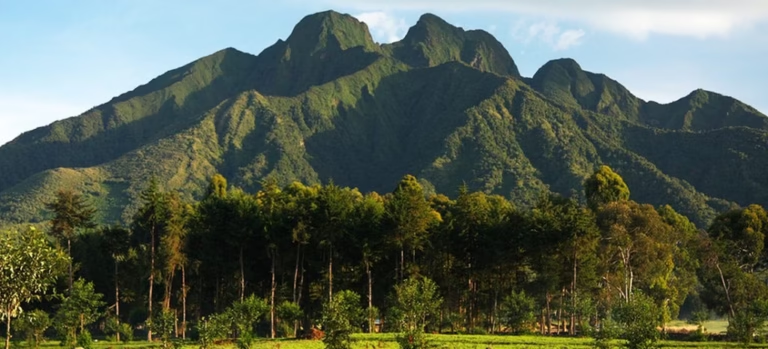
The Virunga volcanoes rise above cultivated fields and communities, creating powerful landscape compositions.
Early mornings can be especially rewarding when mountain peaks emerge from cloud.
Changing weather is part of the photographic experience. A completely clear sky is not always necessary; clouds and mist can create atmosphere and depth.
Birding Around Volcanoes National Park
The wider Volcanoes region supports montane birdlife associated with high-altitude vegetation.
Birding can be combined with selected forest activities depending on permits and interests.
Photographers should be prepared for lower light and rapidly changing weather.
A specialist guide becomes particularly valuable when travellers have target species because vocalizations may provide the first indication that a bird is nearby.
Gorilla Photography Option
For photographers interested in primates, gorilla trekking in Rwanda can be added to the Ruhengeri stay.
Mountain gorillas provide extraordinary photographic opportunities, but the experience is governed by strict rules. Visitors must follow instructions concerning distance, movement and permitted behaviour.
Light in the forest can be challenging, making fast lenses and good high-ISO performance useful.
Photographers should also spend time observing without constantly looking through the viewfinder. The encounter is valuable beyond the images brought home.
Golden Monkey Photography
Golden monkeys provide another photographic challenge. They are energetic and can move rapidly through bamboo.
Fast shutter speeds and responsive autofocus can be particularly useful.
Their distinctive colouring can stand out beautifully against green vegetation when light is favourable.
As with all wildlife photography, ethical behaviour takes priority over obtaining a particular image.
Lake Ruhondo for Landscapes and Birds
A visit to Lake Ruhondo can add both birding and landscape photography.
The lake's hills, islands and views towards the volcanoes provide attractive compositions. Birds around shoreline vegetation can create additional opportunities.
A boat excursion may allow photographers to explore different viewpoints.
Equipment should be protected from water, and lenses should be chosen carefully because changing them repeatedly in a small boat can be inconvenient.
Mid-Range Accommodation for Photographers
A mid-range Rwanda birding safari can provide excellent comfort without the expense of high-end lodges.
Photographers should prioritize practical facilities such as secure rooms, electricity for charging batteries and convenient access to birding locations.
Early breakfasts or packed meals may be required on birding mornings.
A property that understands early departures can be more useful than a luxurious hotel located far from the best habitat.
Essential Photography Equipment
A telephoto lens is central to most bird photography. The exact focal length depends on the photographer's system and preferred style.
A lighter zoom can be more practical during forest walks than extremely heavy equipment.
Extra batteries and memory cards are essential. Photographers should never depend on having enough time to transfer and delete files every evening.
A rain cover, lens cloth and compact cleaning kit are also highly valuable.
Managing Digital Files
An eighteen-day photographic safari can generate thousands of images.
Travellers should establish a simple backup routine. Files can be copied to a portable drive or computer when practical, while original memory cards are retained until a second copy exists.
Organizing images by date and destination makes later editing easier.
Even a basic daily workflow reduces the risk of returning home with a confusing collection of unidentified photographs.
Clothing and Field Preparation
Neutral, comfortable clothing works well for birding. Long trousers are useful in forests, while lightweight layers help travellers adapt to changing temperatures.
Strong walking shoes are essential around Nyungwe and Volcanoes.
Rain protection should cover both the photographer and the equipment.
A small pair of binoculars remains useful even for photographers carrying long lenses because locating birds through a camera can be difficult.
Why Eighteen Days Matter
Birding cannot be rushed successfully. An 18-day Rwanda bird photography safari gives travellers time to revisit habitats, respond to weather and wait for better opportunities.
Akagera introduces open-country species, Nyungwe provides specialized forest birding and Ruhengeri adds highland habitats.
Lake Kivu offers a slower interlude while still providing photographic subjects.
The ecological variation prevents the itinerary from becoming repetitive.
Plan Your Rwanda Bird Photography Safari
An 18-Day Mid-Range Birdwatching Safari in Ruhengeri for Photographers is ideal for travellers who value patience, habitat diversity and photographic opportunity over simply accumulating a long checklist.
Rwanda's compact geography makes it possible to combine wetlands, savannah, rainforest and volcanic highlands during one journey. A private vehicle and experienced bird guide allow the schedule to respond to light, weather and bird activity.
With sensible mid-range accommodation and carefully selected equipment, photographers can dedicate their budget to guiding and field time. The result is an immersive Rwanda journey that produces both memorable sightings and a varied photographic record of the country's remarkable landscapes and wildlife.
Accommodation Options in Kigali


Ready to Experience This Mid-range Safari?
Let our expert team customise this 18-day itinerary to match your interests and travel dates.