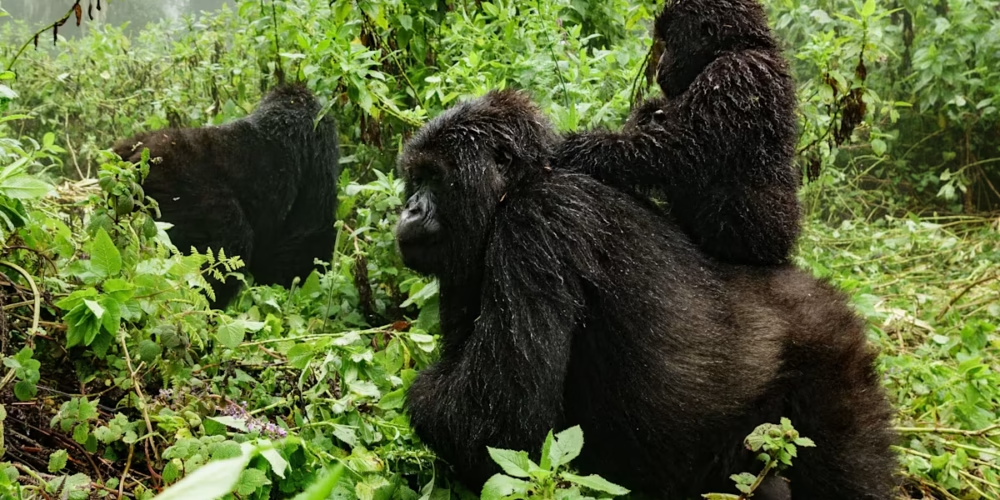

Infant Gorilla Development Stages
Infant Gorilla Development Stages
Infant gorillas develop slowly compared to many other mammals, and this extended growth period plays a crucial role in their survival. From the moment of birth, a baby gorilla depends entirely on its mother for warmth, nutrition, protection, and social learning. Over time, the infant gradually transitions into a playful juvenile, then a more independent adolescent, and eventually a fully integrated adult within the group.
This long development process reflects the complexity of gorilla social life. Every stage shapes behavior, communication skills, and survival instincts. In the wild forests of Uganda, Rwanda, and the Democratic Republic of Congo, infant gorillas learn entirely through observation, interaction, and imitation.
Birth and the First Weeks of Life
Infant gorillas are born after a gestation period of about 8.5 months. At birth, they weigh approximately 1.5 to 2 kilograms, making them extremely fragile and fully dependent on maternal care. The mother holds the infant close to her chest almost continuously, providing warmth and protection in the dense forest environment.
During the first weeks, the infant remains almost entirely immobile except when carried. It clings tightly to its mother’s fur and feeds exclusively on breast milk. This stage focuses on survival rather than exploration. The mother carefully regulates exposure to other group members, allowing only close family interaction.
The silverback, who leads the group, often shows protective interest in newborns. He may sit nearby or monitor interactions closely, ensuring group stability and safety.
Early Infant Stage: Learning Through Attachment
As the infant grows slightly stronger, it begins to loosen its constant grip on the mother and shows brief periods of awareness of its surroundings. This stage marks the beginning of sensory learning.
The infant starts to observe group members more actively. It watches grooming behavior, feeding patterns, and movement through the forest. Although it still depends entirely on milk, it begins to develop recognition of familiar faces within the group.
Play behavior starts to appear in small bursts. The infant may touch leaves, roll on the ground, or attempt short movements away from the mother before quickly returning for reassurance. These early actions build coordination and confidence.
Mid-Infant Stage: Exploration and Social Interaction
During the mid-infant stage, the gorilla becomes more active and independent in short intervals. It spends more time away from the mother but remains within close visual range. This stage typically represents the most playful period of development.
Play becomes more structured. Infants chase each other, engage in gentle wrestling, and experiment with climbing small branches. These activities develop strength, balance, and coordination.
Social interaction expands beyond the mother. The infant begins to interact with siblings, other juveniles, and sometimes tolerant adults. These interactions teach social boundaries and communication signals.
The silverback continues to play a protective role, often tolerating close proximity from infants and occasionally allowing them to interact with him without aggression.
Late Infant Stage: Increasing Independence
As the infant approaches the end of its first few years, it begins to show stronger independence. It still relies on the mother for milk but spends more time exploring the environment and interacting with group members.
Feeding behavior starts to develop alongside nursing. The infant experiments with leaves, stems, and soft vegetation, although it does not yet rely on solid food for nutrition. This transition prepares the digestive system for adult diets.
Motor skills improve significantly during this stage. Climbing, walking, and navigating uneven terrain become more confident and controlled. The infant also becomes more aware of forest dangers and group movement patterns.
The bond with the mother remains strong, but physical distance gradually increases as independence develops.
Juvenile Stage: Full Play and Social Learning
The juvenile stage marks a major shift in development. The gorilla now relies less on milk and more on solid food. It spends most of its time playing, observing, and interacting with other group members.
Play becomes essential for learning adult behaviors. Juveniles engage in mock fights, chase games, and climbing challenges. These activities help develop strength, social understanding, and conflict resolution skills.
Juveniles also begin to imitate adult behaviors more closely. They observe grooming routines, feeding techniques, and group movements. This imitation forms the foundation of future survival skills.
At this stage, social identity begins to form. The juvenile starts to understand its position within the group hierarchy and develops stronger relationships with peers.
Adolescent Stage: Transition to Independence
Adolescence represents a critical transition period in gorilla development. The young gorilla becomes physically larger and more independent, yet it still remains within the family group.
Males begin to show early signs of silverback development, including increased size, muscle growth, and changes in behavior. Females approach sexual maturity and may begin to transfer to other groups.
Adolescents participate less in play and more in adult routines such as long-distance movement, feeding coordination, and resting patterns. They start to develop more serious social interactions and reduce dependency on maternal support.
For males, this stage eventually leads to group departure, while females may transfer earlier to join other groups for reproduction.
Role of the Mother in Development
The mother plays the most important role throughout all stages of infant development. She provides not only nutrition but also emotional security and social guidance.
She determines how much independence the infant can explore at each stage. A protective mother keeps the infant close for longer periods, while a more relaxed mother allows earlier exploration.
The mother also influences social integration by introducing the infant to other group members gradually. This controlled exposure helps the infant learn group dynamics safely.
Even after weaning begins, the mother-child bond often remains strong for several years.
Role of the Silverback in Infant Protection
The silverback provides indirect but critical protection during infant development. He ensures group safety and stability, which allows infants to grow without constant threat.
Silverbacks often show tolerance toward infants and juveniles. They may allow close proximity, gentle interaction, or even play-like behavior in rare cases. This behavior strengthens group cohesion.
His presence also discourages external threats, including rival males or predators, ensuring a safe environment for growth.
Weaning and Full Independence
Weaning typically occurs between three and four years of age, although this varies. Once weaning begins, the infant transitions fully into juvenile status and relies on solid food for nutrition.
Even after weaning, emotional dependence on the mother may continue for some time. Gradual separation allows the young gorilla to develop full independence without abrupt social disruption.
By the time adolescence begins, the young gorilla has learned most survival skills needed for adulthood, including feeding, social communication, and movement patterns.
Conclusion
Infant gorilla development follows a slow and carefully structured path that reflects the complexity of gorilla social life. Each stage—from birth through infancy, juvenile growth, and adolescence—builds essential skills for survival in dense African forests.
This extended development period allows gorillas to learn through observation, imitation, and strong social bonds. The mother provides constant care, while the silverback ensures group safety, creating a stable environment for growth.
Understanding these stages highlights not only the intelligence of gorillas but also the importance of protecting their natural habitats, where every infant depends on a functioning social and ecological system.