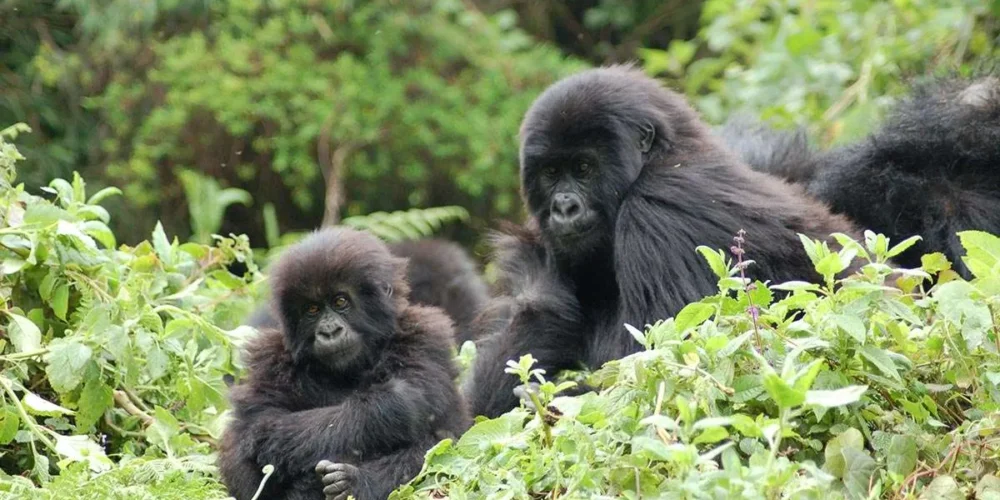

Mountain Gorilla vs Lowland Gorilla
Mountain Gorilla vs Lowland Gorilla: Key Differences, Behavior, Habitat, and Conservation
Mountain gorillas and lowland gorillas belong to the same species group, yet they live in very different environments and show noticeable variations in size, behavior, and adaptation. Both fall under the genus Gorilla, but each subspecies has evolved to survive in distinct ecological zones in Central and East Africa.
Travelers often encounter mountain gorillas in Uganda, Rwanda, and parts of the Democratic Republic of Congo, while lowland gorillas mainly inhabit the dense rainforests of eastern and central Congo. Understanding the differences between these two gorilla types helps visitors appreciate their unique survival strategies and the conservation challenges they face.
Habitat Differences
Mountain gorillas live in high-altitude forests that sit between 2,200 and 4,300 meters above sea level. These regions include volcanic slopes, bamboo forests, and misty montane vegetation zones. The climate stays cooler, and the environment changes rapidly with elevation. Plants grow thick but less densely than in lowland rainforests, which makes movement slightly easier in some areas.
Lowland gorillas prefer dense tropical rainforests at lower elevations. These forests stretch across the Congo Basin and create one of the most biologically rich ecosystems on Earth. The vegetation grows thicker, taller, and more layered, which limits visibility and makes trekking more physically demanding. Rivers, swamps, and seasonal wetlands also shape their habitat.
The difference in elevation shapes every aspect of their survival, from diet to social movement patterns. Mountain gorillas adapt to cooler temperatures and more limited plant diversity, while lowland gorillas thrive in warmer, wetter, and more abundant food environments.
Physical Differences
Mountain gorillas appear more muscular and stockier than lowland gorillas. Their thick fur helps them survive colder temperatures in high-altitude forests. The fur often looks longer and denser, especially around the arms and back. Adult males can develop large body frames, especially dominant silverbacks who lead family groups.
Lowland gorillas tend to have a slimmer build and shorter hair. Their bodies adapt to warmer climates, which reduces the need for heavy insulation. Eastern lowland gorillas, in particular, rank as the largest gorilla subspecies in terms of overall body size, even though they may appear less bulky due to shorter fur.
Facial structure also differs slightly. Lowland gorillas often show broader facial features and larger skull shapes, while mountain gorillas display more compact facial proportions.
Diet and Feeding Behavior
Mountain gorillas rely heavily on leaves, shoots, stems, and bamboo. Their high-altitude environment offers fewer fruiting trees, so they adapt by consuming fibrous vegetation. They spend a large part of their day feeding to meet energy requirements from low-calorie foods.
Lowland gorillas enjoy a more varied diet due to richer forest biodiversity. They consume fruits, leaves, seeds, and occasionally insects. Fruit availability plays a major role in their movement patterns. When fruit becomes abundant, lowland gorilla groups travel longer distances to exploit seasonal feeding zones.
This dietary difference shapes their daily behavior. Mountain gorillas maintain more stable home ranges, while lowland gorillas often move across wider territories in search of food.
Social Structure and Behavior
Both gorilla types live in family groups led by a dominant silverback. The silverback protects the group, resolves conflicts, and leads movements. Group sizes vary depending on habitat conditions and food availability.
Mountain gorilla groups tend to be smaller and more stable. Their social structure remains relatively consistent over time, with strong bonds between members. Juveniles often stay within the same group for longer periods.
Lowland gorilla groups may show more fluid social patterns. Because food resources spread across larger areas, groups sometimes split and merge more frequently. This flexibility helps them adapt to changing forest conditions.
In terms of behavior, mountain gorillas often appear more predictable due to concentrated habitats and long-term research exposure. Lowland gorillas remain less studied and more elusive, especially in dense Congo rainforests where visibility remains limited.
Intelligence and Communication
Both subspecies demonstrate high intelligence and complex communication systems. They use vocalizations, body posture, facial expressions, and gestures to communicate within groups. Researchers have recorded distinct calls that signal danger, food discovery, or social bonding.
Mountain gorillas, studied extensively in Volcanoes National Park and Bwindi Impenetrable Forest, show advanced social learning behaviors due to long-term human observation. Lowland gorillas also display similar intelligence, but dense habitats limit detailed behavioral studies.
Tool use appears occasionally in both groups, although it remains rare. Their cognitive abilities continue to attract scientific interest, especially in understanding primate evolution and social intelligence.
Conservation Status and Threats
Both mountain and lowland gorillas face significant conservation challenges, but their situations differ.
Mountain gorillas once stood on the brink of extinction, but conservation efforts have helped their population gradually increase. Strict protection in Uganda, Rwanda, and Congo has improved their survival prospects. Controlled tourism, anti-poaching patrols, and community conservation programs play a major role in their recovery.
Lowland gorillas face more complex threats due to their wider distribution and less controlled environments. Eastern lowland gorillas suffer from habitat loss, illegal mining, armed conflict, and forest degradation in parts of the Congo Basin. Their populations remain harder to monitor due to remote terrain and security challenges.
Despite these differences, both subspecies remain classified as endangered. Conservation organizations continue to emphasize habitat protection, community engagement, and sustainable tourism as key survival strategies.
Gorilla Trekking Experience Comparison
Mountain gorilla trekking offers a more structured and predictable experience. Parks such as Bwindi Impenetrable National Park, Volcanoes National Park, and Mgahinga Gorilla National Park manage trekking permits strictly. Visitors often enjoy clearer visibility due to slightly less dense vegetation, although hikes can be steep and physically demanding.
Lowland gorilla trekking, especially in places like Kahuzi-Biega National Park, feels more remote and unpredictable. Dense rainforest vegetation reduces visibility, and trekking often involves longer search times. The experience feels more raw and less commercialized, which appeals to travelers seeking wilderness immersion.
Both experiences offer close encounters with wild gorillas, but the atmosphere differs. Mountain gorilla trekking feels more regulated and accessible, while lowland gorilla trekking feels more adventurous and isolated.
Conclusion
Mountain gorillas and lowland gorillas share a common genetic heritage, yet they have adapted to very different worlds. One thrives in cool, high-altitude forests with limited vegetation, while the other dominates vast tropical rainforests rich in biodiversity. Their differences in habitat, behavior, and conservation needs highlight the complexity of gorilla survival in Africa.
Both remain critically important to global conservation efforts. Protecting them ensures the survival of not just two subspecies, but entire ecosystems that depend on forest stability.