
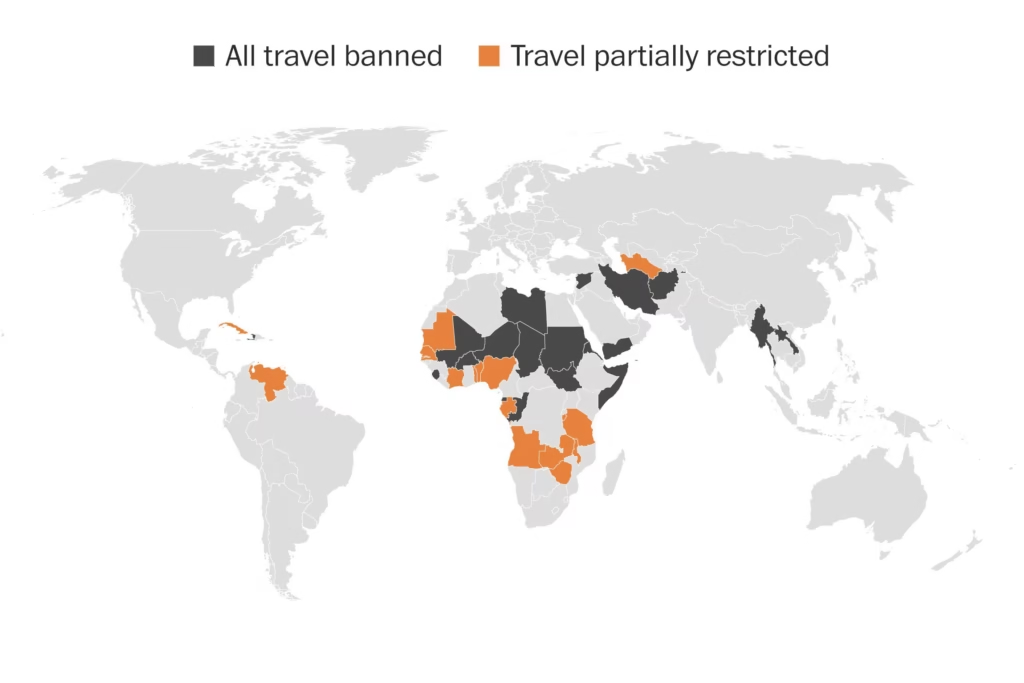
26 African Countries Under Full or Partial U.S. Travel Ban (Post-December Update)
26 African Countries Under Full or Partial U.S. Travel Ban (Post-December Update) Following the December update to U.S.…
Read article →
Travel Guide
Discover the diverse primates of Kibale National Park, Uganda. Learn about the species, their habitats, and ongoing conservation efforts in this primate haven.
The Primates of Kibale National Park are one of the main reasons this rainforest destination occupies such an important place on Uganda’s wildlife circuit. Located in western Uganda, Kibale protects a rich tropical forest environment where visitors can search for chimpanzees while also encountering several other primate species.
Chimpanzees receive most international attention, but concentrating on them alone overlooks much of Kibale’s ecological richness. Monkeys move through different forest levels, calls travel through the canopy and mixed primate encounters can transform an ordinary forest walk into a constantly changing wildlife experience.
For travelers combining Kibale with Queen Elizabeth National Park and Bwindi Impenetrable National Park, the forest also provides a striking contrast to savannah game drives and mountain gorilla trekking.
Kibale National Park protects a varied forest landscape.
Different vegetation communities provide habitats for primates, birds, insects and other wildlife.
The forest structure itself is important.
Some primates spend much of their time high in the canopy, while others may use lower vegetation or move through several forest levels.
Food availability, season and social behavior influence where animals are found.
Visitors should therefore think of Kibale as a complete ecosystem rather than simply a location where chimpanzees have been placed for tourism.
Chimpanzees are the most famous of the Primates of Kibale National Park.
Their intelligence, social complexity and close biological relationship to humans make observing them particularly compelling.
Chimpanzees live in social communities whose members may separate into smaller parties and later come together again.
This means the number of chimpanzees encountered during a tracking activity can vary.
Visitors may hear calls before seeing the animals.
At other times, trackers locate chimpanzees feeding, resting or moving through vegetation.
Chimpanzee tracking involves entering the forest with trained guides.
The experience differs considerably from a vehicle-based safari.
Travelers walk beneath the canopy and listen for vocalizations and movement.
Once chimpanzees are located, visitors observe them according to the rules governing the activity.
The animals may remain on the ground or climb into trees.
Because chimpanzees can move quickly, the experience can sometimes be physically active.
Comfortable walking shoes and clothing suitable for a tropical forest are important.
A habituation experience differs from a standard tracking visit.
Habituation involves the longer process through which wild chimpanzees become accustomed to the controlled presence of researchers and observers.
Where officially available, a habituation-focused visitor experience can provide more time in the forest and a deeper look at chimpanzee behavior.
Travelers should understand that this can involve substantial walking and patience.
It is particularly suitable for visitors with a strong interest in primate behavior, research or photography.
Current permit arrangements should be confirmed before travel.
Black-and-white colobus monkeys are among Kibale’s visually distinctive primates.
Their contrasting coloration makes them relatively recognizable when visible among the trees.
They are strongly adapted to life in the canopy.
Visitors may see groups moving between branches or resting high above the forest floor.
Binoculars improve the experience considerably because many monkey sightings occur overhead.
Rather than waiting for animals to descend, visitors can examine behavior in the part of the forest where the monkeys naturally spend their time.
Red colobus monkeys add another dimension to Kibale’s primate diversity.
Their coloration and social behavior distinguish them from black-and-white colobus.
Seeing multiple primate species during one forest excursion demonstrates how different animals can occupy overlapping habitats.
Guides help visitors identify species accurately.
Without expert interpretation, movement high in the canopy can make identification difficult, particularly for first-time primate watchers.
Binoculars again become extremely valuable.
Red-tailed monkeys are another species visitors may encounter within the Kibale ecosystem.
Distinctive coloration around the tail and face can help with identification when views are clear.
These monkeys may move actively through vegetation, making photography challenging.
Watching them encourages visitors to become attentive to movement throughout the canopy.
A branch shaking unexpectedly may reveal a monkey that was initially hidden.
Forest wildlife observation is therefore as much about listening and noticing movement as looking for obvious animals.
Blue monkeys may also form part of the primate diversity encountered in the wider Kibale forest environment.
Despite the name, visitors should not expect an animal colored bright blue.
Common animal names do not always describe appearance literally.
Guides can explain distinguishing characteristics and help separate similar-looking species.
This is particularly useful in forests where views may be brief.
Keeping a wildlife notebook can help travelers remember the different species encountered during a busy primate safari.
L’Hoest’s monkeys are among the interesting forest primates associated with Uganda’s western forests.
They have a distinctive appearance and are adapted to forest habitats.
Sightings depend on location and chance.
Visitors should avoid approaching a Kibale trip with a rigid checklist demanding every species.
Forest wildlife moves freely, and some animals are naturally more difficult to observe than others.
A successful excursion is one that respects the ecosystem while taking advantage of whatever encounters occur naturally.
Grey-cheeked mangabeys contribute to Kibale’s reputation as an exceptional primate destination.
They are active forest monkeys and can produce interesting behavioral observations.
Experienced guides may identify them by appearance, movement or vocalization.
Learning calls can add an entirely new dimension to forest exploration.
Visitors eventually realize that a rainforest is rarely quiet.
Different sounds provide clues about animals that may remain hidden by vegetation.
Not all of the Primates of Kibale National Park remain exclusively high in dense forest canopy.
Olive baboons can occur in the wider landscape and are much more terrestrial than many monkey species.
Baboons are highly social and may occur in groups.
Visitors should never feed them.
Feeding wildlife can alter natural behavior and encourage animals to associate humans with food.
This can eventually create conflict and safety problems.
Observe baboons from an appropriate distance and secure food around areas where wildlife is present.
Kibale’s primate diversity also includes animals that are more active at night.
This reminds visitors that daytime walks reveal only part of the forest community.
Where legitimate guided night activities are available, travelers may have opportunities to explore another side of the ecosystem.
Independent nighttime walking should not be attempted in protected forest.
Use authorized guides and follow park rules.
A guided experience can also introduce visitors to insects, amphibians and other nocturnal wildlife beyond primates.
Primate diversity is closely connected with habitat.
A productive tropical forest provides different food resources, canopy structures and ecological niches.
Fruit, leaves, insects and other resources can support species with different feeding strategies.
Protecting a large forest landscape allows these ecological relationships to continue.
This is why conservation must focus on habitat as well as individual animals.
Protecting chimpanzees while losing the wider forest ecosystem would not provide a sustainable solution.
Kibale’s conservation importance extends beyond tourism.
Long-term protection helps maintain primate habitat, watersheds, plant communities and other biodiversity.
Research contributes to understanding chimpanzees and other forest species.
Tourism can provide economic support for conservation when carefully managed.
Visitors contribute most effectively by following park rules, respecting viewing distances and supporting responsible operators.
Avoid littering and never remove plants, animals or other natural materials from the forest.
Protected forests exist alongside human communities.
Successful long-term conservation therefore involves relationships extending beyond park boundaries.
Tourism can create employment for guides, lodge staff, drivers, farmers, artisans and other local businesses.
Travelers can support these benefits by choosing responsible community experiences and purchasing local products where appropriate.
Cultural activities should be approached respectfully.
Ask permission before photographing people and avoid treating everyday community life as a staged attraction.
A trip focused on the Primates of Kibale National Park should still leave room for other wildlife.
Kibale is an important birding destination.
Butterflies and smaller forest creatures can also add interest to walks.
Travelers who concentrate only on chimpanzees may walk past extraordinary biodiversity without noticing it.
A good guide can point out plants, tracks, birds and ecological relationships throughout the excursion.
This makes time spent searching for primates interesting even before a major sighting occurs.
Wear comfortable closed walking shoes with reliable grip.
Long trousers protect legs from vegetation.
A lightweight long-sleeved shirt can provide additional protection.
Carry a waterproof jacket because rain is possible in a tropical forest.
Bring drinking water according to activity instructions.
Binoculars are strongly recommended.
Photographers should be prepared for low light beneath the canopy and protect equipment from moisture.
Insect repellent and personal medication should also be included.
Kibale fits naturally into a western Uganda safari.
Travelers can continue toward Queen Elizabeth National Park for game drives and a Kazinga Channel boat experience.
This combination creates a strong contrast between forest primates and savannah wildlife.
From Queen Elizabeth, visitors can continue toward Bwindi for mountain gorilla trekking.
A single itinerary can therefore include chimpanzees, monkeys, elephants, lions, hippos and mountain gorillas.
Travelers should consider spending more than one night around Kibale.
Arriving the evening before chimpanzee tracking avoids unnecessary pressure on the activity day.
An additional night provides time for other forest or community experiences.
Dedicated primate enthusiasts may want longer.
The more time visitors spend in the ecosystem, the more they begin to recognize that chimpanzees are only one part of the story.
The Primates of Kibale National Park demonstrate the extraordinary biodiversity of Uganda’s western forests.
Chimpanzees provide the headline experience, but colobus monkeys, mangabeys, baboons and other primates create a far richer wildlife community.
Every species occupies its own place within the forest.
Watching these animals in the wild requires patience, good guiding and respect for their habitat.
For travelers willing to look beyond the most famous species, Kibale becomes more than a chimpanzee tracking destination. It becomes a living primate ecosystem and one of the most rewarding places in Uganda for understanding the complexity of tropical forest wildlife.

26 African Countries Under Full or Partial U.S. Travel Ban (Post-December Update) Following the December update to U.S.…
Read article →
3 Days Congo Gorilla Safari – Encounter the Gentle Giants of Virunga A 3 Days Congo Gorilla Safari…
Read article →
Children and Kids on Safari – Family-Friendly Adventures in Africa Taking children on an African safari is one…
Read article →
How to Plan a Safari in Uganda—Your Complete Travel Guide Planning a safari in Uganda is the start…
Read article →