
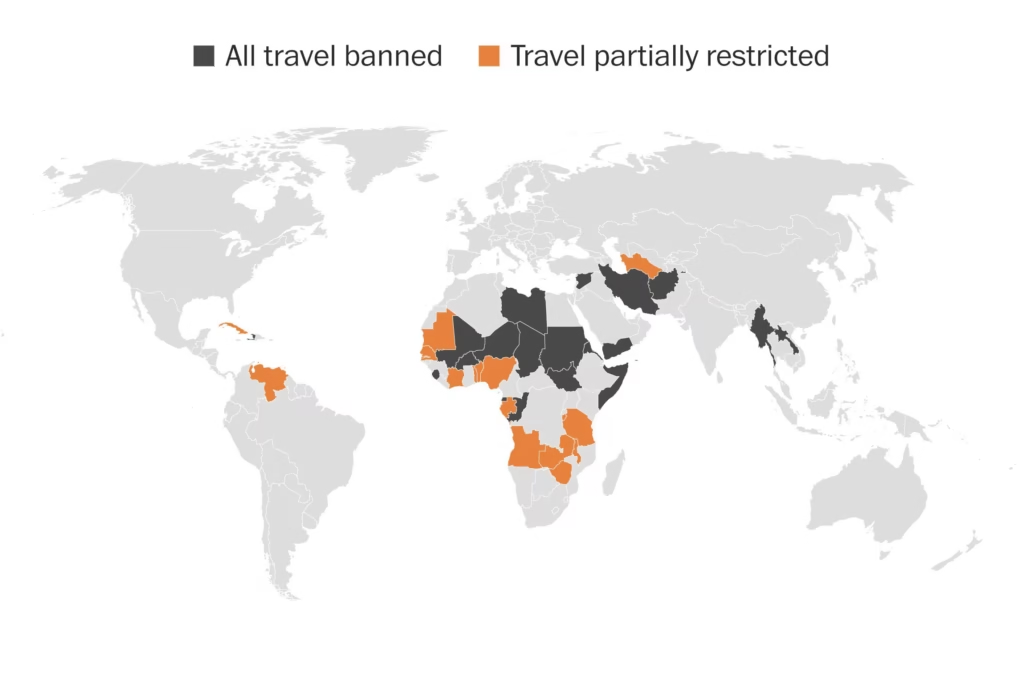
26 African Countries Under Full or Partial U.S. Travel Ban (Post-December Update)
26 African Countries Under Full or Partial U.S. Travel Ban (Post-December Update) Following the December update to U.S.…
Read article →
Travel Guide
Discover Nkusi Falls on Uganda's Lake Albert, a remote waterfall destination with dramatic scenery, boat access and off-the-beaten-track adventure.
Nkusi Falls, situated near the eastern shores of Lake Albert in western Uganda, is one of the country’s lesser-known natural attractions. While many travelers are familiar with Murchison Falls, Sipi Falls and the waterfalls around Mount Elgon, Nkusi offers a more remote experience characterized by dramatic escarpment scenery, Lake Albert landscapes and limited tourism development.
The falls are created by the Nkusi River as it descends from the highlands toward Lake Albert. Their relatively isolated setting has kept them outside many conventional Uganda safari itineraries, making the area particularly interesting for adventurous travelers who want to explore beyond established tourism routes.
Nkusi Falls are found in western Uganda in the broader Lake Albert region. The landscape around the lake forms part of the Albertine Rift, a branch of the East African Rift system that has shaped some of western Uganda’s most dramatic geographical features.
Lake Albert itself lies along the border between Uganda and the Democratic Republic of the Congo. Steep escarpments rise above sections of the shoreline, while rivers descend from higher ground toward the lake.
The Nkusi River is one of these waterways.
The falls are substantially more remote than attractions situated beside major highways or close to large tourism towns. Reaching them therefore requires more deliberate planning.
The Nkusi River flows through western Uganda before descending toward Lake Albert.
As it reaches the escarpment, the dramatic change in elevation creates the waterfall system that makes the area distinctive.
Water volume naturally varies with rainfall and seasonal conditions. During wetter periods, the falls can carry considerably more water, while surrounding vegetation becomes particularly lush.
The visual appeal comes not only from the falling water but also from the wider setting.
Cliffs, valleys, vegetation and Lake Albert combine to create a landscape that feels substantially different from Uganda’s savannah national parks.
Accessibility has played a major role in keeping Nkusi Falls relatively unknown.
Uganda’s established tourism circuit generally concentrates on destinations such as Bwindi Impenetrable National Park, Queen Elizabeth National Park, Kibale National Park, Murchison Falls National Park and Jinja.
These locations have developed substantial accommodation, transport and guiding infrastructure.
Nkusi Falls does not have the same concentration of visitor facilities.
This makes planning more complicated but also preserves the sense of exploration that attracts travelers to remote destinations.
Access should be arranged using current local information because road, trail and boat conditions can change.
Depending on the selected approach and prevailing conditions, travelers may incorporate road travel with local boat transport on Lake Albert.
A boat perspective can be particularly rewarding because the escarpment rises dramatically from the lake.
Travelers should use experienced local guides and suitable boat operators rather than attempting to improvise transportation after arrival.
Lake conditions also need to be considered. Weather can change, and appropriate safety equipment is essential whenever traveling by boat.
Lake Albert is one of the major geographical features of western Uganda.
The lake stretches along the Uganda–DRC frontier and receives water from the Victoria Nile before the river continues north as the Albert Nile.
Its setting beneath the Albertine Rift escarpment creates impressive scenery.
Fishing communities occupy parts of the shoreline, and boats form an important part of local life.
For travelers accustomed to Uganda’s better-known national parks, exploring Lake Albert reveals a different relationship between people, water and landscape.
Nkusi Falls is better suited to adventurous visitors than travelers expecting polished tourism infrastructure.
A journey may involve long road transfers, changing surface conditions and locally arranged transport.
This should be considered part of the character of the destination rather than an inconvenience that can always be eliminated.
Travelers should allow sufficient time and avoid building a tight schedule around a remote excursion.
A flexible itinerary makes it easier to respond to weather and transport conditions.
The combination of waterfalls, escarpments and Lake Albert creates interesting photographic possibilities.
Wide-angle compositions can emphasize the relationship between the falls and surrounding landscape.
Telephoto lenses may help isolate details in distant cliffs or shoreline environments.
Morning and late-afternoon light can create more dimension than harsh midday conditions, although the practical timing of a visit depends on access arrangements.
Photographers traveling by boat should protect equipment against spray and unexpected rain.
A waterproof dry bag provides valuable protection for cameras, phones and travel documents.
Nkusi Falls can be influenced substantially by rainfall.
Higher rainfall generally increases river flow and can make the waterfall more powerful. At the same time, heavy rain may make road or trail access more difficult.
Drier conditions can simplify transportation but may reduce water volume.
There is therefore a trade-off between accessibility and waterfall intensity.
Travelers should obtain current local information rather than choosing a date solely according to general national weather patterns.
Remote excursions require more preparation than conventional sightseeing.
Comfortable walking shoes with good grip are important if the itinerary involves uneven ground.
Lightweight long trousers and long sleeves can provide protection from vegetation and insects.
Travelers should carry sufficient drinking water, sunscreen, insect repellent, rain protection and any personal medication required during the day.
A small first-aid kit is also sensible.
Electronics should be protected from moisture, especially if boat transportation forms part of the journey.
The broader Lake Albert region can potentially be incorporated into itineraries involving Murchison Falls National Park.
Murchison Falls offers conventional wildlife experiences including game drives and boat excursions on the Nile.
Adding a remote waterfall or Lake Albert excursion creates contrast.
However, distances and road conditions must be calculated realistically. A location that appears close on a map can require substantially more travel time than expected.
It is therefore preferable to build the route around actual transportation conditions rather than straight-line distances.
Nkusi can also interest travelers undertaking a more extensive western Uganda journey.
An itinerary might connect Lake Albert landscapes with Kibale’s forests, Queen Elizabeth National Park, the Rwenzori region or other destinations depending on the route.
Such combinations work particularly well for repeat visitors who have already experienced Uganda’s major highlights and want to explore less familiar areas.
The emphasis shifts from ticking off famous attractions to understanding the country’s geographical diversity.
Lake Albert is not an empty wilderness.
Communities depend on fishing, agriculture, trade and other activities connected to the surrounding landscape.
Travelers should approach these areas respectfully.
Photography of people should be undertaken with permission, and visitors should avoid treating working communities as tourism exhibits.
Using local guides can create opportunities for economic participation while providing travelers with more accurate knowledge about the region.
Remote destinations can be environmentally sensitive precisely because they have limited visitor infrastructure.
Travelers should carry out waste and avoid leaving plastic or other materials behind.
Waterfalls and cliffs can also present physical hazards. Visitors should not approach unstable edges or slippery rocks simply to obtain photographs.
Local guides should determine safe viewing areas.
Boat safety deserves equal attention. Suitable flotation equipment and competent operators are essential on Lake Albert.
The attraction of Nkusi Falls lies partly in what it is not.
It is not a heavily developed attraction filled with restaurants, paved viewpoints and large visitor groups.
Instead, the journey emphasizes landscape, remoteness and discovery.
For some travelers, this lack of infrastructure may make another waterfall more appropriate.
For others, it is precisely what makes Nkusi appealing.
Uganda’s reputation as a tourism destination rests strongly on mountain gorillas, chimpanzees, the Nile and national parks filled with wildlife. Yet the country contains many landscapes that remain outside standard itineraries.
Nkusi Falls on Lake Albert demonstrates this diversity.
The combination of cascading water, escarpment scenery, local communities and one of Africa’s Great Lakes creates a destination with significant adventure potential.
Visiting requires more preparation than stopping at a conventional attraction, but travelers willing to organize suitable transport and local guidance can experience a remarkably different side of western Uganda.
For those seeking a genuine off-the-beaten-track addition to a longer Uganda safari, Nkusi Falls offers scenery and a sense of exploration that are increasingly difficult to find along established tourism circuits.

26 African Countries Under Full or Partial U.S. Travel Ban (Post-December Update) Following the December update to U.S.…
Read article →
3 Days Congo Gorilla Safari – Encounter the Gentle Giants of Virunga A 3 Days Congo Gorilla Safari…
Read article →
Children and Kids on Safari – Family-Friendly Adventures in Africa Taking children on an African safari is one…
Read article →
How to Plan a Safari in Uganda—Your Complete Travel Guide Planning a safari in Uganda is the start…
Read article →