
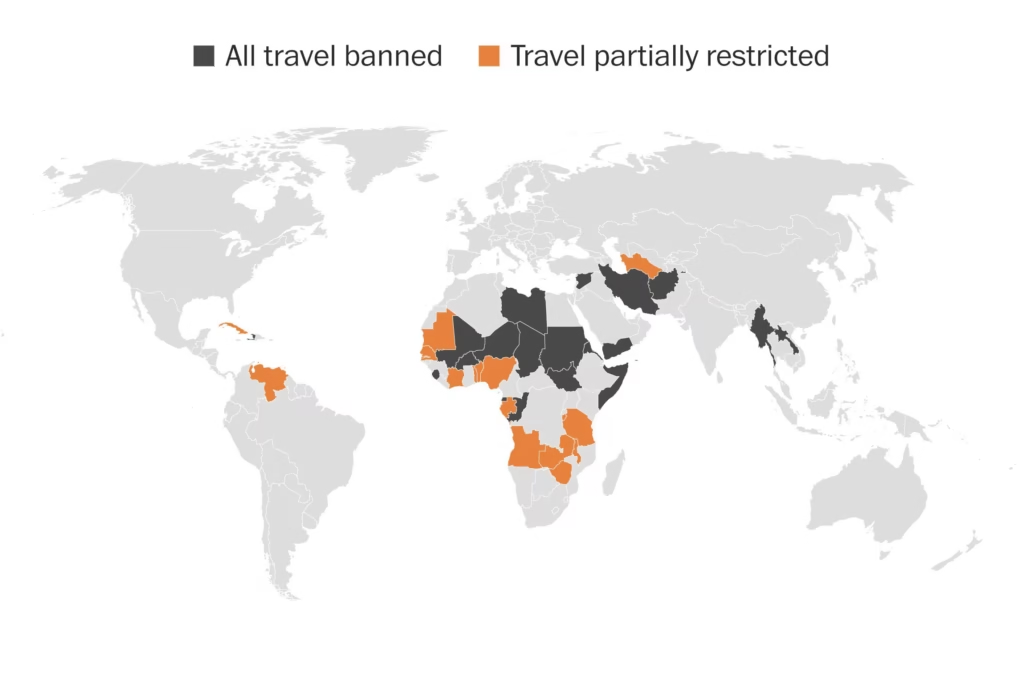
26 African Countries Under Full or Partial U.S. Travel Ban (Post-December Update)
26 African Countries Under Full or Partial U.S. Travel Ban (Post-December Update) Following the December update to U.S.…
Read article →
Travel Guide
Meet the mountain gorilla families of Virunga National Park. Explore each group’s story and learn how to trek with them in Congo’s oldest national park.
The Gorilla Families in Virunga National Park, Congo—2025 Guide introduces travelers to the social groups of mountain gorillas living within the Virunga landscape of eastern Democratic Republic of Congo. Virunga National Park forms part of the wider transboundary mountain gorilla ecosystem shared with neighboring Rwanda and Uganda.
Mountain gorillas live in social groups rather than as isolated animals. Each family develops its own structure, relationships and history, usually involving adult females, younger gorillas and one or more mature males.
For travelers, understanding the concept of gorilla families adds depth to a trekking experience. Visitors are not simply looking for individual animals. They are observing a functioning social unit in which feeding, resting, parenting, play and communication occur continuously.
Tourism access and individual family availability can change, so travelers should always confirm current park operations before planning a journey to eastern Congo.
A gorilla family is a social group whose members travel, feed and rest together.
A mature silverback often plays a central role.
He may influence movement, provide protection and intervene during conflict. Females care for infants, while juveniles spend considerable time playing and developing social skills.
Group composition is not permanent.
Gorillas mature, females may transfer between groups, young males can eventually leave, and leadership can change.
This means descriptions of individual families represent a particular period rather than an unchanging structure.
Virunga National Park protects part of the mountain habitat forming the larger Virunga ecosystem.
Mountain gorillas in this region are part of a population whose range extends across international borders.
The animals themselves do not recognize political boundaries.
Their conservation therefore depends on cooperation across the broader ecosystem as well as effective management within individual protected areas.
Tourism requires selected gorilla families to become accustomed gradually to controlled human presence.
This process is known as habituation.
Habituated gorillas remain completely wild.
They are not trained to pose, approach tourists or remain in one location.
Habituation simply reduces their fear of carefully managed human observers sufficiently for research and tourism to occur.
Travelers sometimes encounter online lists presenting a fixed number of named gorilla families.
Such information should be treated as time-specific.
Groups can divide, leadership can change and tourism access can be suspended.
Some families may be monitored primarily for conservation rather than tourism.
For that reason, visitors should confirm which groups are currently available through official park channels rather than relying exclusively on an older list.
Kabirizi is among the names historically associated with mountain gorilla tourism in Virunga.
Like other gorilla groups, its story has been shaped by leadership changes and the wider challenges of protecting wildlife within eastern Congo.
Travelers researching a particular family should verify its current composition and tourism status before departure.
The identity of a group is much more than the name of its silverback.
Humba has also been recognized among Virunga’s habituated mountain gorilla groups.
Observing any habituated family allows visitors to notice how individuals interact rather than focusing exclusively on the dominant male.
Females, juveniles and infants often provide some of the most revealing behavioral moments.
Current group details should always be obtained from park authorities or guides.
The Rugendo name is deeply connected with Virunga’s mountain gorilla history.
As with other families, its composition has changed over time.
This illustrates an important point about gorilla tourism: families are living social systems.
A guidebook can document their history, but it cannot freeze their relationships permanently.
Visitors benefit from asking guides about recent developments during the trek.
Munyaga is another name associated with Virunga’s habituated gorillas.
Family histories can include changes in leadership, births and transfers.
These developments are valuable to researchers because they reveal how gorilla society functions over long periods.
For visitors, they create an opportunity to understand individual animals within a broader social story.
Mapuwa has likewise appeared in accounts of Virunga’s gorilla groups.
Descriptions of such families should be understood within their historical context.
The number of individuals and identity of leading silverbacks can change.
Rather than arriving with a rigid expectation of exactly which gorillas will be encountered, visitors should listen to the trackers and guides who follow current developments.
Lulengo is another family name associated with Virunga’s mountain gorillas.
Each habituated group contributes to the wider conservation and tourism story of the park.
Long-term monitoring helps conservation teams understand births, deaths, movement and changes in social organization.
Tourism can then introduce visitors to individual animals while maintaining controlled access.
Other named groups have also been documented within Virunga.
The existence and tourism status of families can evolve, which is why a current park briefing is more reliable than treating any historical list as permanent.
This dynamic nature is one of the most interesting aspects of gorilla biology.
Groups change because individual animals make decisions, mature and respond to social pressures.
Silverbacks attract immediate attention because of their size.
A mature male can appear extraordinarily powerful when seen at close range.
His role can include protection and maintaining group cohesion.
However, visitors should not interpret every silverback action as aggression.
Gorilla communication includes subtle posture, vocalizations and social responses that guides can help explain.
Females play central roles in gorilla families.
Mothers provide prolonged care to infants, carrying and protecting them while they develop.
Watching an infant remain close to its mother provides insight into the slow reproductive cycle of mountain gorillas.
Because reproduction is slow, protecting each breeding population is particularly important for long-term conservation.
Young gorillas can be extremely entertaining to observe.
They may climb, wrestle or chase one another.
Play contributes to physical and social development.
Visitors should resist the temptation to encourage interaction.
A juvenile approaching people remains a wild gorilla, and tourists must follow their guide’s instructions.
A trekking experience begins long before visitors reach a gorilla family.
Trackers and conservation personnel monitor movements within the forest.
Because gorillas move naturally, the time required to locate them varies.
Terrain, vegetation and weather also influence trekking difficulty.
Travelers should prepare for a genuine forest hike rather than expecting a short walk directly to the animals.
Once a family is located, visitor behavior becomes especially important.
People should remain quiet and follow distancing instructions.
Gorillas must never be touched or fed.
Flash photography should not be used.
If an animal approaches unexpectedly, visitors should remain calm and follow the guide rather than trying to create physical contact.
Great apes can be vulnerable to diseases transmitted by humans.
Visitors should take health rules seriously.
Anyone experiencing symptoms should report them rather than attempting to hide illness to avoid missing a trek.
Masks and distancing requirements, where instructed, help protect gorillas.
A wildlife encounter should never take priority over the health of the animals.
Travel to eastern Democratic Republic of Congo requires careful planning.
Security conditions and tourism operations can change.
Travelers should verify official information before booking flights, accommodation or permits.
A historical account showing that gorilla trekking operated during a previous year does not prove that the same activity is currently available.
Protecting the Gorilla Families in Virunga National Park, Congo—2025 Guide involves much more than managing tourists.
Habitat protection, monitoring, ranger operations, regional instability and community relationships all influence conservation.
The continued survival of mountain gorillas depends on maintaining functioning forest ecosystems and long-term protection.
Learning about gorilla families transforms trekking from a search for a famous species into an observation of complex social life.
Each group has a history shaped by births, deaths, transfers and changing leadership.
That history continues whether tourists are present or not.
The Gorilla Families in Virunga National Park, Congo—2025 Guide therefore represents more than a list of group names. It introduces visitors to living communities of wild primates whose survival depends on conservation across one of Africa’s most extraordinary and challenging mountain landscapes.

26 African Countries Under Full or Partial U.S. Travel Ban (Post-December Update) Following the December update to U.S.…
Read article →
3 Days Congo Gorilla Safari – Encounter the Gentle Giants of Virunga A 3 Days Congo Gorilla Safari…
Read article →
Children and Kids on Safari – Family-Friendly Adventures in Africa Taking children on an African safari is one…
Read article →
How to Plan a Safari in Uganda—Your Complete Travel Guide Planning a safari in Uganda is the start…
Read article →