
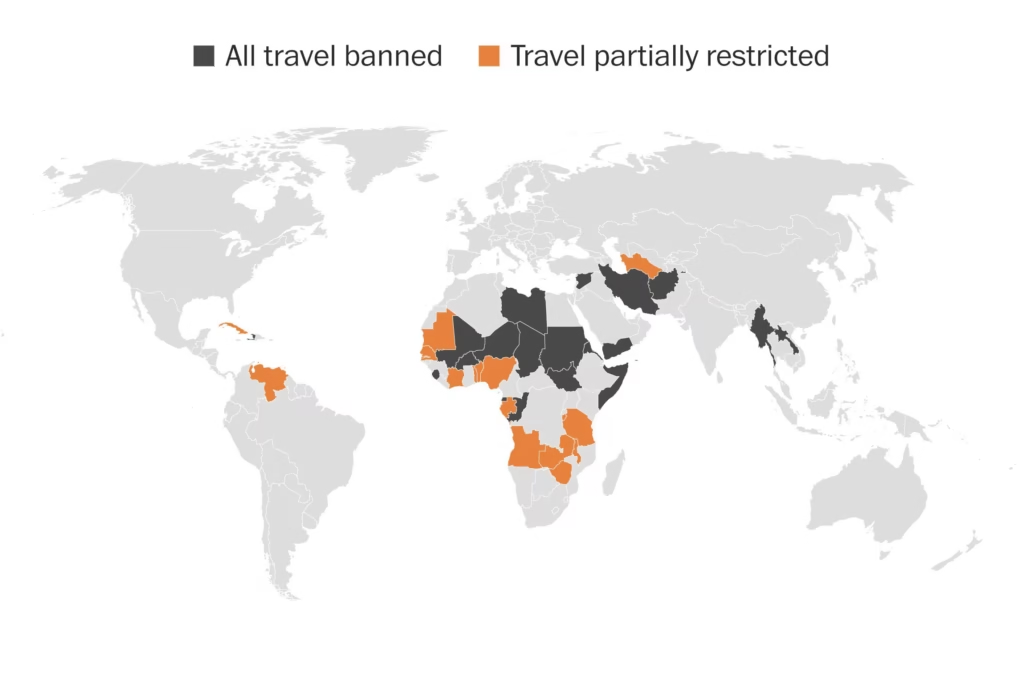
26 African Countries Under Full or Partial U.S. Travel Ban (Post-December Update)
26 African Countries Under Full or Partial U.S. Travel Ban (Post-December Update) Following the December update to U.S.…
Read article →
Travel Guide
Explore 5 fascinating facts about the common chimpanzee, from their advanced tool-making skills and social behaviors to their intelligence and communication abilities.
The most Fascinating Facts About the Common Chimpanzee reveal an animal whose intelligence, social relationships, communication, and problem-solving abilities are remarkably complex. The common chimpanzee, scientifically known as Pan troglodytes in the supplied source, has fascinated researchers and wildlife enthusiasts because many aspects of its behavior invite comparison with humans while still reflecting a distinctly chimpanzee way of life.
The supplied material focuses on five characteristics: tool use, complex social structures, intelligence, communication, and close genetic similarity with humans.
Together, these characteristics explain why watching chimpanzees in natural habitat can be such a rewarding primate experience.
A chimpanzee encounter becomes much more meaningful when visitors look beyond the simple fact of seeing the animal and begin observing what individuals are actually doing.
The first characteristic highlighted by the supplied source is tool use.
Chimpanzees can use objects from their environment to help obtain food or accomplish specific tasks.
The source gives examples such as using sticks to extract termites, stones to open nuts, and leaves to collect water.
The importance of these behaviors lies not only in the objects themselves but also in the problem-solving required to use them effectively.
A stick lying on the forest floor has no fixed purpose.
A chimpanzee can recognize that it can be used to access food that would otherwise be difficult to reach.
The animal may need to select or modify an appropriate object before inserting it into a termite mound.
This behavior demonstrates a connection between recognizing a problem and using part of the environment as a solution.
The supplied source also describes the use of stones to crack nuts.
This requires a different kind of coordination.
The chimpanzee needs a suitable hard surface, an appropriate stone, and enough control to break the shell without simply scattering or destroying the food.
Repeated practice can improve efficiency.
Such behavior provides researchers with valuable insight into chimpanzee learning and problem-solving.
Leaves can also become functional objects.
The source refers to chimpanzees using leaves to soak up water.
This demonstrates that tool use is not limited to one feeding technique.
Different environmental challenges can produce different solutions.
For wildlife observers, recognizing these actions can transform what initially looks like ordinary feeding into evidence of sophisticated behavior.
The supplied source emphasizes that tool-related skills can be learned through observation and practice.
Young chimpanzees spend considerable time around older individuals.
Watching experienced animals provides opportunities to learn behaviors gradually.
This makes social life important not only for companionship but also for the transmission of useful knowledge.
When behaviors are learned socially and maintained within groups, researchers can study differences between chimpanzee communities.
The supplied source frames this as cultural transmission of knowledge.
This concept is particularly fascinating because it means behavior is not determined only by anatomy or instinct.
What an individual learns from others can also influence how it interacts with the environment.
The second major fact concerns chimpanzee society.
The supplied source describes communities that can contain approximately 20 to more than 100 individuals.
These communities are not simply crowds of animals moving together continuously.
Relationships, alliances, status, family bonds, and individual personalities influence how chimpanzees interact.
Understanding these relationships is essential for interpreting what visitors see during a chimpanzee trek.
The source describes a hierarchy that can include an alpha male.
Leadership is not explained solely by physical strength.
Alliances and social relationships can also matter.
This makes chimpanzee politics within a community surprisingly complicated.
An individual needs to navigate relationships with other chimpanzees rather than simply overpowering every competitor.
Grooming is one of the social behaviors highlighted by the supplied material.
At first glance, grooming may appear to be only about cleaning fur.
Within a social community, however, spending time grooming another individual can reinforce relationships.
Observers who watch patiently may notice that some individuals interact repeatedly while others maintain different patterns of association.
Young chimpanzees can be particularly engaging to observe because of their playful behavior.
Play provides opportunities to develop physical coordination and social skills.
It can also strengthen relationships.
For visitors, these interactions often provide some of the most memorable moments because they reveal energy, curiosity, and individual character.
The supplied source notes that chimpanzees can form bonds beyond their closest family relationships.
This broad social network contributes to community cohesion.
An individual may rely on alliances or long-term associations in different circumstances.
Understanding these relationships requires extended observation, which is why long-term chimpanzee research has been so valuable.
The third of the Fascinating Facts About the Common Chimpanzee concerns intelligence.
The supplied source highlights problem-solving, abstract thinking, self-awareness, and the ability to learn symbolic tasks under research conditions.
Chimpanzee intelligence is not expressed in exactly the same way as human intelligence.
It is shaped by the challenges the animals face within their own social and ecological environment.
Tool use already demonstrates problem-solving, but chimpanzees also need to solve social and environmental challenges.
They must remember food locations, interpret relationships, respond to competition, and adapt when circumstances change.
Intelligence therefore influences many areas of daily life.
Visitors may see only a small part of this during a short encounter, but patient observation can reveal decision-making in real time.
The supplied source refers to experiments involving mirror recognition.
Such research has contributed to discussions about chimpanzee self-awareness.
For travelers, the broader point is that chimpanzees possess cognitive abilities far more complex than simple stimulus-and-response behavior.
Their reactions to other individuals and their surroundings can involve memory, recognition, and learned expectations.
Chimpanzees inhabit environments that can change seasonally and spatially.
They need to locate food and adapt their behavior accordingly.
Learning allows individuals to respond to these changes.
The combination of memory, observation, social knowledge, and practical problem-solving helps explain why chimpanzee behavior can appear so flexible.
Chimpanzee communication extends well beyond simple calls.
The supplied source identifies vocalizations, facial expressions, body language, and gestures as important components.
These communication channels allow chimpanzees to express alarm, excitement, requests, and other information.
Observers who learn to recognize even a few of these signals can gain much more from a chimpanzee encounter.
The source gives the pant-hoot as a particularly recognizable vocalization.
This call can carry across substantial distances and helps chimpanzees communicate with other community members.
For visitors in a forest, hearing chimpanzees before seeing them can be an exciting moment.
A distant call may tell guides that animals are somewhere ahead even when dense vegetation prevents visual contact.
Different situations can produce different vocal responses.
Calls may signal excitement, alarm, or the presence of other individuals.
Communication therefore helps coordinate social life.
A chimpanzee does not need to remain physically beside every other community member to maintain contact.
Sound can travel through forest where vision is limited.
The supplied source also highlights gestures, including extending a hand to request food or assistance.
Gestural communication is especially interesting because it can appear immediately understandable to human observers.
However, visitors should avoid assuming that every movement has a human-equivalent meaning.
Guides and researchers interpret behavior through careful observation rather than superficial resemblance.
Faces and posture provide additional information.
Chimpanzees can communicate through expressions and body movements during social interactions.
Understanding these signals helps individuals navigate relationships and avoid or resolve conflict.
For wildlife photographers, behavioral context matters.
A facial expression is more meaningful when the observer understands what happened immediately before and after it.
The fifth fact in the supplied source concerns genetic similarity.
The material states that chimpanzees share about 98% of human DNA.
The precise percentage can vary depending on how genetic similarity is measured, but the source uses this figure to illustrate the close evolutionary relationship between humans and chimpanzees.
This relationship helps explain why aspects of chimpanzee anatomy and behavior can feel familiar.
Genetic closeness should not be interpreted as meaning chimpanzees are simply smaller or less developed humans.
They are a distinct species with their own evolutionary history, physical adaptations, communication, and social systems.
The supplied source explicitly notes differences in appearance, speech capabilities, and cultural complexity.
Recognizing both similarities and differences leads to a more accurate appreciation of chimpanzees.
Visitors may recognize gestures, play, grooming, curiosity, conflict, caregiving, and problem-solving that appear familiar.
These moments can make chimpanzee observation emotionally engaging.
The challenge is to appreciate the connection without projecting human intentions onto every behavior.
Professional guides can provide useful interpretation and explain what researchers understand about particular actions.
Understanding chimpanzee intelligence and social complexity reinforces the importance of responsible tourism.
Visitors should follow ranger instructions, maintain required distances, avoid interfering with behavior, and respect health precautions.
A chimpanzee encounter should allow animals to continue their normal activities.
The goal is observation rather than interaction.
Chimpanzees reward patient observation.
A portrait may capture a face, but behavior reveals much more.
Watching one individual select a tool, another groom a companion, juveniles play, or community members respond to a distant call can demonstrate several of the characteristics described in the supplied source.
The best primate experiences therefore involve watching sequences rather than chasing isolated photographic moments.
These Fascinating Facts About the Common Chimpanzee demonstrate why the species remains one of the world’s most compelling primates.
Chimpanzees use and modify tools, live within complex communities, solve practical and social problems, communicate through multiple channels, and share a close evolutionary relationship with humans.
Each characteristic becomes more meaningful when observed within natural behavior.
A chimpanzee using a stick is not simply holding an object. Grooming is not merely cleaning fur. A pant-hoot is not random noise. These actions exist within a sophisticated system of learning, relationships, communication, and adaptation.
Understanding that complexity can transform a chimpanzee trek from a wildlife sighting into a deeper exploration of one of humanity’s closest living relatives.

26 African Countries Under Full or Partial U.S. Travel Ban (Post-December Update) Following the December update to U.S.…
Read article →
3 Days Congo Gorilla Safari – Encounter the Gentle Giants of Virunga A 3 Days Congo Gorilla Safari…
Read article →
Children and Kids on Safari – Family-Friendly Adventures in Africa Taking children on an African safari is one…
Read article →
How to Plan a Safari in Uganda—Your Complete Travel Guide Planning a safari in Uganda is the start…
Read article →