

26 African Countries Under Full or Partial U.S. Travel Ban (Post-December Update)
26 African Countries Under Full or Partial U.S. Travel Ban (Post-December Update) Following the December update to U.S.…
Read article →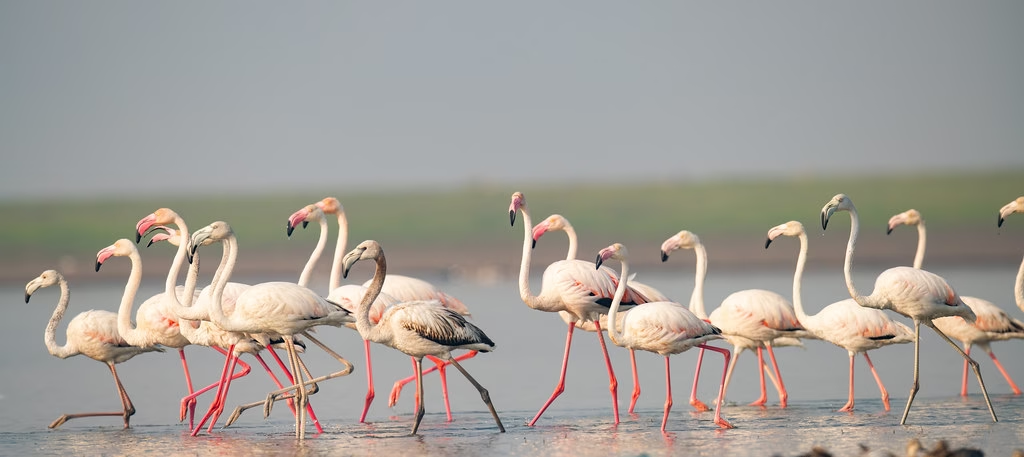
Travel Guide
Discover 5 fascinating facts about flamingos, from their pink color and social behaviors to unique feeding techniques and ingenious nesting strategies.
Few wetland birds are as immediately recognizable as flamingos. Their long legs, curved necks, distinctive bills, and striking pink plumage create an appearance that stands out even when they are seen from a considerable distance. Yet some of the most interesting Fascinating Facts About Flamingos have little to do with appearance alone.
The supplied source emphasizes five characteristics that help explain how flamingos live: their famous color comes from their diet, they form enormous social colonies, they possess highly specialized feeding structures, their long legs and necks have important practical functions, and they construct raised mud nests for breeding.
Together, these adaptations show that the flamingo’s unusual appearance is closely connected with its life in wetland environments.
One of the most surprising flamingo facts is that the birds do not begin life with their familiar bright pink coloration.
The supplied source describes young flamingos as naturally grey. The pink coloration develops because of pigments called carotenoids in their food.
Their diet can include algae, shrimp, and other small crustaceans containing these pigments.
As the food is digested, the pigments are processed and eventually deposited in the flamingo’s feathers, skin, and bill.
The result is the pink or reddish appearance associated with adult flamingos.
Not every flamingo displays exactly the same intensity of pink.
The source explains that coloration depends partly on the quantity and quality of carotenoids available in the diet.
Birds living in different habitats can therefore show variations in color.
Some may appear pale pink, while others can develop much stronger shades.
This variation demonstrates how directly an animal’s environment and food resources can influence visible physical characteristics.
The color is not simply decorative; it reflects biological processes associated with feeding.
For travelers, color is usually the first feature noticed when encountering flamingos.
A large flock can transform a wetland visually, particularly when hundreds or thousands of birds gather in shallow water.
Knowing how the coloration develops adds another dimension to the sighting.
Instead of viewing the birds only as naturally pink animals, observers can understand that the wetland’s food resources contribute directly to their appearance.
That relationship between diet and plumage is one of the most memorable Fascinating Facts About Flamingos.
The second major characteristic in the supplied source concerns social behavior.
Flamingos can gather in colonies numbering in the thousands.
These large groups are an important part of how the birds feed, breed, and respond to threats.
A single flamingo may look elegant, but the behavior of an entire colony reveals much more about the species.
Large concentrations create some of the most dramatic birdwatching scenes in wetland environments.
The source explains that colony living can provide safety in numbers.
When many birds are together, predators have greater difficulty isolating one individual.
A large group also creates many eyes capable of detecting disturbance.
Although individual birds still need to remain alert, collective living can reduce some of the risks associated with feeding and resting in exposed wetland habitats.
This social strategy is especially noticeable when a flock suddenly responds to the same stimulus.
Living in colonies also supports feeding and breeding behavior.
Large numbers of flamingos may forage in the same wetland where food conditions are favorable.
During breeding periods, the social character becomes even more obvious.
The supplied source describes synchronized courtship displays involving many birds.
Instead of courtship being limited to an isolated pair, numerous flamingos may participate in coordinated movements.
Flamingo courtship can create remarkable visual patterns.
Groups move together, displaying postures and repeated movements as part of the process of attracting mates.
For photographers and birdwatchers, these moments demonstrate why observing behavior can be more rewarding than concentrating only on portrait photographs.
The spectacle comes from coordination across the colony.
One bird may be interesting, but hundreds performing similar movements can transform the wetland into a constantly changing scene.
The third of the Fascinating Facts About Flamingos concerns feeding.
Their unusual bills are specially adapted to filter small food items from water and mud.
The supplied source compares the basic filtering principle with the way baleen whales separate food from water.
Although the animals and structures are very different, both feeding strategies involve filtering small organisms from an aquatic environment.
For flamingos, the process begins with their distinctive feeding posture.
A flamingo often lowers its head into the water so that the bill operates in an inverted position.
This can look unusual to an observer unfamiliar with the bird’s biology.
However, the bill is adapted specifically for this method.
The flamingo moves its head through water or soft sediment while filtering potential food.
The bird’s long neck makes it possible to reach the feeding surface while the body remains supported by its long legs.
Inside the bill are comb-like structures called lamellae.
The supplied source identifies these structures as essential to filtering.
As water moves through the bill, the lamellae help trap small organisms and food particles.
Algae, shrimp, and other suitable food can then be consumed while much of the water is expelled.
This feeding system allows flamingos to exploit food resources that would be difficult for many other birds to use efficiently.
The flamingo’s bill should therefore be understood together with the habitat.
Shallow wetlands contain food dispersed through water and sediment rather than presented as large individual prey.
Filter feeding provides a solution to this challenge.
The shape of the bill, the position of the head, the neck, and the bird’s ability to stand in shallow water all work together.
What appears visually strange is actually a highly specialized feeding system.
The fourth fact highlighted by the source concerns the flamingo’s remarkable proportions.
Long legs are not simply responsible for the bird’s elegant appearance.
They allow flamingos to wade into deeper water than many shorter-legged birds can comfortably reach.
This gives them access to feeding zones that might otherwise remain unavailable.
The ability to move through varying water depths can reduce direct competition with species limited to the shoreline.
Wetland water levels are rarely uniform.
One section may be extremely shallow while another becomes substantially deeper.
A flamingo’s long legs allow it to continue foraging across a wider portion of this environment.
When food is concentrated away from the immediate edge, this ability becomes particularly valuable.
Travelers watching a flock may notice how comfortably the birds remain standing in water that would cover much of the body of a smaller wader.
The flamingo’s long neck works with the legs.
Standing high above the water would create a feeding problem if the bird could not reach the surface.
The flexible neck solves that problem.
It allows the head and specialized bill to reach downward while the body remains above the water.
The flamingo’s unusual silhouette is therefore not a collection of exaggerated features without purpose.
Its legs, neck, and bill form an integrated feeding system.
These adaptations help flamingos exploit habitats that may look difficult from a human perspective.
Mud, shallow water, fluctuating depth, and tiny food organisms all create challenges.
The bird’s anatomy addresses each of them.
Long legs provide access, the neck provides reach, and the bill provides filtration.
Understanding this relationship can make a flamingo sighting much more interesting because every visible feature has a practical ecological function.
The fifth fact in the supplied source concerns reproduction.
Flamingos construct cone-shaped nests from mud in shallow wetland areas.
The nest raises the egg above the immediate ground or water surface.
This design is particularly important in environments where water levels and wet mud could otherwise threaten an egg placed directly on the substrate.
The structure may look simple, but it performs a vital protective role.
The source describes flamingo nests as reaching approximately 12 inches, or 30 centimeters, in height.
This elevation helps keep the egg above surrounding water.
The nest therefore functions almost like a small platform.
Its raised design can also help protect the egg from some immediate environmental hazards associated with a wet breeding site.
The birds use locally available material rather than transporting nesting resources over long distances.
According to the supplied material, flamingos typically lay one egg per breeding season.
Both parents participate in incubation.
Shared responsibility is important because incubation requires time and attention while adults still need to maintain themselves.
Parental cooperation continues the broader social theme visible throughout flamingo life.
These are birds whose feeding, courtship, breeding, and protection are all strongly associated with group living.
Flamingos are frequently used as symbols of tropical scenery because their color and body shape are visually striking.
Yet concentrating only on appearance misses the biological adaptations that make them successful wetland birds.
Their pink plumage reveals something about diet.
Their colonies demonstrate a strongly social lifestyle.
Their bills reveal specialized feeding, while their legs and necks show how anatomy can be shaped by habitat.
Even their mud nests represent a practical response to breeding in wet environments.
Travelers encountering flamingos can improve the experience by spending time watching behavior rather than simply photographing the flock.
Look at how individual birds position their heads while feeding.
Notice how far they wade from shore.
Observe whether the group is resting, feeding, moving, or displaying.
If breeding behavior is visible from an appropriate distance, the social organization of the colony becomes even clearer.
Binoculars can reveal details without requiring observers to approach sensitive nesting or feeding areas.
These Fascinating Facts About Flamingos reveal birds whose famous appearance is closely connected to highly specialized biology. Their pink coloration develops from carotenoid-rich foods. They gather in enormous social colonies, perform coordinated courtship behavior, filter small organisms through specialized bills, use long legs and necks to exploit wetland feeding areas, and construct raised mud nests to protect their eggs.
Understanding these characteristics changes a flamingo sighting.
The pink flock on the horizon is no longer simply a beautiful photographic subject. It becomes a community of highly adapted wetland birds whose color, anatomy, feeding, social behavior, and breeding strategy all reflect the environments in which they live.

26 African Countries Under Full or Partial U.S. Travel Ban (Post-December Update) Following the December update to U.S.…
Read article →
3 Days Congo Gorilla Safari – Encounter the Gentle Giants of Virunga A 3 Days Congo Gorilla Safari…
Read article →
Children and Kids on Safari – Family-Friendly Adventures in Africa Taking children on an African safari is one…
Read article →
How to Plan a Safari in Uganda—Your Complete Travel Guide Planning a safari in Uganda is the start…
Read article →