
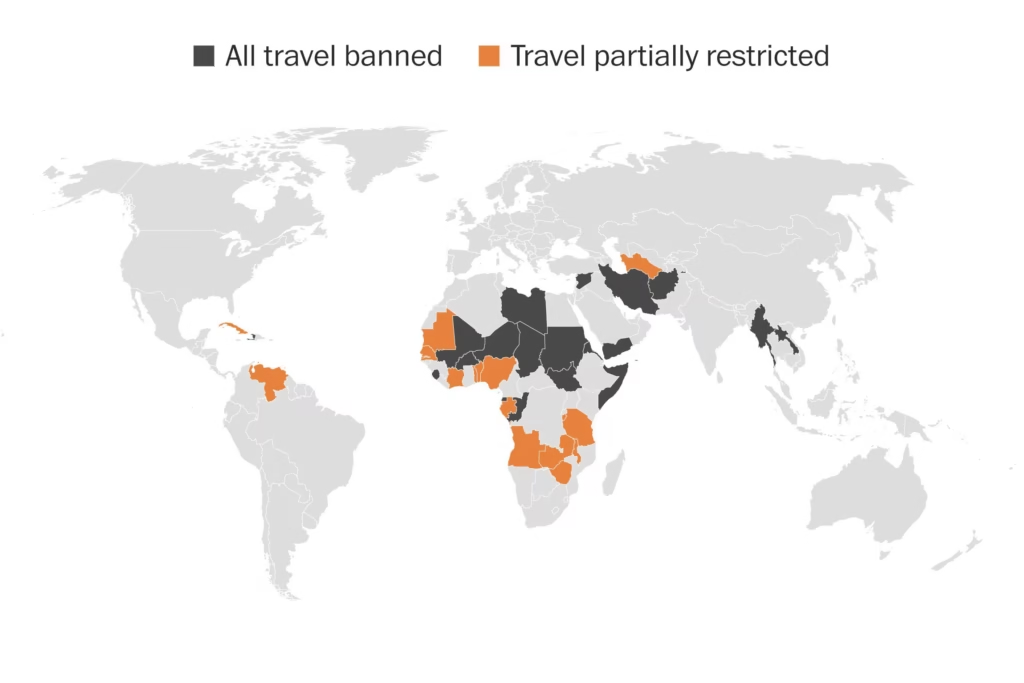
26 African Countries Under Full or Partial U.S. Travel Ban (Post-December Update)
26 African Countries Under Full or Partial U.S. Travel Ban (Post-December Update) Following the December update to U.S.…
Read article →
Travel Guide
Discover key facts about the Gorilla Habituation Experience, how it differs from gorilla trekking, and what to expect when spending extended time with wild gorillas.
The Gorilla Habituation Experience: Facts & What to Expect are important for travelers deciding between Uganda’s standard gorilla trekking experience and the longer habituation option. Both activities involve entering mountain gorilla habitat with trained teams, but they differ significantly in visitor numbers, time around the gorillas, permit price and the nature of the experience.
Uganda’s Gorilla Habituation Experience is associated with the Rushaga area of Bwindi Impenetrable National Park.
The activity provides visitors with up to four hours around a gorilla family involved in the habituation process, compared with approximately one hour during a standard gorilla trek once the gorillas are located.
That additional time makes habituation particularly attractive to photographers, primate enthusiasts and travelers interested in observing behavior in greater depth.
Habituation is the gradual process through which wild gorillas become accustomed to the controlled presence of humans.
It is not domestication.
The gorillas remain wild and continue living naturally within their forest habitat.
Researchers, trackers and other specialists spend substantial time around selected families, gradually allowing the animals to become familiar with predictable human presence.
The process is carefully managed because gorilla welfare comes first.
A habituated gorilla does not become a pet and should never be treated like one.
Uganda’s Gorilla Habituation Experience is conducted in the Rushaga sector of Bwindi Impenetrable National Park.
This location is important when choosing accommodation.
Travelers should stay within a practical distance of the relevant starting point.
Booking a lodge simply because it advertises itself as being “near Bwindi” can create problems because Bwindi contains several tourism sectors separated by significant road distances.
The permit and activity location should therefore guide accommodation selection.
The Uganda Gorilla Habituation Experience permit costs USD 1,500 per person.
This is higher than Uganda’s standard gorilla trekking permit, which costs USD 800 per person.
The price difference reflects the specialized nature of the experience and the longer period visitors may spend around the gorillas.
Travelers should confirm permit availability before paying for non-refundable accommodation or flights.
Permits are limited and should be treated as the central component of the itinerary.
The best-known difference is the amount of observation time.
During a standard gorilla trek, visitors normally have approximately one hour with the gorilla family after locating it.
The habituation experience allows up to four hours around the gorillas according to the activity’s official structure.
This does not mean the entire excursion lasts four hours.
Travelers must first trek through the forest to locate the family.
The complete activity can therefore occupy a substantial portion of the day.
The habituation experience involves a smaller tourist group than standard trekking.
This can make the encounter feel more intimate and can provide photographers with greater flexibility.
Smaller numbers do not mean visitors can ignore gorilla rules.
Instructions from guides and researchers remain essential.
The forest environment can also limit where people stand regardless of group size.
Travelers should arrive expecting a genuine wildlife experience rather than a controlled photographic session.
The word “four hours” sometimes causes travelers to focus only on the extended observation period.
The trek itself may be demanding.
Mountain gorillas move through natural forest, and their location changes.
Visitors may encounter steep slopes, muddy ground, tangled vegetation and rain.
There is no fixed distance that applies to every habituation experience.
Good fitness helps, but pacing and appropriate preparation are equally important.
Hiring a porter can make the experience considerably easier.
Porters can help carry a daypack and provide assistance on difficult sections of trail.
Their role becomes particularly valuable during a long forest day.
Using a porter also provides direct income connected with conservation tourism.
Travelers sometimes avoid porters because they want to prove they can manage independently.
There is little benefit in exhausting yourself before reaching the gorillas simply to carry a bag unnecessarily.
Long trousers and a long-sleeved shirt help protect against vegetation.
Wear sturdy hiking footwear with reliable grip.
A lightweight waterproof jacket is important because rain can occur in Bwindi.
Gaiters can be useful in muddy conditions.
Gloves are sometimes helpful when moving through vegetation, although visitors should follow guide instructions and avoid grabbing plants unnecessarily.
Clothing should prioritize comfort and protection rather than appearance.
Bring sufficient drinking water and food according to the day’s instructions.
Carry only equipment you genuinely need.
A heavy camera bag becomes much heavier after several hours on steep forest trails.
Protect electronics from rain.
Spare batteries and memory cards are useful for photographers.
Keep important items inside waterproof bags within the daypack.
The forest environment can change quickly from dry to wet.
Four hours creates exceptional photographic possibilities.
Instead of trying to capture every image during a one-hour window, photographers have more time to observe behavior.
Gorillas may feed, rest, groom or move through vegetation.
Lighting can remain challenging because Bwindi’s forest canopy creates shade and strong contrast.
A camera that performs well at higher ISO settings can be useful.
Flash photography is not appropriate around gorillas.
The longer experience is particularly valuable when visitors occasionally lower their cameras.
Four hours allows time to notice relationships among individuals.
A silverback’s position within the family, interactions between mothers and infants and juvenile play can become easier to understand.
Not every minute produces dramatic behavior.
Quiet periods are part of wildlife observation.
Patience allows the experience to become more than a collection of photographs.
Gorillas are vulnerable to diseases transmitted by humans.
Visitors must follow health and hygiene rules carefully.
Masks are used as part of protective measures, and travelers should maintain the required distance.
Anyone who is ill should report their condition honestly.
Missing a trek is disappointing, but exposing gorillas to preventable disease would be far more serious.
Conservation takes priority over an individual’s holiday plans.
The standard guidance requires visitors to keep an appropriate distance from gorillas, generally around seven meters when circumstances allow.
Gorillas themselves may sometimes move closer.
Visitors should not deliberately approach or touch them.
If an animal moves nearby, follow the guide’s instructions.
The fact that a gorilla family is undergoing habituation does not make physical contact acceptable.
These are powerful wild animals and must be respected as such.
The choice depends on the traveler.
Standard trekking is less expensive and provides the classic gorilla experience with approximately one hour around a habituated family.
The habituation experience costs more and involves a longer day, smaller visitor numbers and up to four hours around a family involved in the habituation process.
A first-time visitor can enjoy either option.
Photographers and serious primate enthusiasts may find the additional observation time especially valuable.
It can be.
More time increases the chance of experiencing different lighting and behavior.
A gorilla hidden behind vegetation at the beginning may later move into a clearer position.
Photographers also have more opportunity to slow down and compose images rather than shooting continuously.
However, the forest remains unpredictable.
Four hours does not guarantee perfect light or unobstructed photographs.
Wildlife photography always involves chance.
The minimum age for gorilla activities is 15.
Families traveling with younger children need alternative arrangements for the day of the trek.
This should be planned before booking.
A lodge may be able to assist with suitable activities or supervision, but arrangements differ by property.
Never assume younger children can join simply because they are physically fit.
Permit regulations apply regardless of individual ability.
Booking four to six months ahead is advisable for popular travel periods, and earlier planning can be sensible when dates are fixed.
Habituation permits are limited.
Travelers should first establish permit availability and then align accommodation, transportation and other activities.
Booking an expensive lodge before confirming the permit can create unnecessary complications.
The experience can be incorporated into a wider Uganda itinerary.
Queen Elizabeth National Park adds savannah wildlife and the Kazinga Channel.
Kibale provides chimpanzee tracking.
Lake Mburo can help break the journey between southwestern Uganda and central areas.
Travelers with sufficient time can therefore build an itinerary around several different ecosystems.
Allow a relatively relaxed day after habituation if possible.
The forest experience can be tiring.
The most important Gorilla Habituation Experience: Facts & What to Expect relate to time, exclusivity and the character of the encounter.
The permit costs USD 1,500 per person. The activity is associated with Rushaga in Bwindi. Visitor numbers are smaller than standard trekking, and participants can spend up to four hours around the gorillas after locating them.
Yet the experience is not simply an extended photo session.
It provides an opportunity to observe mountain gorillas within an ongoing conservation process.
The animals remain wild, the forest remains unpredictable and every visit unfolds differently.
For travelers willing to accept the physical demands and higher permit cost, those additional hours can provide one of the deepest primate experiences available in Uganda.

26 African Countries Under Full or Partial U.S. Travel Ban (Post-December Update) Following the December update to U.S.…
Read article →
3 Days Congo Gorilla Safari – Encounter the Gentle Giants of Virunga A 3 Days Congo Gorilla Safari…
Read article →
Children and Kids on Safari – Family-Friendly Adventures in Africa Taking children on an African safari is one…
Read article →
How to Plan a Safari in Uganda—Your Complete Travel Guide Planning a safari in Uganda is the start…
Read article →