
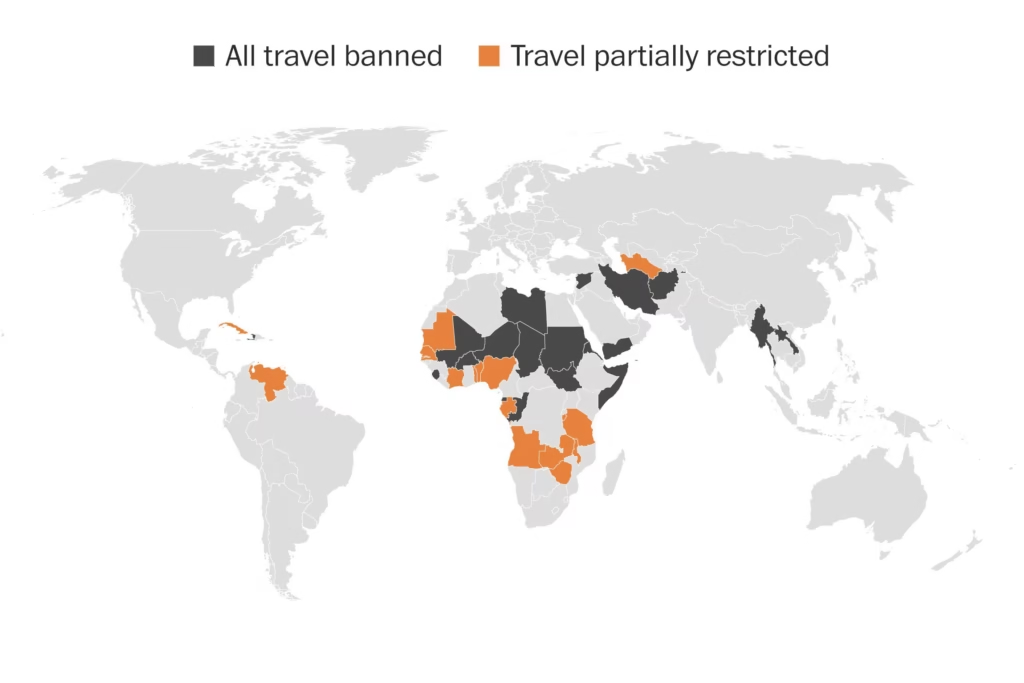
26 African Countries Under Full or Partial U.S. Travel Ban (Post-December Update)
26 African Countries Under Full or Partial U.S. Travel Ban (Post-December Update) Following the December update to U.S.…
Read article →
Travel Guide
Explore 5 fascinating facts about the plains zebra, including their unique stripes, social behavior, survival strategies, and communication methods.
The plains zebra, scientifically known as Equus quagga, is one of the most recognizable animals of the African landscape. Its bold black-and-white coat makes it instantly distinctive, yet there is much more to this animal than its appearance. The most interesting Plains Zebra Facts involve individual stripe patterns, strong social relationships, adaptability to demanding environments, sophisticated communication, and a close relationship with horses and donkeys.
Plains zebras are herbivores associated with Africa’s savannas and grasslands. They live in social groups and rely on a combination of vigilance, speed, physical strength, and communication to survive in environments shared with predators.
Watching zebras on safari can therefore reveal far more than a herd of striped animals feeding on grass. Their interactions, movements, and responses to danger provide a fascinating picture of how a highly social herbivore survives in the African wild.
The most famous feature of a plains zebra is its coat.
According to the supplied source, no two plains zebras have exactly the same pattern of stripes. The comparison is often made with human fingerprints because each animal can be distinguished through the arrangement of its markings.
This individuality has practical value for researchers.
When studying zebra populations, distinctive stripe patterns can help identify particular animals and follow them over time.
For a casual safari visitor, a large herd may initially look almost identical. Looking more carefully reveals variations in stripe width, shape, and arrangement.
This makes every zebra visually individual despite the strong similarity created by the species’ characteristic coat.
The supplied source presents several possible functions for zebra stripes.
One suggestion is camouflage. Black-and-white patterns may help break up the outline of an animal within its surroundings or make it more difficult for predators to isolate one individual when many zebras are moving together.
The source also mentions the possibility that stripes can help deter biting flies.
Rather than presenting the zebra’s coat as decoration, these explanations connect the pattern with practical survival.
The stripes are therefore one of the most interesting examples of an animal feature that is both visually striking and potentially functional.
A group of zebras creates an extraordinary visual effect.
When several individuals stand close together, their patterns overlap.
During movement, those patterns can become even more complex.
The source suggests that this may contribute to confusion for predators.
A predator such as a lion needs to concentrate on a particular target.
A mass of moving stripes can make the visual environment more complicated than when pursuing an isolated animal.
Regardless of the precise role of each function, the striped coat remains central to zebra identity.
Another important Plains Zebra Fact is that these animals are strongly social.
The supplied source describes herds ranging from a few individuals to more than 100 animals.
Within these larger gatherings, zebras can form family groups.
A dominant male may lead or defend a family unit, while females and young remain closely associated.
These social bonds provide practical benefits.
Living in a group increases the number of animals available to watch for danger.
While some individuals feed, others may notice movement or scent associated with predators.
Predators such as lions and hyenas are identified in the source as threats to plains zebras.
A solitary animal can be more vulnerable because it must detect danger without assistance.
Within a herd, many eyes and ears contribute to vigilance.
When one zebra reacts, its behavior can quickly alert others.
The herd can then move together.
This does not make every individual safe, but coordinated group behavior can reduce vulnerability.
Zebras also possess powerful kicks and can defend themselves when threatened.
Their physical strength should not be underestimated simply because they are herbivores.
The social structure of plains zebras goes beyond simply standing near one another.
Family groups create ongoing relationships between individuals.
Adults remain aware of other members, while young zebras develop within this social environment.
These bonds contribute to coordinated movement and protection.
On safari, patient observation can reveal these relationships.
A young animal may remain close to its mother, while adults maintain positions around the group.
Watching such behavior gives visitors a better understanding of zebras than simply photographing the herd and moving on.
The source notes that zebra herds can sometimes exceed 100 individuals.
Large gatherings can be particularly impressive in open landscapes.
The sight of many zebras moving or grazing together demonstrates how group-oriented the species can be.
Large numbers also create more complicated social dynamics.
Animals need ways to maintain contact and recognize signals within the group.
This helps explain why communication is another important part of zebra behavior.
The supplied source describes plains zebras as well adapted to savannas and grasslands.
These environments can change considerably with seasons.
Food and water may become widely separated, requiring animals to travel long distances.
Plains zebras are capable of making these movements.
Their muscular bodies provide the strength needed for regular travel, while their digestive strategy allows them to make use of tough grasses.
This adaptability helps them survive in areas where food quality may not always be ideal.
Plains zebras are herbivores whose diet consists largely of grasses.
The source particularly notes their ability to feed on tough, coarse vegetation.
This is an important survival advantage.
Animals that depend only on highly nutritious plant material may struggle when environmental conditions become difficult.
Zebras can continue using vegetation that may be less suitable for some other herbivores.
Their feeding behavior therefore allows them to exploit extensive grassland environments.
Savannah resources are not always available in the same places throughout the year.
Rainfall changes vegetation, and water sources can become more or less important as conditions shift.
The supplied source emphasizes the zebra’s ability to travel long distances in search of food and water.
This mobility is essential.
A herd that could not move efficiently would be much more vulnerable when local grazing deteriorated.
Strong legs and endurance therefore contribute to survival just as much as the zebra’s famous stripes.
The source states that plains zebras can run at speeds of up to approximately 65 kilometers per hour or 40 miles per hour when necessary.
Speed provides an important defense against predators.
However, escape involves more than simply running fast.
Zebras must detect danger, react quickly, remain coordinated, and use their physical strength effectively.
A predator may attempt to isolate a vulnerable individual.
The herd’s ability to respond collectively can make that task more difficult.
This combination of speed, awareness, and social behavior is central to zebra survival.
The source also highlights the use of powerful kicks when zebras defend themselves.
A zebra may look peaceful while grazing, but it is a strong wild animal.
Its legs provide both speed and defense.
Predators must therefore approach carefully.
A well-placed kick can make attacking dangerous.
This physical capability adds another layer to the zebra’s survival strategy.
It does not depend on one defense alone. Group living, vigilance, running ability, and physical resistance all work together.
One of the most interesting Plains Zebra Facts is the variety of ways these animals communicate.
The supplied source identifies sounds, body language, and facial expressions.
Zebras are particularly known for distinctive braying calls.
These sounds can carry across distance and help animals remain in contact.
Vocal communication is useful in open landscapes where members of a herd may become spread out while feeding or moving.
Calls can help maintain social connections even when animals are not standing directly beside one another.
The braying call of a zebra can surprise travelers hearing it for the first time.
Its voice is quite different from what some visitors expect based purely on the animal’s appearance.
The supplied source explains that vocalizations help herd members remain in contact over longer distances.
Sound can therefore serve a practical social purpose.
A call may provide information about location or help animals reconnect.
For safari visitors, listening to wildlife adds another dimension to observation.
The landscape is filled with communication that is easy to miss when attention is focused entirely on photography.
Zebras also communicate visually.
The source specifically identifies facial expressions and ear movements.
Ear position can provide clues about attention or mood.
An alert animal may orient its ears toward a sound, while different positions can accompany social interactions.
Facial signals also contribute to communication between individuals.
These behaviors can be subtle.
Spending several minutes watching a herd often reveals much more than taking a quick photograph.
Individuals constantly respond to the movements and signals of others.
The source includes tail flicks among zebra communication behaviors.
Tail movement can occur in different contexts and forms part of the animal’s visible body language.
Together with ear position, facial expression, posture, and sound, these signals create a broad communication system.
This is particularly important for a species living in social groups.
Strong herd bonds require animals to interpret what other members are doing.
Communication therefore contributes directly to social stability and survival.
Communication becomes especially important when predators are nearby.
One animal may detect a threat before the rest of the herd.
Its posture, movement, or vocal response can alert nearby zebras.
The group can then become more vigilant or begin moving.
This rapid transfer of information demonstrates why social living can provide a survival advantage.
The herd functions partly as a shared detection system.
The final major fact in the supplied source concerns the zebra’s biological relationships.
Plains zebras belong to the Equidae family, which also includes horses and donkeys.
The resemblance becomes obvious when visitors look beyond the stripes.
Zebras have familiar equid characteristics such as hooves, long faces, strong legs, and a body structure resembling their relatives.
Their striped coats and wild behavior make them visually distinctive, but they share a common evolutionary background with horses and donkeys.
The similarities among zebras, horses, and donkeys demonstrate how related animals can develop different characteristics in response to their environments.
A zebra’s coat immediately separates it visually from its relatives.
Its social organization and survival strategies also reflect life in African ecosystems where large predators remain a constant factor.
The basic equid body plan provides speed and mobility.
The zebra’s specific adaptations build upon that foundation.
Understanding these relationships gives visitors a more complete picture of the animal.
Plains zebras are often so common in certain safari landscapes that travelers can begin to overlook them.
This is unfortunate because their behavior rewards careful observation.
A herd can reveal family relationships, vigilance, communication, feeding behavior, and predator awareness.
Photographers can concentrate on individual stripe patterns or use larger groups to create dramatic compositions.
Young zebras interacting with adults can be particularly interesting.
Instead of treating zebras as background animals while searching for lions, visitors can spend time observing how the herd functions.
Predators are an important influence on zebra behavior.
The source identifies lions and hyenas among their threats.
A grazing herd may appear relaxed, but individuals remain alert.
Changes in posture can quickly spread through the group when something attracts attention.
If danger becomes immediate, the peaceful scene can transform into rapid movement.
Watching this transition helps safari visitors understand how survival shapes everyday behavior.
The five central facts in the source are closely connected.
Unique stripes contribute to individual identity and may serve survival functions. Social groups provide protection and shared vigilance. Strong bodies and mobility allow zebras to cope with challenging grassland environments. Communication maintains contact and coordinates behavior, while their equid anatomy provides speed and strength.
These characteristics work together.
No single feature explains the zebra’s success.
The animal survives through a combination of physical and behavioral adaptations.
The most interesting Plains Zebra Facts reveal that this familiar safari animal deserves much more attention than its striped coat alone might suggest.
Every individual carries a unique pattern. Herds form strong social structures. Zebras can travel considerable distances and use tough vegetation, communicate through sound and body language, and rely on speed and powerful kicks when threatened.
Their close relationship with horses and donkeys also places them within a broader evolutionary story.
For travelers exploring Africa’s savannas and grasslands, taking time to watch plains zebras can reveal one of the continent’s most adaptable, social, and visually distinctive herbivores.

26 African Countries Under Full or Partial U.S. Travel Ban (Post-December Update) Following the December update to U.S.…
Read article →
3 Days Congo Gorilla Safari – Encounter the Gentle Giants of Virunga A 3 Days Congo Gorilla Safari…
Read article →
Children and Kids on Safari – Family-Friendly Adventures in Africa Taking children on an African safari is one…
Read article →
How to Plan a Safari in Uganda—Your Complete Travel Guide Planning a safari in Uganda is the start…
Read article →