
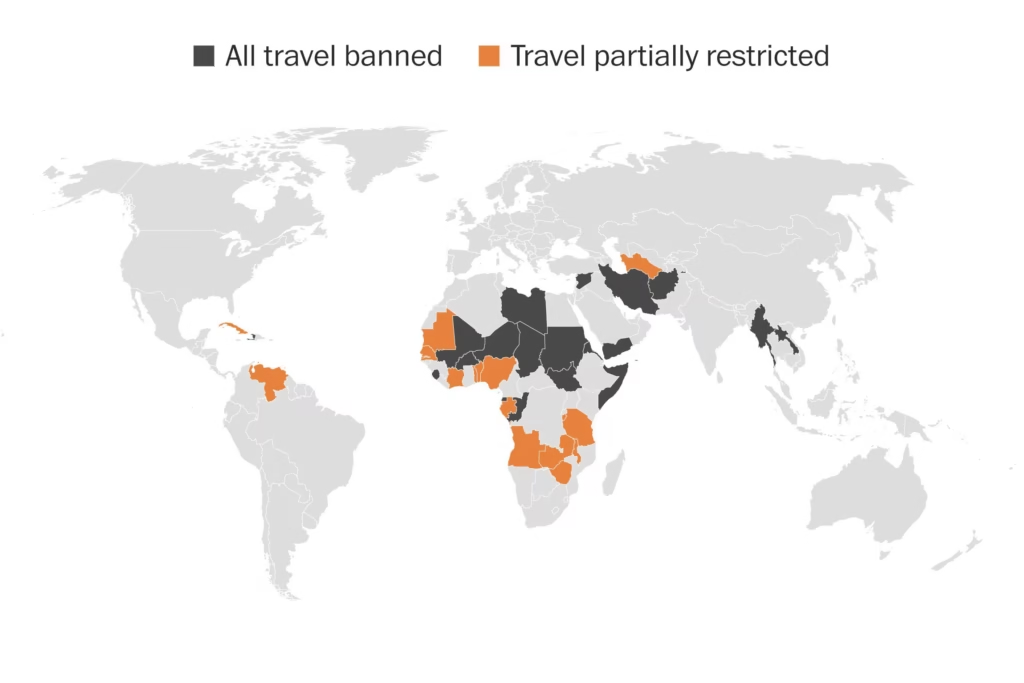
26 African Countries Under Full or Partial U.S. Travel Ban (Post-December Update)
26 African Countries Under Full or Partial U.S. Travel Ban (Post-December Update) Following the December update to U.S.…
Read article →
Travel Guide
Discover 5 fascinating facts about the Nile monitor, from its swimming abilities and territorial behavior to its diverse diet and impressive defense mechanisms.
The Fascinating Facts About the Nile Monitor highlighted in the source focus on swimming ability, territorial behavior, a diverse diet, and impressive defense mechanisms. These characteristics make the Nile monitor an interesting reptile for travelers who want to look beyond the large mammals that dominate many African safari itineraries.
A wildlife experience becomes richer when visitors pay attention to reptiles, birds, insects, and smaller animals as well as lions, elephants, gorillas, and other famous species.
The Nile monitor provides a particularly useful example because its behavior connects land and water environments.
Rather than seeing the animal simply as a large lizard, travelers can consider how its physical abilities and behavior help it survive.
Swimming ability is one of the first Fascinating Facts About the Nile Monitor identified by the source.
This characteristic means travelers may encounter the animal around environments associated with water as well as on land.
Seeing a reptile move confidently through water can challenge assumptions held by visitors who think of lizards only as terrestrial animals.
A safari guide can help identify the animal and explain what visitors are observing.
Travelers should remain at an appropriate distance.
A Nile monitor should never be approached simply because it appears calm.
Wild animals need space, and reptiles can react quickly when disturbed.
Photography is best done with suitable zoom rather than by attempting to move closer.
Images showing the monitor near water can communicate the relationship between the animal and its environment.
The ability to swim also makes patient observation worthwhile.
Visitors who see an animal enter water should avoid assuming the sighting is finished immediately.
Where viewing conditions and guide instructions allow, watching quietly may reveal additional behavior.
Territorial behavior is another theme identified by the source.
Wildlife behavior is one of the most rewarding subjects for travelers because it transforms a sighting from simple identification into observation.
Instead of asking only, “What animal is that?” visitors can ask what the animal is doing and why the behavior may matter.
The source does not provide detailed territorial patterns, so unsupported specifics should not be added.
The important point is that territorial behavior forms part of the Nile monitor’s natural life.
Visitors should avoid interfering with interactions between animals.
If two monitors are displaying or responding to each other, tourists should allow the behavior to unfold naturally.
Wildlife should never be provoked to create a more dramatic photograph or video.
Responsible guides understand that the objective is observation rather than manipulation.
This principle applies equally to reptiles and famous mammals.
A diverse diet is another of the Fascinating Facts About the Nile Monitor highlighted in the source.
Diet can help travelers understand why an animal uses particular habitats and behaves in particular ways.
The source does not provide a detailed list of food items, so there is no need to invent one.
Instead, visitors can use the concept of dietary diversity to think about the monitor’s ecological role.
Wild animals should obtain food naturally.
Tourists should never feed Nile monitors.
Feeding can change behavior and encourage animals to associate people with food.
This can create problems for wildlife as well as visitors.
Food waste should therefore be handled carefully around lodges, picnic areas, and wildlife destinations.
Leaving scraps accessible to animals can amount to unintended feeding.
Travelers should follow local waste-disposal rules and keep food secured where necessary.
Families can use a monitor sighting as an educational opportunity.
Children may initially focus on the animal’s appearance, but guides can help them think about habitat, diet, and behavior.
This creates a more complete understanding of reptiles.
Defense mechanisms form another major part of the source’s description.
An animal’s defensive behavior exists to protect it from perceived threats.
Tourists should therefore never deliberately trigger such behavior for entertainment.
A reptile displaying defensive behavior may be communicating that it feels threatened.
The appropriate response is to give it space according to professional guidance.
This is particularly important for travelers who encounter monitors outside a formal game drive.
An animal near accommodation, a waterway, or another travel setting should not be chased, cornered, or handled.
Local staff or wildlife professionals can provide appropriate guidance where necessary.
The Fascinating Facts About the Nile Monitor should encourage respect rather than fear.
Understanding that an animal has defense mechanisms does not mean it is constantly attempting to attack people.
Wildlife generally needs appropriate space and sensible human behavior.
Photography should never involve surrounding an animal.
A group of people approaching from different directions can create unnecessary stress.
One responsible viewing position is better than a dramatic photograph obtained through disturbance.
Reptiles are frequently overlooked because travelers arrive with lists dominated by mammals.
Yet biodiversity includes far more than the most heavily advertised safari animals.
A Nile monitor sighting can encourage visitors to slow down and notice details around rivers, wetlands, and other habitats.
Guides can play an important role in this process.
A skilled guide does not only locate large mammals.
They can help visitors understand birds, reptiles, vegetation, tracks, and ecological relationships.
Travelers who show curiosity often discover that quieter sightings become some of the most educational moments of a safari.
The source emphasizes swimming, territorial behavior, dietary diversity, and defense mechanisms.
Together these characteristics demonstrate why the Nile monitor is well adapted to its environment.
They also provide several different behaviors for visitors to observe.
The Fascinating Facts About the Nile Monitor remind travelers that safari experiences do not need to revolve exclusively around the biggest animals.
A reptile moving through water, interacting with its environment, feeding naturally, or simply resting can provide a valuable wildlife observation.
Visitors should maintain distance, avoid feeding or provoking the animal, and follow professional guidance.
With patience and curiosity, the Nile monitor can become much more than a species briefly spotted beside the road.
It can provide an introduction to reptile behavior, adaptation, and the wider ecological diversity that makes African wildlife travel so rewarding.

26 African Countries Under Full or Partial U.S. Travel Ban (Post-December Update) Following the December update to U.S.…
Read article →
3 Days Congo Gorilla Safari – Encounter the Gentle Giants of Virunga A 3 Days Congo Gorilla Safari…
Read article →
Children and Kids on Safari – Family-Friendly Adventures in Africa Taking children on an African safari is one…
Read article →
How to Plan a Safari in Uganda—Your Complete Travel Guide Planning a safari in Uganda is the start…
Read article →