
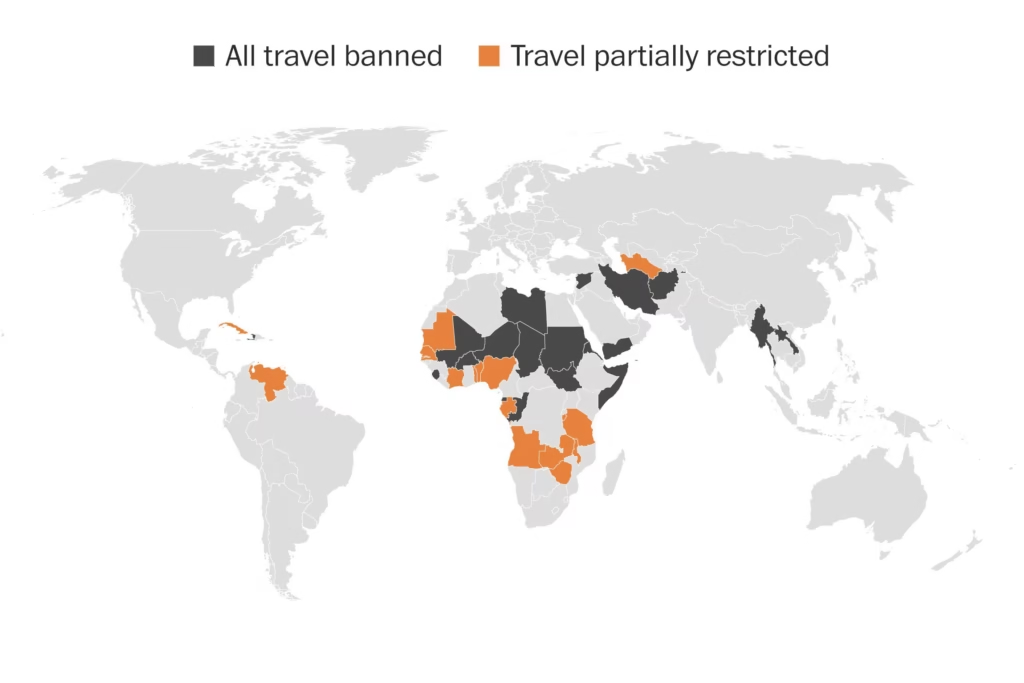
26 African Countries Under Full or Partial U.S. Travel Ban (Post-December Update)
26 African Countries Under Full or Partial U.S. Travel Ban (Post-December Update) Following the December update to U.S.…
Read article →
Travel Guide
5 fascinating facts about the caracal, from its hunting skills and tufted ears to its solitary behavior and resilience in the wild.
The caracal is one of the most distinctive wild cats found across Africa, the Middle East, and parts of Central Asia. With its long legs, athletic body, reddish coat, and unmistakable black ear tufts, the animal has an appearance that immediately separates it from many other small and medium-sized cats.
The scientific name Caracal caracal reflects a species adapted to surviving in varied environments. Caracals can occupy savannahs, dry woodland, scrub, semi-desert landscapes, and mountainous terrain. Their adaptability has helped them persist across a wide geographic range, even though individual animals can be difficult to observe because of their secretive behavior.
Among the most Fascinating Facts About the Caracal are its extraordinary hunting ability, distinctive tufted ears, solitary lifestyle, remarkable agility, and resilience in landscapes increasingly influenced by people.
Understanding these characteristics adds another layer of interest to an African safari. The caracal may not receive the same attention as lions, leopards, or cheetahs, but it is an exceptionally capable predator with a set of adaptations perfectly suited to its lifestyle.
One of the most impressive Fascinating Facts About the Caracal is the animal’s ability to hunt efficiently.
The source describes caracals as capable of taking prey larger than themselves, including small antelopes. This ability is possible because the caracal combines stealth, speed, strength, and a powerful pounce.
Like many cats, a caracal does not simply chase every animal it encounters. It can stalk potential prey, using vegetation, terrain, and low body posture to reduce the distance before attacking.
This strategy conserves energy. A successful predator needs to balance the energy spent hunting with the nutrition gained from a successful capture.
The caracal’s muscular hindquarters play an important role. They provide the explosive force needed for rapid acceleration and jumping.
These abilities make the caracal an effective predator across environments where prey can be widely dispersed.
Perhaps the most dramatic example of caracal hunting ability is its capacity to leap into the air after birds.
The source states that caracals can jump as high as approximately 10 feet or 3 meters while attempting to catch birds in flight.
The sight of a medium-sized cat launching vertically into the air illustrates how specialized its body is for sudden movement.
Long, powerful legs provide the necessary acceleration, while excellent coordination allows the animal to adjust its position rapidly.
Bird hunting is only one part of the caracal’s feeding behavior, but it has become one of the species’ most recognizable characteristics.
For safari travelers, seeing a caracal at all can be fortunate because these cats are often elusive. Witnessing hunting behavior is even less predictable and should never be expected on a scheduled basis.
The caracal’s hunting success does not depend only on dramatic leaps.
Much of its effectiveness begins with remaining unnoticed. Moving quietly through grass or scrub allows the cat to approach prey before revealing its presence.
Its coat helps it blend into many dry African landscapes. Reddish and sandy tones can become difficult to distinguish from surrounding vegetation and soil, particularly in softer light.
Once sufficiently close, the caracal can use a sudden burst of speed rather than attempting a prolonged chase.
This combination of camouflage, patience, hearing, agility, and explosive movement helps explain why the caracal is such a capable hunter.
Few features identify a caracal as quickly as its ears.
The animal has tall ears topped with conspicuous black tufts. The source notes that these tufts can reach approximately 2.5 inches or 6.5 centimeters in length.
They contribute significantly to the caracal’s striking appearance. Even when much of the animal is partly concealed by vegetation, its upright ears can sometimes remain visible.
The source associates these ears with the caracal’s strong sense of hearing and ability to detect prey.
Sensitive hearing is extremely useful for a predator that frequently hunts animals hidden in vegetation.
The ability to identify the location of subtle movements can provide an advantage before the prey even realizes that a predator is nearby.
African savannah and scrub environments contain countless sounds. Wind moves through grass, birds call, insects create background noise, and small animals move beneath vegetation.
A successful predator must separate useful information from that constant background.
The caracal’s large ears help it detect subtle sounds produced by potential prey.
This becomes particularly valuable when an animal cannot be seen clearly.
A rodent or bird hidden behind vegetation may reveal itself through movement long before it becomes visually obvious.
The caracal can then orient its body toward the sound and approach more carefully.
This relationship between hearing and hunting is one reason the ears are more than simply an attractive physical characteristic.
The ear tufts are only part of the animal’s appearance.
Caracals generally have a relatively uniform coat compared with heavily patterned cats such as leopards.
The body is athletic, with long legs that contribute to the animal’s jumping ability.
Its facial markings and black-backed ears further distinguish it.
Together, these features create an animal that looks elegant but powerful.
For wildlife photographers, the ears often become the defining feature of a portrait. However, because caracals are wild animals, photographers must depend on natural sightings rather than attempting to approach or influence their behavior.
Another of the most important Fascinating Facts About the Caracal concerns its social behavior.
The source describes caracals as primarily solitary animals. They generally live and hunt alone rather than forming the permanent groups associated with lions.
This lifestyle makes sense for a predator that must secure enough prey within its territory.
Sharing every hunting opportunity with several other adults could increase competition for food.
Instead, individual caracals can maintain their own ranges and communicate their presence through scent and vocalizations.
Males and females generally come together primarily for reproduction.
The solitary lifestyle also contributes to the difficulty of seeing caracals on safari. Even in areas where they occur, there may be only one animal moving quietly through a substantial area.
The source notes that caracals use scent glands and vocalizations in territorial behavior.
Scent communication is useful for solitary animals because individuals do not need to meet physically in order to exchange information.
A scent mark can indicate that another caracal has recently occupied an area.
This type of communication helps animals organize their use of space while reducing unnecessary direct confrontation.
Vocal communication can provide another method of interaction when individuals are within hearing range.
For safari visitors, much of this behavior happens unnoticed. A caracal may have passed through an area without leaving any obvious sign to an untrained observer.
Researchers and experienced guides can therefore provide useful insight into the hidden lives of these elusive cats.
Solitary behavior is one reason sightings can be challenging.
A pride of lions contains several visible animals, and lions often rest in relatively open areas. A solitary caracal presents a completely different viewing challenge.
Its smaller body can disappear quickly into grass or scrub.
Camouflage further reduces visibility.
Caracals also do not need to remain around large groups of their own species.
For travelers, this means a caracal sighting should be appreciated as an opportunity rather than expected as a guaranteed part of a safari.
Patience and experienced guiding can help, but wild animals ultimately determine where and when they appear.
The caracal’s agility is central to its survival.
The source describes long legs, a muscular body, and large paws as physical characteristics that help the animal move quickly and accurately.
This agility serves several purposes.
It supports hunting by allowing the caracal to accelerate rapidly and leap toward prey. It also helps the animal negotiate uneven landscapes and dense vegetation.
The same athleticism is responsible for the spectacular vertical jumps associated with catching birds.
A caracal therefore represents a combination of strength and precision rather than simply raw speed.
Its movements need to be controlled enough to stalk quietly and explosive enough to complete a successful attack.
Caracals occur in a range of habitats.
The source identifies environments including savannahs, forests, mountains, and deserts.
Surviving across such varied terrain requires behavioral flexibility.
An animal moving through open grassland encounters different hunting conditions from one living in rocky or heavily vegetated terrain.
The caracal’s body provides the flexibility needed to navigate many of these environments.
Its ability to survive in different habitats is one reason the species maintains a broad geographic distribution.
However, adaptability does not mean the species is immune to environmental pressure.
The source states that caracals are not currently categorized as endangered but still face significant threats.
These include habitat loss, poaching, and human-wildlife conflict.
Habitat change can reduce available hunting areas or alter prey populations.
Conflict may occur when caracals move into areas used for livestock. Farmers protecting domestic animals may regard predators as a threat.
The source also notes that caracals can be hunted for their fur in some regions.
These pressures demonstrate why a species does not need to be globally endangered for local conservation challenges to matter.
Populations can face very different circumstances in different parts of their range.
One of the caracal’s advantages is adaptability.
The source emphasizes the species’ ability to survive across varied habitats.
This resilience can help populations persist where environmental conditions change, provided sufficient habitat and prey remain.
However, resilience should not be interpreted as unlimited tolerance of habitat destruction or persecution.
Wildlife conservation depends on maintaining functional ecosystems in which predators have enough space and prey.
Reducing human-wildlife conflict is equally important, particularly in landscapes where predators and livestock occur close together.
Caracals can occur across parts of Africa, but they are generally less predictable to see than some larger safari species.
Their solitary behavior, camouflage, and ability to move quietly make them easy to miss.
An experienced safari guide can improve the chances of noticing signs or identifying suitable habitat, but no ethical safari should promise a particular wild caracal sighting.
Travelers should instead approach wildlife viewing with patience.
A safari becomes richer when visitors appreciate less famous animals alongside iconic species.
If a caracal does appear, observing it from an appropriate distance allows the animal to continue its natural behavior.
A caracal’s distinctive ears and athletic shape make it a compelling photography subject.
Longer lenses allow photographers to create detailed images without approaching too closely.
Visitors should avoid asking drivers to pressure an animal into a better position.
If the caracal is hunting, resting, or moving through vegetation, allowing it to behave naturally should remain the priority.
Natural behavior usually produces more meaningful photographs anyway.
The best wildlife images tell the story of an animal in its environment rather than showing an animal reacting to intrusive tourism.
Predators play important roles within ecosystems.
Caracals hunt a range of prey and therefore form part of the wider ecological relationships connecting vegetation, herbivores, smaller animals, and larger predators.
Their presence also contributes to the extraordinary diversity that makes African wildlife destinations so interesting.
A safari focused only on the largest mammals can easily overlook species whose adaptations are equally impressive.
The caracal is a perfect example.
It may be smaller than a lion and less famous than a leopard, but its ability to stalk, jump, listen, adapt, and survive makes it one of Africa’s most fascinating wild cats.
The five central Fascinating Facts About the Caracal reveal an animal shaped by its environment.
It is an exceptional hunter capable of powerful leaps. Its black-tufted ears contribute to its unmistakable appearance and highly developed sensory abilities. Its solitary behavior allows it to occupy and defend hunting areas independently. Its agility helps it capture prey and navigate challenging terrain. Finally, its adaptability enables it to survive across varied landscapes even while habitat loss and conflict create conservation pressures.
Together, these traits make the caracal much more than a beautiful safari sighting.
It is a specialized predator whose physical and behavioral adaptations demonstrate the remarkable diversity of Africa’s wild cats.

26 African Countries Under Full or Partial U.S. Travel Ban (Post-December Update) Following the December update to U.S.…
Read article →
3 Days Congo Gorilla Safari – Encounter the Gentle Giants of Virunga A 3 Days Congo Gorilla Safari…
Read article →
Children and Kids on Safari – Family-Friendly Adventures in Africa Taking children on an African safari is one…
Read article →
How to Plan a Safari in Uganda—Your Complete Travel Guide Planning a safari in Uganda is the start…
Read article →