

26 African Countries Under Full or Partial U.S. Travel Ban (Post-December Update)
26 African Countries Under Full or Partial U.S. Travel Ban (Post-December Update) Following the December update to U.S.…
Read article →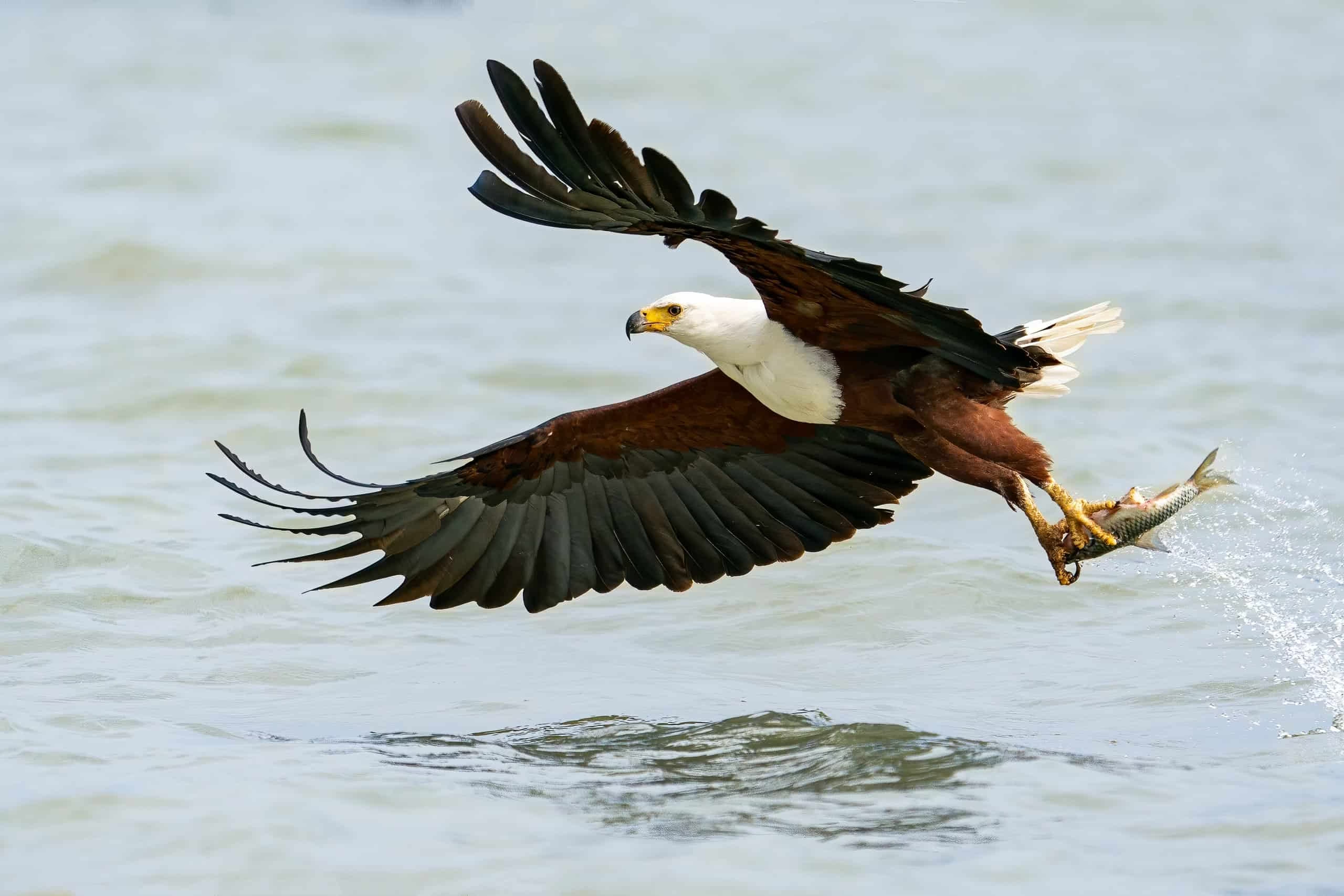
Travel Guide
Five fascinating facts about the African fish eagle, from its powerful call to its expert fishing skills. Discover why this bird is a true icon of Africa.
Few birds create a stronger sense of the African wilderness than the African fish eagle. Its distinctive cry carries across lakes and rivers, while its contrasting plumage and powerful talons make it immediately recognizable. The most interesting African Fish Eagle facts reveal an animal closely connected to water but capable of using a surprisingly varied diet and sophisticated hunting strategies.
The supplied source highlights five major characteristics: its unforgettable voice, dependence on aquatic habitats, flexible diet, strong pair bonds, and exceptional fishing ability.
Together, these characteristics explain why the African fish eagle has become one of the continent’s most recognizable birds.
For safari travelers, the species is particularly associated with water-based experiences. Boat cruises and visits to lakes, rivers, and floodplains can provide opportunities to hear its call, watch it perch above the water, or perhaps observe a hunting attempt.
The first of the supplied African Fish Eagle facts concerns sound.
The African fish eagle produces a loud, distinctive call often described as yodeling or laughter-like.
The call can carry across large bodies of water.
Travelers may therefore hear a fish eagle before seeing it.
For many visitors, this sound becomes closely associated with time spent beside African lakes and rivers.
A bird perched high in a tree can be difficult to notice initially, but its vocalization immediately draws attention to its presence.
The supplied source describes the African fish eagle’s call as something widely recognized as a sound of the African wilderness.
This connection is understandable because the bird is strongly associated with open water and wild landscapes.
Sound can become one of the strongest memories of safari travel.
Visitors often concentrate on visual experiences, but wildlife areas have their own soundscape.
Bird calls, primate vocalizations, insects, frogs, and larger animals all contribute.
The African fish eagle is particularly memorable because its call is powerful and distinctive.
The source states that countries including Zambia, South Sudan, and Zimbabwe use the African fish eagle as a national symbol.
Its proud appearance and association with freedom and wild landscapes help explain this cultural significance.
National symbolism gives the bird an importance extending beyond ornithology.
It becomes connected with identity, landscape, and ideas about the natural heritage of the continent.
For visitors, understanding this symbolic role adds another layer to seeing the species in the wild.
The second major fact is closely connected with the bird’s name.
African fish eagles are associated with lakes, rivers, and floodplains.
These environments provide both food and suitable places from which to hunt.
The supplied source describes the birds perching on tall trees or snags while watching the water below.
This elevated position provides a wide view.
Instead of flying continuously while searching for prey, an eagle can wait from a strategic perch until an opportunity appears.
A tree overlooking water functions almost like an observation tower.
From there, the eagle can scan the surface.
When it identifies a suitable fish, it can leave the perch and begin an attack.
This hunting strategy combines patience with sudden speed.
For safari travelers hoping to photograph an African fish eagle, watching likely perches can therefore be productive.
An apparently inactive bird may suddenly launch toward the water.
Understanding the behavior helps visitors anticipate the action rather than reacting only after the eagle has moved.
Aquatic habitats provide the conditions needed for the fish eagle’s primary hunting behavior.
Fish become available near the surface, while trees along the shore provide places to watch.
The relationship between bird and habitat is therefore very strong.
Protecting riverbanks, lakes, floodplains, and associated vegetation supports not only African fish eagles but many other species.
Water-based safaris are particularly rewarding because these ecosystems concentrate wildlife from both aquatic and terrestrial environments.
Despite the name, the supplied source explains that the African fish eagle has a more varied diet.
Fish remain strongly associated with the species, but it can also feed on birds, small mammals, reptiles, and carrion.
This dietary flexibility helps the eagle take advantage of different food opportunities.
An animal that depended on only one prey source could struggle whenever that resource became difficult to obtain.
A broader diet creates more options.
This adaptability is one reason the species can function across different aquatic landscapes.
The source also states that African fish eagles may steal food from other birds such as herons or ospreys when opportunities arise.
This behavior demonstrates that hunting is not the only way the eagle obtains food.
Wild predators often balance energy expenditure against potential reward.
If another animal has already captured suitable prey, taking advantage of that opportunity may require less effort than catching a new meal.
This opportunistic behavior adds another dimension to the eagle’s reputation as an efficient predator.
The inclusion of carrion in the supplied source further demonstrates dietary flexibility.
Scavenging may not fit the popular image of an eagle dramatically catching fish, but survival in the wild rewards adaptability.
Animals use available resources.
The African fish eagle’s ability to hunt different prey and take advantage of carrion allows it to respond to changing circumstances.
This is a useful reminder that wildlife behavior is often more complex than an animal’s common name suggests.
The fourth major fact concerns reproduction and social relationships.
According to the supplied source, African fish eagles form strong pair bonds and often mate for life.
Pairs establish nesting areas near water.
This creates continuity within a territory.
A pair may return to and maintain the same general nesting area over an extended period.
For birdwatchers, knowing this behavior can make established territories particularly interesting because the birds may remain closely associated with the location.
The source describes African fish eagle nests as large structures built from sticks in tall trees near water.
Pairs may use and rebuild the same nest over many years.
Instead of starting completely from the beginning every season, they add material to an existing structure.
Over time, this can produce a remarkably large nest.
The supplied source states that some nests can grow to more than two meters wide.
This scale reflects years of repeated construction and maintenance.
A nest high in a tree near water offers several advantages.
The elevated position provides separation from many ground-level disturbances, while the proximity to aquatic hunting areas keeps food resources accessible.
The nest becomes part of a wider territory that includes hunting perches and shoreline.
For safari visitors, nests should be observed responsibly from an appropriate distance.
Breeding birds should not be disturbed for photography.
The fifth fact is perhaps the behavior most closely associated with the species.
The African fish eagle is a highly specialized fisher.
The supplied source explains that it has rough, spiny soles that help it grip slippery fish.
This adaptation is essential because capturing a fish is only the first challenge.
The eagle must maintain its grip while leaving the water and carrying the prey.
Its feet and talons are therefore central to the hunting process.
Fishing often begins with patience.
The eagle waits from a perch and watches the surface.
Once a fish is detected, the bird leaves the perch and moves rapidly toward the water.
Timing matters.
A fish may remain near the surface only briefly.
The eagle must coordinate vision, speed, foot position, and flight in a very short period.
The dramatic final grab is therefore the result of several abilities working together.
The source describes the eagle swooping low over the water before taking the fish with its talons.
A successful attack can happen quickly.
For photographers, capturing the moment requires anticipation.
Watching the bird’s posture before takeoff may provide clues that it is preparing to hunt.
Even when an attempt fails, observing the process reveals the skill involved.
Wild predators do not succeed automatically.
Hunting requires repeated decisions and physical effort.
One of the most unusual behaviors in the supplied source occurs when a fish is too heavy for the eagle to lift easily.
The material states that the bird may use its wings to swim toward shore while dragging the prey across the water.
This demonstrates strength as well as behavioral flexibility.
Instead of simply abandoning the catch, the eagle may adapt its strategy.
It is an impressive example of problem-solving within the context of feeding.
The source highlights several water-based safari areas, including the Nile, Lake Naivasha, and Chobe River.
These examples illustrate the type of environment where visitors can look for the species.
A boat safari can be particularly rewarding because travelers move through the eagle’s aquatic habitat.
Guides may recognize regular perches and calls.
However, wildlife sightings remain natural events.
Visitors should enjoy the wider birdlife and river environment rather than expecting a particular hunting performance.
The bird’s appearance makes it an excellent photographic subject.
Its white head contrasts strongly with darker plumage, and its flight can create dramatic images.
Fishing behavior adds action.
A photographer can begin by observing rather than immediately taking photographs.
Where does the bird perch?
Is it watching the water?
How does its posture change before flight?
Understanding behavior can improve the chances of anticipating a useful photographic moment.
The five major African Fish Eagle facts described by the source work together to explain the bird’s iconic reputation.
Its voice creates an unmistakable sound.
Its association with water places it in some of Africa’s most beautiful landscapes.
Its varied diet demonstrates adaptability.
Strong pair bonds and large nests reveal another side of its life, while specialized feet and dramatic fishing techniques show why it is such an effective predator.
The result is a bird that is impressive whether sitting quietly in a tree or diving toward the water.
Travelers do not need to be specialist birdwatchers to appreciate the African fish eagle.
Hearing its call for the first time can be as memorable as seeing it.
Watching a pair around a nesting territory provides insight into its social behavior.
Seeing an individual scan the water reveals the patience behind its hunting strategy.
If a fishing attempt occurs, the speed and precision can transform a quiet boat safari into a dramatic wildlife encounter.
The African fish eagle therefore rewards patient observation.
Its distinctive voice, aquatic lifestyle, flexible feeding behavior, pair bonds, and extraordinary fishing skills make it one of the most recognizable and fascinating birds associated with Africa’s rivers and lakes.

26 African Countries Under Full or Partial U.S. Travel Ban (Post-December Update) Following the December update to U.S.…
Read article →
3 Days Congo Gorilla Safari – Encounter the Gentle Giants of Virunga A 3 Days Congo Gorilla Safari…
Read article →
Children and Kids on Safari – Family-Friendly Adventures in Africa Taking children on an African safari is one…
Read article →
How to Plan a Safari in Uganda—Your Complete Travel Guide Planning a safari in Uganda is the start…
Read article →