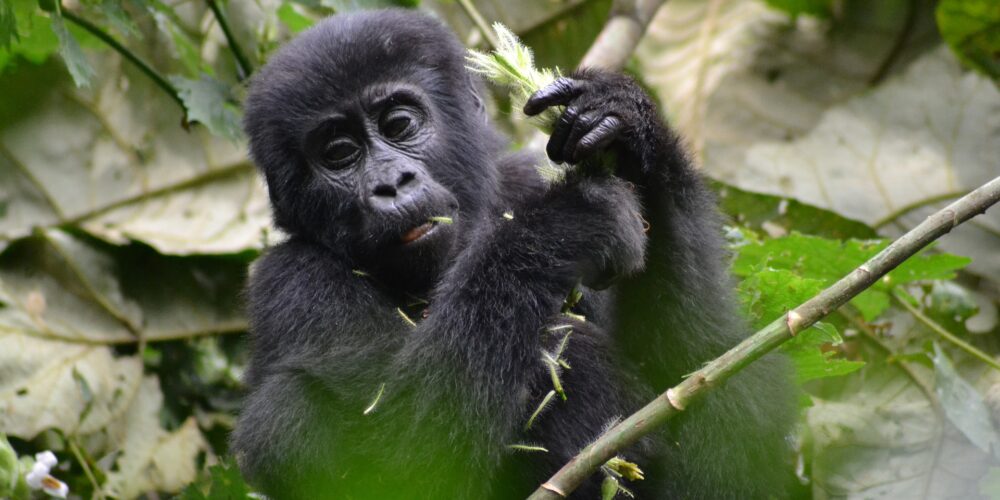

Eastern Gorilla
Eastern Gorilla: The Endangered Giant of East and Central Africa
The eastern gorilla stands as one of Africa’s most remarkable great apes, known for its immense strength, complex social life, and highly restricted distribution. It survives only in a few protected and fragmented forests across Uganda, Rwanda, and the Democratic Republic of Congo. Unlike its western counterpart, the eastern gorilla faces a more concentrated set of environmental pressures, yet it also includes one of conservation’s greatest success stories.
This gorilla group includes two subspecies: the mountain gorilla and the eastern lowland gorilla, also called Grauer’s gorilla. Both share a common lineage but adapted to very different environments, ranging from volcanic mountain forests to dense lowland rainforests.
Habitat and Geographic Range
Eastern gorillas occupy habitats across the Albertine Rift, one of Africa’s most biologically diverse regions. This area includes high-altitude volcanic slopes, bamboo forests, montane woodlands, and lowland tropical rainforests. The habitat changes dramatically with elevation, shaping how each subspecies survives.
Mountain gorillas live in high-altitude forests between 2,200 and 4,300 meters above sea level. These environments remain cool, misty, and covered in thick vegetation. They include iconic protected areas such as Bwindi Impenetrable National Park, Mgahinga Gorilla National Park, and Volcanoes National Park.
Eastern lowland gorillas inhabit the lowland rainforests of eastern Democratic Republic of Congo, especially within and around Kahuzi-Biega National Park. Their environment remains warmer and more humid, with dense forest cover, swampy areas, and vast stretches of unbroken jungle.
This combination of highland and lowland habitats makes eastern gorillas ecologically diverse, yet also vulnerable due to fragmentation and human pressure.
Physical Characteristics
Eastern gorillas show a powerful and robust build, especially in eastern lowland gorillas, which rank as the largest gorilla subspecies. Adult males can exceed 200 kilograms in weight and develop broad chests, strong arms, and thick muscular frames that support life in dense forest environments.
Mountain gorillas appear stockier and more heavily furred due to their cold, high-altitude habitat. Their long, thick hair provides insulation against low temperatures and frequent rainfall.
Eastern lowland gorillas, on the other hand, have slightly shorter hair suited to warmer conditions. Their body structure remains large and muscular but appears less dense compared to mountain gorillas.
Facial features include a strong brow ridge, deep-set eyes, and wide nostrils. Each gorilla carries unique nose prints that researchers use for identification in long-term monitoring programs.
Diet and Feeding Behavior
Eastern gorillas follow different dietary patterns depending on subspecies and habitat.
Mountain gorillas rely heavily on vegetation such as leaves, shoots, stems, bamboo, and wild celery. Fruit remains limited in their high-altitude environment, so they spend much of their day feeding to meet energy requirements from low-calorie plants.
Eastern lowland gorillas enjoy a more varied diet that includes fruits, leaves, seeds, bark, and occasional insects. Fruit plays a more important role in their feeding behavior, especially in certain seasons when trees produce abundant harvests.
These dietary differences influence movement patterns. Mountain gorillas maintain smaller, more stable home ranges, while eastern lowland gorillas move across larger territories in search of seasonal food sources.
Social Structure and Group Dynamics
Eastern gorillas live in family groups led by a dominant silverback male. He protects the group, guides movement, and maintains social order.
Mountain gorilla groups tend to be stable and cohesive. Members often remain together for long periods, and strong family bonds form between mothers, infants, and juveniles. Group sizes usually remain moderate and predictable.
Eastern lowland gorillas show more flexible group structures. Their larger home ranges and variable food availability encourage group splitting and merging. This adaptability helps them survive in unpredictable environments but also makes long-term tracking more difficult.
Females transfer between groups to avoid inbreeding, while young males eventually leave to form bachelor groups or establish new families. These movements maintain genetic diversity across populations.
Behavior and Communication
Eastern gorillas communicate using vocalizations, gestures, facial expressions, and body posture. Soft grunts help maintain contact within dense vegetation, while louder calls signal danger or coordinate movement.
Chest beating, a well-known gorilla behavior, plays multiple roles including dominance display, communication, and sometimes play. Silverbacks use posture and movement to assert leadership without frequent physical conflict.
Mountain gorillas, in particular, have been extensively studied, which has revealed detailed insights into their intelligence, social learning, and emotional complexity. Eastern lowland gorillas remain less studied due to remote habitats and limited access.
Despite this, both subspecies show high intelligence, strong memory, and the ability to learn through observation within family groups.
Reproduction and Life Cycle
Female eastern gorillas reach maturity between 8 and 10 years of age. Males mature later and require several additional years before becoming dominant silverbacks. Gestation lasts around 8.5 months, resulting in a single infant.
Infants depend heavily on maternal care during early development. They travel closely with their mothers, feeding on milk and gradually learning social behaviors from the group. As they grow, they interact more with other members and develop independence over time.
Eastern gorillas can live up to 35 to 40 years in the wild, particularly in well-protected environments with low human interference.
Conservation Status and Threats
Eastern gorillas remain endangered, with mountain gorillas showing positive population recovery while eastern lowland gorillas continue to decline.
Mountain gorilla conservation represents one of the greatest success stories in wildlife protection. Strong government protection, anti-poaching patrols, and regulated tourism in Uganda, Rwanda, and Congo have helped increase their population over recent decades.
Eastern lowland gorillas face more severe threats. Habitat destruction, illegal mining, armed conflict, and forest fragmentation in eastern Democratic Republic of Congo continue to reduce their numbers and isolate populations.
Security challenges in some regions make conservation work difficult and limit scientific research. Despite this, organizations continue to support ranger programs, community conservation initiatives, and habitat protection efforts.
Gorilla Trekking Experience
Gorilla trekking in eastern gorilla habitats offers two very different experiences.
Mountain gorilla trekking takes place in well-managed national parks such as Bwindi, Mgahinga, and Volcanoes National Park. Visitors hike through steep forests under strict regulation and spend a limited time observing habituated gorilla families. The experience feels structured, safe, and deeply immersive.
Eastern lowland gorilla trekking, especially in Kahuzi-Biega National Park, feels more remote and adventurous. Dense rainforest, longer trekking hours, and lower tourist numbers create a raw wilderness experience with fewer predictable elements.
Both experiences provide rare encounters with wild gorillas in their natural habitats, yet they differ in accessibility, infrastructure, and visibility.
Ecological Importance
Eastern gorillas play a crucial role in maintaining forest ecosystems. Their feeding habits support seed dispersal, vegetation regeneration, and biodiversity balance.
Mountain gorillas help shape high-altitude forest vegetation, while eastern lowland gorillas influence lowland rainforest dynamics. Their presence indicates ecosystem health and stability across the Albertine Rift.
Protecting them ensures the survival of entire ecosystems that support thousands of other plant and animal species.
Conclusion
The eastern gorilla represents both resilience and vulnerability. Mountain gorillas show how conservation success can restore populations when protection is strong and sustained. Eastern lowland gorillas highlight ongoing challenges in regions affected by conflict and habitat loss.
Together, they define the ecological richness of East and Central Africa. Their survival depends on continued conservation commitment, habitat protection, and community involvement across all range countries.