

Nshongi Gorilla Family in Bwindi
Nshongi Gorilla Family in Bwindi: History, Location and Trekking Guide The Nshongi Gorilla Family holds an important place…
Read article →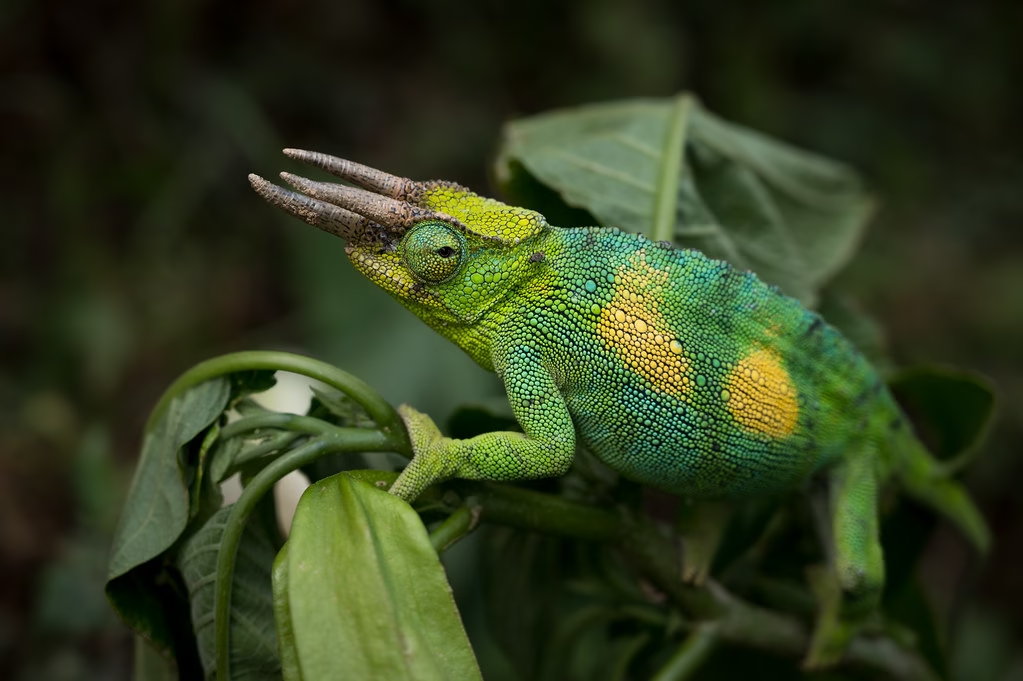
Travel Guide
Discover the three-horned chameleons of Bwindi Impenetrable National Park. Learn about their unique features, habitat, and the best places to spot these rare reptiles in Uganda.
The Three-horned chameleons in Bwindi are among the fascinating smaller creatures that remind visitors that Uganda’s famous rainforest is about far more than mountain gorillas. Bwindi Impenetrable National Park contains an extraordinary range of life, from primates and birds to reptiles, amphibians, insects and plants.
Visitors understandably arrive in Bwindi with gorillas at the top of their wildlife lists. Yet travelers who slow down and look carefully can discover an ecosystem filled with less conspicuous species. Chameleons are particularly interesting because their unusual appearance, slow movements and remarkable adaptations make them completely different from the large mammals normally associated with an African safari.
Learning to appreciate these smaller forest residents can transform a gorilla trekking journey into a broader exploration of Bwindi’s biodiversity.
Bwindi Impenetrable National Park protects an ancient tropical forest in southwestern Uganda.
Steep ridges, valleys, streams and thick vegetation create numerous habitats within a relatively compact area.
Mountain gorillas are its most famous inhabitants, but they exist within a complex ecological community.
Primates, forest birds, butterflies, reptiles and amphibians all contribute to the richness of the ecosystem.
The Three-horned chameleons in Bwindi demonstrate why travelers should occasionally shift their attention from the canopy and distant forest slopes toward nearby vegetation.
Some of Bwindi’s most intriguing wildlife can be remarkably small.
The most immediately noticeable characteristic suggested by the name is the horned appearance associated with males of certain three-horned chameleon species.
These projections give the animal a prehistoric appearance.
Chameleons are also famous for independently moving eyes, specialized feet, long tongues used for capturing prey and tails adapted to life among vegetation.
Their bodies are designed for deliberate movement through branches and leaves.
Rather than running quickly through the forest, they can move slowly and carefully, making them easy to overlook.
Their ability to blend with surrounding vegetation adds to the challenge of finding them.
Chameleons are famous for changing color, but the popular idea that they simply match any background is an oversimplification.
Color changes can be associated with communication, environmental conditions and physiological responses.
A chameleon should never be handled or deliberately stressed simply to encourage a color change for photographs.
Responsible wildlife viewing means observing natural behavior without interference.
Guides who locate a chameleon can help visitors appreciate its characteristics while ensuring the animal remains undisturbed.
Bwindi’s cool, humid forest environment provides suitable habitats for a wide range of smaller animals.
Chameleons may be associated with vegetation where they can move between branches and hunt insects.
Their survival depends on healthy habitat.
This is one reason forest conservation benefits far more than the mountain gorillas that attract most international attention.
Protecting Bwindi maintains an entire ecological system, including countless organisms visitors may never see.
The Three-horned chameleons in Bwindi are therefore part of a much larger conservation story.
Spotting a chameleon requires patience.
Their slow movements and natural camouflage mean travelers can walk close to one without noticing it.
Experienced local guides are valuable because they know where to look and may recognize subtle shapes or movements that visitors miss.
Forest edges, vegetation around walking routes and appropriate habitats may provide opportunities, although sightings can never be guaranteed.
Wildlife is not positioned for tourism, and part of the excitement comes from encountering animals naturally.
Some smaller forest animals can be easier to notice under particular conditions, and specialized nature walks may reveal wildlife overlooked during busy daytime activities.
Visitors interested in reptiles and amphibians should ask their safari operator or accommodation about legitimate guided nature experiences available in the area.
Activities should always comply with park and local regulations.
Independent wandering in unfamiliar forest environments is not advisable.
A trained guide improves safety while also helping travelers identify species correctly.
A gorilla trekking day naturally focuses on finding mountain gorillas.
However, the hike itself provides opportunities to observe the forest.
Guides may point out plants, birds and other wildlife encountered along the trail.
Travelers should keep expectations realistic because trekking groups cannot stop indefinitely for every sighting.
Those with a strong interest in reptiles, birds or plants should consider adding a separate nature activity to their itinerary.
This provides time to explore the forest without the primary objective of reaching a gorilla family.
Photographing a small chameleon requires a different approach from photographing gorillas.
Close focusing ability becomes more useful than a powerful telephoto lens.
Natural light under forest vegetation can be limited, so photographers should understand their camera settings before encountering an animal.
Avoid placing cameras extremely close to wildlife.
Flash photography should only be considered when permitted and appropriate, and visitors should follow their guide’s instructions.
The welfare of the animal is more important than obtaining a particular photograph.
Chameleons form part of forest food webs.
They consume insects and are themselves part of the broader ecological relationships connecting predators and prey.
Their presence also demonstrates the importance of maintaining complex vegetation structures.
Conservation is often communicated through large, charismatic animals because they attract public attention.
Yet a functioning forest depends on interactions among organisms of every size.
Protecting habitat for gorillas consequently protects many less famous species living within the same landscape.
Bwindi is globally associated with mountain gorilla conservation, but the value of protecting the forest extends much further.
Forest protection maintains watersheds, plant communities and habitats for birds, mammals, reptiles and countless invertebrates.
Tourism can contribute to conservation when it is carefully managed.
Permit systems, park regulations, community benefits and responsible visitor behavior all form part of this relationship.
Visitors who become interested in Three-horned chameleons in Bwindi may leave with a broader understanding of why entire ecosystems must be protected rather than concentrating on a single species.
Finding an unusual reptile can tempt visitors to touch or pick it up.
This should be avoided.
Wild animals can experience stress from unnecessary handling, and travelers may unintentionally injure delicate creatures.
Observe the chameleon where it naturally occurs.
Allow your guide to manage the sighting and explain appropriate viewing behavior.
Do not remove animals from vegetation or reposition them simply to improve photographs.
Ethical wildlife tourism depends on allowing animals to remain wild.
Bwindi offers far more biodiversity than can be experienced during a single gorilla trek.
Visitors can look for monkeys, forest birds, butterflies and numerous smaller creatures.
Birdwatching is particularly rewarding because the Albertine Rift region supports exceptional avian diversity.
Forest walks may also introduce travelers to plants used traditionally by surrounding communities.
Each layer of the forest tells a different ecological story.
A longer stay allows visitors to appreciate these details instead of arriving, trekking gorillas and immediately departing.
Many visitors spend two or three nights around Bwindi.
One day is normally dedicated to gorilla trekking.
Adding another full day can create opportunities for birding, community visits or other permitted nature activities.
Travelers specifically interested in reptiles and smaller wildlife should communicate that interest before arrival.
A guide selected for general sightseeing may have different expertise from one with specialized knowledge of birds, reptiles or plants.
Advance planning therefore improves the likelihood of a rewarding experience.
Strong hiking shoes are important for Bwindi because trails can be steep and muddy.
Long trousers and long-sleeved shirts protect against vegetation.
Bring a lightweight waterproof jacket because rain is possible throughout the year.
Binoculars are useful for birds and primates, while photographers should carry equipment suited to both distant and close subjects.
A small flashlight may be useful for certain lodge-based or guided evening activities, although visitors should follow local instructions.
Insect repellent, drinking water and personal medication are also important.
Bwindi can be visited throughout the year.
Relatively drier periods may provide easier trekking conditions, while wetter periods create exceptionally lush vegetation.
Rain should always be expected as a possibility because this is a tropical forest.
Smaller wildlife does not operate according to a tourism calendar, so no month can guarantee a particular chameleon sighting.
Travelers should focus on experiencing the forest ecosystem as a whole.
Visitors can contribute to Bwindi’s conservation through simple actions.
Remain on authorized routes, follow guides, avoid littering and never remove plants or animals from the forest.
Respect rules surrounding wildlife photography.
Support legitimate local guides and community tourism activities.
Minimize unnecessary plastic waste and use water responsibly at accommodation properties.
These actions may appear small individually, but responsible behavior becomes significant when practiced by thousands of visitors.
The Three-horned chameleons in Bwindi represent a side of the national park that can easily be overshadowed by mountain gorillas.
Gorilla trekking deserves its reputation as an extraordinary wildlife experience, but Bwindi’s real significance lies in the complete forest ecosystem.
Looking carefully at branches, leaves and forest edges reveals another scale of wildlife.
Chameleons demonstrate remarkable adaptations to life among vegetation and provide an excellent reason to slow down.
For travelers interested in nature rather than simply collecting famous wildlife sightings, discovering one of these reptiles can become an unexpected highlight.
Bwindi is called an impenetrable forest because of its dense vegetation, but within that complexity exists an astonishing diversity of life. Appreciating its smaller residents allows visitors to understand why protecting the entire forest matters.

Nshongi Gorilla Family in Bwindi: History, Location and Trekking Guide The Nshongi Gorilla Family holds an important place…
Read article →
Mishaya Gorilla Family in Bwindi: History, Trekking and What to Know The Mishaya Gorilla Family is one of…
Read article →
Semuliki Hot Springs Visit Guide: What to Expect Semuliki Hot Springs offers one of the most unusual natural…
Read article →
Kidepo Valley Remote Safari Guide: What to Expect Kidepo Valley National Park offers one of Uganda's most remote…
Read article →