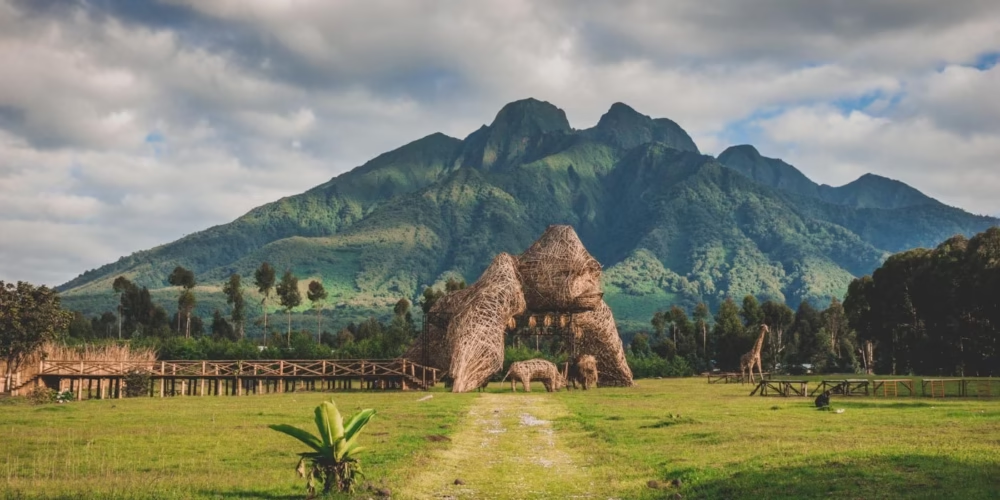

Interesting Facts About Volcanoes National Park.
Interesting Facts About Volcanoes National Park—Rwanda’s Primate Paradise
Tucked in Rwanda’s northwestern corner, Volcanoes National Park is a place of towering mountains, mist-shrouded forests, and rare wildlife encounters. Known globally for its role in mountain gorilla conservation, this park offers more than just trekking adventures. It’s a mosaic of natural wonders, cultural heritage, and scientific history.

Here are some fascinating facts that make Volcanoes National Park one of Africa’s most intriguing protected areas:
-
Home to Endangered Mountain Gorillas
Volcanoes National Park is one of only three places on Earth where you can see mountain gorillas in the wild. It protects around one-third of the world’s remaining population, with roughly 350 gorillas living in habituated family groups. This makes Rwanda a leading destination for gorilla trekking safaris.
-
Oldest National Park in Africa
Established in 1925, Volcanoes National Park is Africa’s first national park. It was originally created to protect mountain gorillas from poaching and encroachment. Its conservation legacy stretches nearly a century.
-
Part of the Virunga Mountains
The park is part of the Virunga Massif, a chain of eight volcanoes shared between Rwanda, Uganda, and the Democratic Republic of Congo. Five of these volcanoes lie within Rwanda’s section of the range: Karisimbi, Bisoke, Muhabura, Gahinga, and Sabyinyo.
-
Location of Dian Fossey’s Research
The park is where legendary primatologist Dian Fossey lived and worked. She founded the Karisoke Research Center in 1967 between Mount Karisimbi and Mount Bisoke. Her groundbreaking work with gorillas raised global awareness and inspired the film Gorillas in the Mist.
You can hike to her original camp and grave site during a Dian Fossey Tomb Trail trek.
-
Shared Borders With Two Countries
Volcanoes National Park shares its ecosystem with:
- Mgahinga Gorilla National Park in Uganda
- Virunga National Park in the D.R. Congo
This transboundary protected area supports coordinated conservation of gorillas and other species across borders.
-
Habitat for the Rare Golden Monkey
Besides gorillas, the park is also home to the endangered golden monkey, a colorful and playful primate found only in the Albertine Rift. Golden monkey trekking is a lesser-known but equally rewarding activity in the park.
-
Birthplace of Community-Based Tourism in Rwanda
Volcanoes National Park helped pioneer community tourism initiatives in Rwanda. Programs like Iby’Iwacu Cultural Village and revenue-sharing policies have allowed local communities to benefit directly from gorilla tourism, promoting conservation through livelihoods.
-
Climb to Crater Lakes and Peaks
The park offers volcano hikes for adventurers. You can climb:
- Mount Bisoke, known for its beautiful crater lake at the summit
- Mount Karisimbi, the tallest of the Virungas at 4,507 meters
These hikes require stamina but reward with stunning scenery and rich biodiversity.
-
Home to Over 200 Bird Species
Birders will find over 200 bird species in the park, including Albertine Rift endemics like the Rwenzori batis, strange weaver, and Archer’s ground robin. The misty bamboo and montane forests are especially productive for spotting rare species.
-
Weather Shifts in Minutes
Volcanoes National Park sits at a high altitude—ranging from 2,400 to over 4,500 meters. Due to this elevation, weather can change rapidly. Visitors often start treks in sunshine and end in mist or drizzle, making rain gear and warm layers essential.
Final Thought
Volcanoes National Park is more than a gorilla trekking destination—it’s a living story of resilience, science, biodiversity, and community-driven conservation. Whether you’re tracing the footsteps of Dian Fossey, hiking into the clouds, or meeting a silverback face-to-face, the experience stays with you forever.