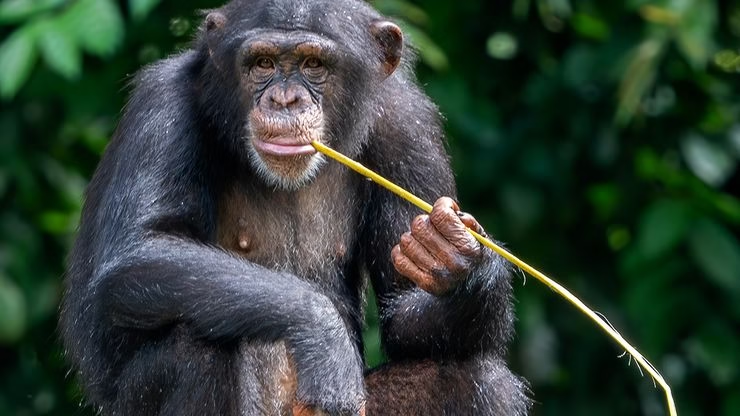

Facts about chimpanzees
15 Fascinating Facts About Chimpanzees
Facts about chimpanzees. Chimpanzees are our closest living relatives in the animal kingdom, sharing around 98.7% of our DNA. Intelligent, emotional, and incredibly social, these great apes continue to surprise scientists and fascinate wildlife lovers across the globe. Found in the forests and savannahs of equatorial Africa, chimpanzees play a vital role in their ecosystems—and offer rare glimpses into our own evolutionary past.
Here are 15 incredible facts about chimpanzees that reveal just how extraordinary these primates really are.
-
Chimpanzees Are Our Closest Genetic Relatives
Chimpanzees and humans share nearly 99% of their DNA. This close genetic link explains many of our shared traits, including emotions, communication methods, and the use of tools.
-
They Live in Large, Complex Communities
Chimpanzees live in fission-fusion societies, where individuals form smaller sub-groups that change daily. A single community may have up to 150 individuals led by a dominant male.
-
They Use Tools Like Humans Do
Chimpanzees craft and use tools with purpose and precision. In the wild, they use sticks to fish for termites, rocks to crack nuts, and leaves as sponges to scoop water—behaviors once believed to be uniquely human.
-
They Communicate Using Gestures, Sounds, and Facial Expressions
Chimpanzees rely on an advanced system of communication. They use body language, vocal calls, pant-hoots, and expressive faces to convey warnings, greetings, and emotions.
-
Chimpanzees Are Excellent Problem Solvers
These primates can solve puzzles, remember numbers in sequence, and even use symbolic language in controlled studies. Their cognitive abilities continue to impress researchers studying learning and memory.
-
They Show Strong Emotional Bonds
Chimpanzees express grief, joy, empathy, and even jealousy. Mothers remain deeply connected to their offspring for years, and group members console each other during times of stress or conflict.
-
They Experience Mourning and Death
When a group member dies, chimpanzees show signs of mourning. They may groom the deceased, stay close to the body, or remain unusually quiet—reflecting a complex emotional world.
-
Their Diet Is Omnivorous
Chimpanzees eat fruits, leaves, seeds, and flowers, but they also hunt. Small mammals like monkeys and bush babies are part of their diet, often shared during social meals.
-
They Can Live Over 50 Years
In the wild, chimpanzees live up to 40–50 years. In protected environments like sanctuaries, some individuals have reached their 60s with proper care and nutrition.
-
Chimps Practice Altruism and Cooperation
Chimpanzees help each other, especially within family units. They share food, defend one another from threats, and assist during injuries—demonstrating cooperation not seen in many species.
-
They Walk Mostly on All Fours but Can Stand Upright
While primarily quadrupedal (knuckle-walking), chimpanzees can walk on two legs for short distances, especially when carrying objects or scanning the environment.
-
Grooming Is Social Glue
Grooming goes beyond hygiene. It strengthens bonds, eases tension, and reaffirms alliances within chimpanzee communities.
-
Young Chimps Stay with Their Mothers for Years
Infant chimpanzees are completely dependent on their mothers for the first five years. Even after weaning, juveniles often stay close, learning skills crucial for survival.
-
They Are Endangered
Chimpanzees are listed as endangered due to habitat loss, poaching, and disease. Their population has declined drastically in recent decades, with fewer than 300,000 remaining in the wild.
-
You Can See Them in the Wild in Uganda
Uganda offers one of the best chimpanzee trekking experiences in Africa. Kibale Forest National Park, Budongo Forest, and Kyambura Gorge allow visitors to track and observe wild chimpanzees in their natural habitat, led by experienced rangers.
Plan Your Primate Safari Today
Chimpanzees offer more than a wildlife encounter—they offer a window into our own origins. Whether you want to see them swing through treetops or interact within a forest troop, Uganda’s tropical forests offer rare and unforgettable access.