60+ Fascinating Facts About Africa: A Region-by-Region Guide
Africa is a continent of immense beauty, complexity, and heritage. Spanning more than 11.7 million square miles, Africa boasts diverse climates, ecosystems, languages, and cultures. This detailed blog post explores 60+ fascinating facts about Africa, organized by region: North, West, Central, East, and Southern Africa. Discover what makes each corner of this vast continent so uniquely captivating.
General Facts About Africa
- Second Largest Continent
Africa is the second-largest continent on Earth, covering over 11.7 million square miles, or roughly 20% of the world’s land area. It is home to 54 recognized countries and more than 1.4 billion people. - Sahara Desert
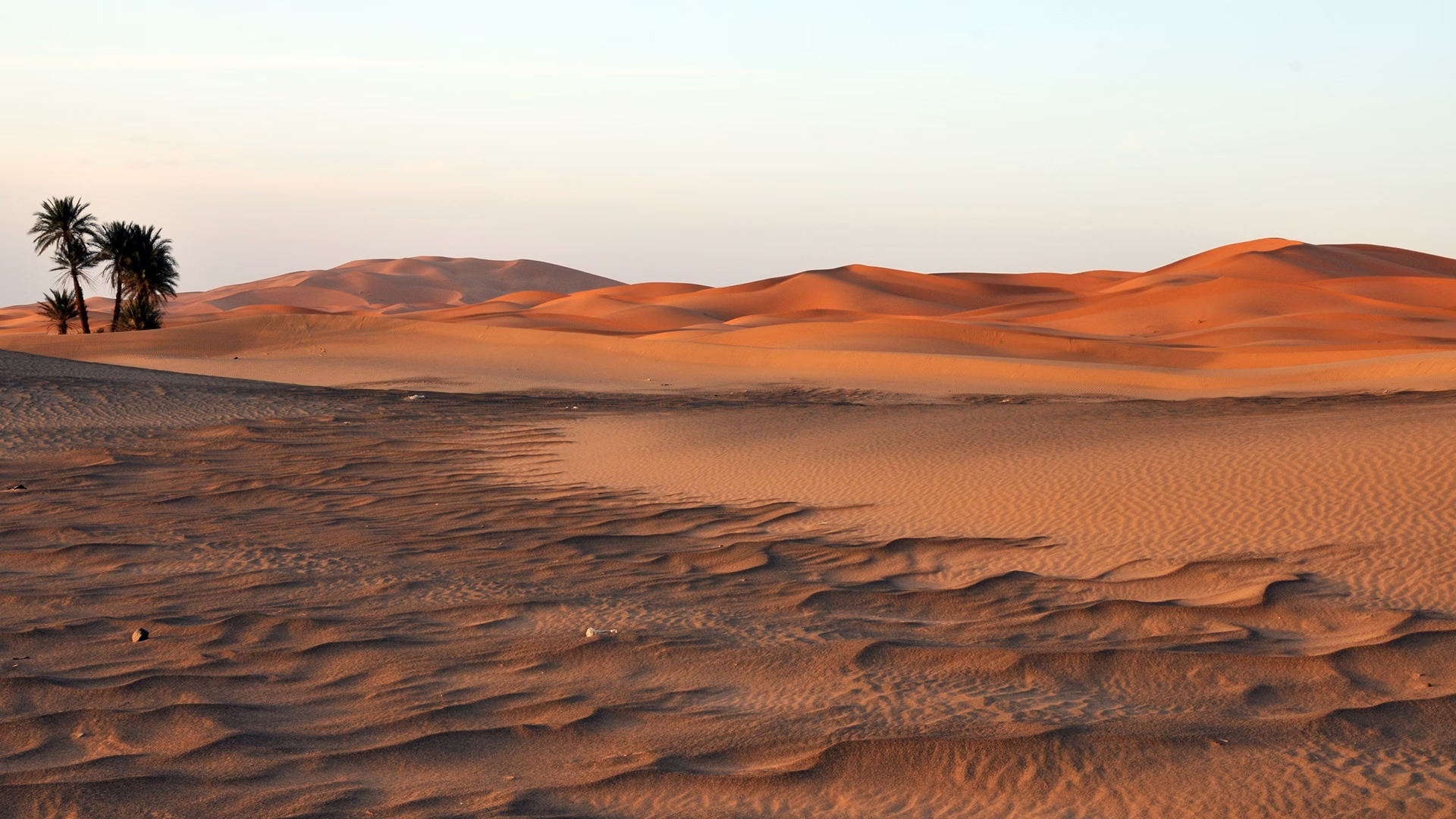
Stretching across 11 countries, the Sahara is the largest hot desert in the world, spanning 3.6 million square miles. It features dramatic sand dunes, rocky plateaus, and salt flats, supporting nomadic groups and desert-adapted wildlife. - Mount Kilimanjaro
Located in northeastern Tanzania, Kilimanjaro is Africa’s tallest mountain at 19,341 feet. This dormant volcano has three cones and features a variety of ecosystems, from tropical rainforests to glaciers at the summit. - Horn of Africa
Comprising Somalia, Ethiopia, Eritrea, and Djibouti, this peninsula juts into the Arabian Sea and is one of the most drought-prone regions globally. Despite the challenges, it is rich in culture, ancient trade history, and linguistic diversity. - Congo River
The Congo River is the world’s deepest river at 720 feet and the second-longest in Africa. It snakes through the Congo Rainforest, supporting transport, hydroelectric energy, and millions of people. - Lake Victoria
Lake Victoria spans 26,600 square miles and borders Tanzania, Uganda, and Kenya. It is a critical source of water, fish, and transportation, supporting more than 30 million people. - Victoria Falls
Known locally as “Mosi-oa-Tunya” or “The Smoke That Thunders,” Victoria Falls is one of the largest and most spectacular waterfalls in the world, with a width of 5,604 feet and a height of 355 feet. - River Nile
At 4,135 miles, the Nile is the world’s longest river. Flowing north from East Africa to the Mediterranean, it has sustained ancient civilizations like Egypt and Nubia for thousands of years. - Megafauna Diversity
Africa is home to the highest concentration of large mammals, including elephants, lions, rhinos, giraffes, hippos, and buffalo. Many are found in world-renowned national parks such as Kruger, Serengeti, and Maasai Mara. - African Lions
Primarily found in Eastern and Southern Africa, African lions are apex predators and crucial for ecosystem balance. Conservation parks in Tanzania and South Africa are major refuges for them. - African Wild Dog
Also called painted wolves, fewer than 6,000 African wild dogs remain. Known for their endurance and complex social behavior, they hunt in packs and are endangered due to habitat loss and disease. - Mountain Gorillas in Rwanda
Mountain gorillas live in the Virunga Mountains. Rwanda’s Volcanoes National Park protects these critically endangered primates, with controlled eco-tourism helping fund their conservation. - Birthplace of Coffee
Ethiopia’s Kaffa region is considered the birthplace of Arabica coffee. Coffee ceremonies are an integral part of Ethiopian culture and social life. - Great Rift Valley
The Great Rift Valley stretches from the Middle East to Mozambique, featuring volcanoes, hot springs, and fertile lakes. It’s also a cradle of early human evolution, with major fossil discoveries made here.
North Africa
- Atlas Mountains (Morocco, Algeria, Tunisia)
This rugged mountain range supports biodiversity and separates the Mediterranean and the Sahara. It is home to Berber communities, who practice ancient customs and language. - Algeria: Largest Country in Africa
Spanning over 919,595 square miles, Algeria boasts diverse landscapes from Mediterranean coasts to vast desert dunes. Its oil and gas industry forms the backbone of its economy. - Nile Delta (Egypt)
This fan-shaped delta feeds into the Mediterranean and is among the most fertile areas on Earth, supporting agriculture and dense populations for over 7,000 years. - Libya’s Desert Coverage
Approximately 90% of Libya is covered by desert, including the arid Libyan Desert. Despite harsh conditions, it contains hidden oases and ancient caravan routes. - Oldest University (Morocco)
Founded by a woman, Fatima al-Fihri, in 859 AD, Al-Quaraouiyine in Fez is a center of Islamic scholarship and is recognized as the world’s oldest continuously operating university. - Pyramids of Meroe (Sudan)
Located near the Nile, these ancient Nubian pyramids are remnants of the Kingdom of Kush. Unlike Egypt’s, they have steep angles and were built as royal tombs. - Ancient Carthage (Tunisia)
A Phoenician-founded city, Carthage became a maritime empire before being destroyed by Rome. The ruins reflect its importance in ancient Mediterranean geopolitics. - Western Sahara Dispute
Claimed by both Morocco and the Sahrawi Arab Democratic Republic, this region remains a point of tension in North Africa and a subject of international debate.
West Africa
- Royal Palaces of Abomey (Benin)
These UNESCO-listed palaces were built between the 17th and 19th centuries and served as the residence of 12 successive kings of the Dahomey Kingdom. The complex features intricate bas-reliefs and houses sacred artifacts that highlight Benin’s regal heritage. - Burkina Faso’s Name Meaning
The country’s name translates to “Land of Incorruptible People” from the Mossi and Dyula languages. Adopted in 1984, it reflects the ideals of honesty and integrity after a period of revolutionary change under Thomas Sankara. - Pico do Fogo (Cape Verde)
This active stratovolcano, standing at 9,281 feet, is the highest point in Cape Verde. Its last major eruption in 2014 caused significant damage to nearby villages. The fertile volcanic soil supports local agriculture, particularly coffee and grapes. - Cocoa Production in Côte d’Ivoire
Côte d’Ivoire is the world’s leading cocoa producer, responsible for about 40% of global output. Cocoa farming supports millions of Ivorians and is a vital part of the country’s economy. - The Gambia: Smallest in Mainland Africa
Completely surrounded by Senegal (except for its Atlantic coast), The Gambia spans only 30 miles across at its widest. Despite its size, it’s rich in biodiversity and cultural heritage. - Ghana’s Independence (1957)
Ghana was the first sub-Saharan African country to gain independence from colonial rule. Led by Kwame Nkrumah, the movement became a model for African liberation efforts across the continent. - Guinea’s Bauxite Reserves
Guinea holds one of the world’s largest reserves of bauxite—the ore used to produce aluminum. Mining dominates its economy, and the mineral is exported globally, fueling infrastructure and industrial development. - Liberia’s American Connection
Liberia was founded in 1847 by freed African American slaves. Its capital, Monrovia, is named after U.S. President James Monroe. The country retains strong cultural and historical ties to the United States. - Timbuktu (Mali)
This ancient trading city was a renowned center of Islamic scholarship during the 14th to 16th centuries. Manuscripts from its libraries offer insights into Africa’s pre-colonial intellectual achievements. - Richat Structure (Mauritania)
Also known as the “Eye of the Sahara,” this 25-mile-wide circular formation is visible from space. Once thought to be a meteor crater, it’s now believed to be a highly eroded geological dome. - Niger River
Flowing over 2,600 miles through West Africa, the Niger River is essential for agriculture, fishing, and trade. Its inner delta in Mali creates a unique inland wetland supporting vast biodiversity. - Nigeria’s Population
With over 200 million people, Nigeria is Africa’s most populous nation. It is a cultural mosaic with over 250 ethnic groups and is a powerhouse in music, film, and technology across the continent. - Dakar’s Geographical Status (Senegal)
Dakar, the capital of Senegal, is the westernmost city on the African mainland. Its coastal position has made it a key cultural and economic hub for centuries. - Sierra Leone and Blood Diamonds
Sierra Leone’s diamond wealth has historically fueled civil conflict. Efforts through the Kimberley Process now aim to curb the trade in conflict diamonds and ensure ethical sourcing.
Central Africa
- Mount Cameroon (Cameroon)
Also known as “Fako,” Mount Cameroon is the highest peak in Central and West Africa at 13,255 feet (4,040 meters). It is an active volcano with frequent eruptions and dominates the skyline near the Gulf of Guinea. The mountain is a popular destination for hikers and hosts an annual international race. - Dzanga-Sangha Reserve (Central African Republic)
This remote national park is home to one of the largest populations of forest elephants and western lowland gorillas. Located in the Congo Basin, the park supports ecotourism, research, and community-based conservation in collaboration with the local Ba’Aka people. - Lake Chad’s Shrinking Size (Chad)
Once one of Africa’s largest lakes, Lake Chad has shrunk by more than 90% since the 1960s due to climate change, overuse, and reduced rainfall. The lake is a vital lifeline for over 30 million people in Nigeria, Chad, Niger, and Cameroon, providing water and livelihoods. - Congo Basin Rainforest
Second only to the Amazon in size, the Congo Basin rainforest spans six countries, including the Democratic Republic of the Congo (DRC), Gabon, and Republic of the Congo. It’s a biodiversity hotspot and one of the world’s largest carbon sinks, crucial for climate stability. - Spanish in Equatorial Guinea
Equatorial Guinea is the only African country where Spanish is an official language, a remnant of Spanish colonization. Alongside French and Portuguese, Spanish is used in government and education. This linguistic uniqueness sets the country apart culturally from its neighbors. - Ivindo National Park (Gabon)
Ivindo National Park is known for its untouched tropical rainforest and spectacular waterfalls, such as Kongou Falls. The park hosts critically endangered species including mandrills, chimpanzees, and forest elephants. In 2021, it was inscribed as a UNESCO World Heritage Site. - Mineral Wealth in the DRC
The Democratic Republic of the Congo is one of the richest countries in the world in terms of mineral resources. It holds vast reserves of cobalt, copper, gold, and coltan—essential for electronic devices. However, resource exploitation has also fueled conflict and corruption. - Oil Economy of the Republic of the Congo
This country’s economy heavily relies on oil, which makes up more than 80% of its exports. Offshore drilling and petroleum refining dominate its industrial landscape, though economic diversification remains limited. - Loango National Park (Gabon)
Called “Africa’s Last Eden,” Loango is one of the few places on Earth where elephants, hippos, and even gorillas can be seen walking along beaches. The park’s marine and terrestrial ecosystems are among the most pristine in Africa. - Bangui: Capital on a River (CAR)
The capital of the Central African Republic, Bangui, is located along the Ubangi River. The city serves as the country’s political and economic center, and its river access facilitates trade with neighboring countries like the DRC and Republic of the Congo.
East Africa
- Burundi’s High Population Density
Despite being one of Africa’s smallest countries by land area, Burundi has one of the highest population densities on the continent. The nation is largely agrarian, but land scarcity poses challenges for food security, sustainability, and infrastructure development. - Mount Karthala (Comoros)
Mount Karthala is one of the most active volcanoes in the world, located on Grande Comore Island. Standing at 7,746 feet (2,361 meters), it has erupted over 20 times since the 19th century. Its fertile volcanic soil supports the island’s agriculture, especially vanilla and ylang-ylang. - Djibouti’s Strategic Red Sea Location
Djibouti sits at the intersection of the Red Sea and the Gulf of Aden, a crucial maritime chokepoint known as the Bab el-Mandeb Strait. Its strategic location has attracted military bases from countries like the U.S., France, China, and Japan, boosting its geopolitical importance. - Dahlak Archipelago (Eritrea)
Comprising over 200 islands in the Red Sea, the Dahlak Archipelago is known for its coral reefs, marine biodiversity, and archaeological significance. Only a few islands are inhabited, and the area is ideal for diving, fishing, and marine research. - South Sudan: Africa’s Newest Nation
Gaining independence in 2011, South Sudan became the world’s youngest country. Despite its wealth in oil and natural resources, it has faced ongoing challenges, including civil unrest, poor infrastructure, and humanitarian crises. - Ethiopia’s Ancient History
Ethiopia is one of the world’s oldest nations, with human habitation dating back millions of years. It was never colonized, except for a short Italian occupation (1936–1941). The country is rich in historical sites like Lalibela’s rock-hewn churches and Axum’s obelisks. - Great Wildebeest Migration (Kenya & Tanzania)
One of nature’s most dramatic spectacles, the annual migration sees over 1.5 million wildebeest, 200,000 zebras, and 500,000 gazelles traverse the Serengeti–Maasai Mara ecosystem in search of water and grazing. It’s a global wildlife tourism highlight. - Madagascar’s Unique Wildlife
Around 90% of Madagascar’s flora and fauna are endemic, including lemurs, baobab trees, and chameleons. The island’s long geographic isolation has created a one-of-a-kind ecosystem, but deforestation and habitat loss threaten its biodiversity. - Rwanda’s Clean and Green Policy
Rwanda is one of Africa’s cleanest countries, thanks to progressive policies such as banning plastic bags and organizing monthly national clean-up days (Umuganda). Kigali, its capital, is known for its orderliness, cleanliness, and sustainability efforts. - Seychelles: Indian Ocean Paradise
This archipelago of 115 islands is famed for its granite boulders, white sand beaches, and vibrant coral reefs. With strict conservation policies and numerous protected marine areas, Seychelles is a leader in sustainable island tourism. - Laas Geel Cave Paintings (Somalia)
Discovered in the early 2000s, these ancient cave paintings near Hargeisa depict cattle, humans, and wild animals in vivid colors. Estimated to be over 5,000 years old, they offer a glimpse into Somalia’s prehistoric past. - Zanzibar’s Spice Heritage (Tanzania)
Zanzibar, known as the “Spice Island,” has a long history of clove, nutmeg, cinnamon, and pepper cultivation. Its spice farms are a major tourist attraction, and the island’s culture reflects Arab, Persian, and African influences from centuries of trade. - Uganda: The Pearl of Africa
Nicknamed by Winston Churchill for its breathtaking beauty and rich biodiversity, Uganda features the Rwenzori Mountains, Lake Victoria, and gorilla-filled Bwindi Forest. It’s one of the only three countries with endangered mountain gorillas.
Southern Africa
- Angola – One of Africa’s Largest Oil Producers
Angola ranks among Africa’s top oil producers. Oil brings in over 90% of its export revenue. Most oil fields lie offshore in the Atlantic Ocean. Oil wealth funds infrastructure, but inequality and lack of economic diversity remain major issues. - Tsodilo Hills (Botswana)
Often called the “Louvre of the Desert,” Tsodilo Hills is a UNESCO World Heritage Site. The San people created over 4,500 rock paintings here. Some are more than 20,000 years old. This sacred site holds deep spiritual and archaeological value. -
Hlane Royal National Park (Eswatini)
Hlane Royal National Park protects Eswatini’s iconic wildlife—lions, rhinos, and elephants. Once a royal hunting area, it now promotes conservation. Visitors enjoy game drives, birdwatching, and cultural experiences. -
Lesotho – A Country Within a Country
Lesotho lies entirely within South Africa. Its highlands start at 1,400 meters, earning it the name “Kingdom in the Sky.” The country celebrates Basotho traditions, especially seen in its horsemen and colorful blankets. -
Malawi – The Warm Heart of Africa
Malawi’s friendly people earned it this nickname. Lake Malawi, the third-largest in Africa, hosts the world’s most diverse freshwater fish. Locals and tourists enjoy fishing, kayaking, diving, and beach getaways. -
Mozambique’s Indian Ocean Coastline
Mozambique stretches over 1,600 miles along the Indian Ocean. Its coast features sandy beaches, coral reefs, and islands like Bazaruto and Quirimbas. The region offers great marine tourism, though past conflict and poor infrastructure slow development. -
Namib Desert – Earth’s Oldest Desert (Namibia)
The Namib Desert, over 55 million years old, holds some of the tallest dunes on Earth, especially near Sossusvlei. Fog from the Atlantic supports oryx, desert elephants, and other hardy species. -
Kariba Dam (Zambia and Zimbabwe)
Kariba Dam spans the Zambezi River and forms Lake Kariba. It produces hydroelectric power for both countries. The lake supports fishing, boating, and wildlife like hippos, crocodiles, and birds. -
Table Mountain (South Africa)
Table Mountain rises above Cape Town and belongs to the Cape Floral Region. Over 8,000 plant species grow here. Tourists reach the summit by hiking or cable car. The mountain ranks among the New 7 Wonders of Nature. -
Kruger National Park (South Africa)
Kruger National Park covers nearly 7,600 square miles. It houses the Big Five and over 500 bird species. Visitors explore it via self-drives or guided safaris, thanks to its vast roads and diverse lodges.