

Nshongi Gorilla Family in Bwindi
Nshongi Gorilla Family in Bwindi: History, Location and Trekking Guide The Nshongi Gorilla Family holds an important place…
Read article →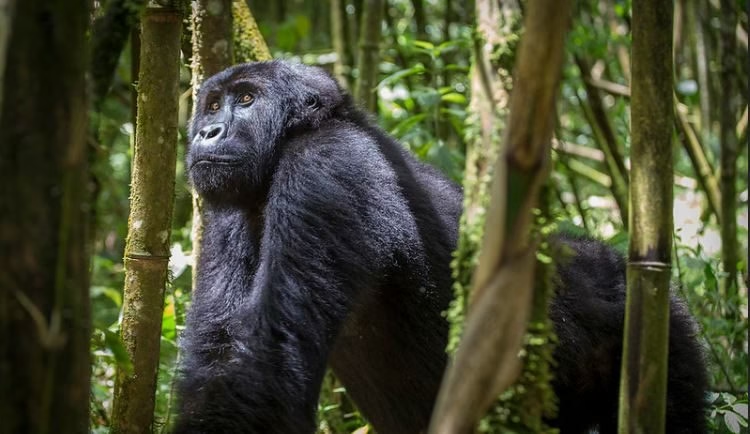
Travel Guide
Read traveler reviews about gorilla trekking and habituation experiences in Uganda, Rwanda, and DRC. Discover what to expect, tips, and unforgettable moments with mountain gorillas.
Gorilla trekking reviews commonly focus on far more than the moment visitors first see a mountain gorilla. According to the supplied source, travelers discussing trekking and habituation experiences repeatedly describe the forest journey, physical challenge, guides, gorilla family interactions, conservation context, and emotional impact of the encounter.
The source covers impressions associated with Uganda, Rwanda, and the Democratic Republic of Congo while also distinguishing standard gorilla trekking from the longer habituation experience.
These traveler perspectives are useful because they highlight an important reality: gorilla tourism is not a simple sightseeing excursion.
Visitors enter a natural forest environment, walk on terrain that can be steep or muddy, adapt to changing weather, and rely on trackers to locate animals that move freely.
The uncertainty and effort often become part of why the encounter feels so significant.
The supplied source describes many travelers using words such as life-changing and awe-inspiring when discussing gorilla trekking.
Such descriptions reflect the unusual closeness of the wildlife experience.
Mountain gorillas share recognizable social behaviors that visitors can observe at relatively close range under ranger supervision.
A mother caring for an infant or juveniles interacting with one another can feel immediately understandable even to someone with no specialist primate knowledge.
The forest setting adds to this emotional intensity.
Many gorilla trekking reviews mentioned by the source emphasize the journey through dense forest and rugged terrain.
This is significant because travelers sometimes focus so heavily on the expected gorilla encounter that they underestimate the trek required to reach it.
The walk may involve slopes, mud, thick vegetation, and changing weather.
The duration depends on the gorillas' location.
A visitor should therefore approach the activity as a forest trek with a wildlife encounter rather than expecting a short walk followed by guaranteed easy viewing.
The supplied source identifies close observation as one of the strongest elements in traveler feedback.
Seeing a mountain gorilla within its own habitat is fundamentally different from seeing one in a controlled captive environment.
Vegetation surrounds the animals, and the family determines its own behavior.
The gorillas may feed, groom, rest, move, or interact.
Visitors must follow ranger instructions and allow the animals to control the encounter.
The sense of proximity can be powerful even when the visitor remains focused on respectful behavior.
Travelers frequently mention family interactions.
The supplied source specifically highlights playful infants and protective silverbacks.
These relationships often become more memorable than simply seeing a gorilla for the first time.
An infant's movement can reveal curiosity and energy, while adult behavior provides insight into social structure.
The silverback's physical size naturally attracts attention, but observing how the whole group functions gives visitors a deeper appreciation of gorilla life.
Guide expertise is another recurring theme in the source.
Professional guides help visitors understand what they are seeing.
They can explain gorilla behavior, forest ecology, conservation, and the practical rules governing the encounter.
Trackers and guides also manage the journey through the forest.
For many travelers, this interpretation turns the activity from a wildlife sighting into an educational experience.
A visitor who understands why a gorilla is behaving in a particular way gains more from the encounter than someone concentrating only on photographs.
The source notes that travelers frequently mention steep trails, mud, long hikes, and unpredictable weather.
These conditions should not automatically discourage visitors, but they should shape preparation.
The exact trek cannot be predicted because gorillas move.
One group may locate its family relatively quickly, while another may walk substantially farther.
Travelers who arrive with realistic expectations are less likely to become frustrated when the trek proves physically demanding.
Appropriate footwear, rain protection, and suitable clothing can make a substantial difference.
The supplied source also emphasizes physical fitness and patience.
Preparation does not remove the challenge, but it makes visitors better able to manage it.
Travelers should also avoid carrying unnecessary equipment.
A heavy bag becomes increasingly inconvenient on steep or muddy terrain.
The aim is to be prepared without turning the trek into an exercise in transporting excessive gear.
A standard gorilla trek involves locating a habituated family that is already accustomed to controlled human observation.
Visitors join guides and trackers and move through the forest until the group is found.
The encounter then takes place according to established wildlife rules.
The supplied source portrays this as an extraordinary experience in its own right.
For many travelers, standard trekking provides the combination of forest adventure and gorilla observation they are seeking.
The gorilla habituation experience is different.
The supplied source describes it as an opportunity to observe the process through which gorillas gradually become accustomed to human presence for research and controlled tourism.
This process requires patience and careful professional management.
Visitors are not simply watching an already familiar tourist group in the same manner as standard trekking.
The educational context becomes more prominent because the experience is connected with understanding how habituation works.
Traveler impressions summarized in the source emphasize the educational value of the experience.
Participants can gain greater insight into gorilla behavior, family dynamics, and conservation challenges.
The longer observation context gives visitors more time to notice subtle behavior.
Rather than focusing only on the excitement of first seeing a gorilla, participants can settle into observation and begin recognizing interactions within the group.
This is one reason some reviewers describe habituation as particularly meaningful.
The source highlights extended time with habituation groups as a major attraction.
More time changes the rhythm of wildlife observation.
During a shorter encounter, visitors may feel pressure to photograph quickly and absorb as much as possible.
An extended experience can allow periods of simply watching.
The gorillas may move, feed, rest, or interact during that time.
The visitor gains a broader sample of behavior rather than a single brief snapshot.
Additional observation time can create more photography opportunities, but the same ethical principles remain important.
Visitors should follow professional instructions and avoid attempting to manipulate animal behavior.
Forest light remains challenging, and vegetation can still obstruct photographs.
More time does not guarantee a perfect image.
Its real value is that photographers can become more patient, wait for natural behavior, and spend periods observing without constantly pressing the shutter.
The supplied source notes that travelers appreciate the connection between habituation, research, and conservation.
Understanding this context can make the experience feel more meaningful than wildlife observation alone.
Mountain gorilla tourism depends on carefully managed relationships between conservation authorities, researchers, local communities, tourism operators, and visitors.
Habituation is one part of this wider system.
A responsible visitor should therefore respect all instructions designed to protect the gorillas.
The source indicates that travelers often describe the habituation experience as physically demanding because the walks can be longer.
Participants should prepare accordingly.
More time in the forest means greater exposure to terrain and weather.
Travelers attracted primarily by the idea of extended gorilla observation should also consider whether they are comfortable with the physical requirements associated with reaching and following the group.
Another consistent theme in the source is emotional impact.
Travelers describe feeling humbled, inspired, or deeply moved after seeing gorillas in the wild.
Part of this reaction may come from the animals themselves, while part comes from the journey required to reach them.
Walking through dense forest creates anticipation.
When the trackers finally indicate that the family is close, the experience changes instantly.
That transition from searching to observing can be especially powerful.
Wildlife does not operate according to a visitor's preferred schedule.
Gorillas may be farther away than expected.
Rain may arrive.
Trails may become difficult.
The family may spend part of the encounter behind vegetation.
Patience allows visitors to accept these realities as part of a genuine wildlife experience.
The source's emphasis on flexibility is therefore important.
Trying to control every detail can create disappointment in an environment where nature determines much of the day.
The supplied source recommends securing permits well ahead of travel because availability is limited.
A gorilla permit is central to the itinerary.
Travelers should avoid finalizing an entire safari around an assumed trekking date before confirming the required permit.
A reputable operator can assist with coordinating permits, transportation, accommodation, and other logistics.
The source advises keeping essential travel documents ready, including the passport, visa, and permit.
This practical preparation prevents unnecessary problems around the trekking date.
Travelers should confirm current entry requirements and permit rules with the appropriate official authorities or their authorized operator because operational requirements can change.
Documents should be organized before leaving for the park rather than searched for at the last moment.
The supplied source recommends hiking boots, rain gear, gloves, masks, and binoculars among useful items.
The exact equipment required should follow current park guidance.
Comfortable footwear is particularly important because trail conditions can be difficult.
Rain protection helps visitors continue more comfortably when weather changes.
The broader principle is to prepare for a humid forest environment rather than dressing as if the experience were an ordinary sightseeing excursion.
Standard trekking and habituation appeal to slightly different priorities.
A traveler seeking the classic gorilla encounter may find standard trekking sufficient.
Someone especially interested in primate behavior, conservation, research context, or extended observation may prefer habituation where it is available.
Neither should be viewed simply as a superior version of the other.
The appropriate experience depends on time, budget, physical ability, and personal interests.
The gorilla trekking reviews summarized in the supplied material reveal a consistent pattern.
Visitors value the closeness of the encounter, family interactions, professional guides, and emotional impact, while also emphasizing mud, steep terrain, unpredictable weather, and the importance of preparation.
Habituation reviews add another dimension by emphasizing longer observation, education, conservation, and the possibility of a more demanding day in the forest.
Together, these impressions provide a realistic picture.
Gorilla tourism is rewarding precisely because it is not a perfectly controlled attraction. Travelers enter the gorillas' environment, adapt to the conditions they find, and experience wildlife on terms shaped by the forest and the animals themselves.

Nshongi Gorilla Family in Bwindi: History, Location and Trekking Guide The Nshongi Gorilla Family holds an important place…
Read article →
Mishaya Gorilla Family in Bwindi: History, Trekking and What to Know The Mishaya Gorilla Family is one of…
Read article →
Semuliki Hot Springs Visit Guide: What to Expect Semuliki Hot Springs offers one of the most unusual natural…
Read article →
Kidepo Valley Remote Safari Guide: What to Expect Kidepo Valley National Park offers one of Uganda's most remote…
Read article →